


How Brands Are Driving Revenue with TikTok Shop

Published: August 05, 2026
Share on LinkedIn Share on Twitter Share on Facebook Click to print Click to copy url
Summarize with ChatGPT

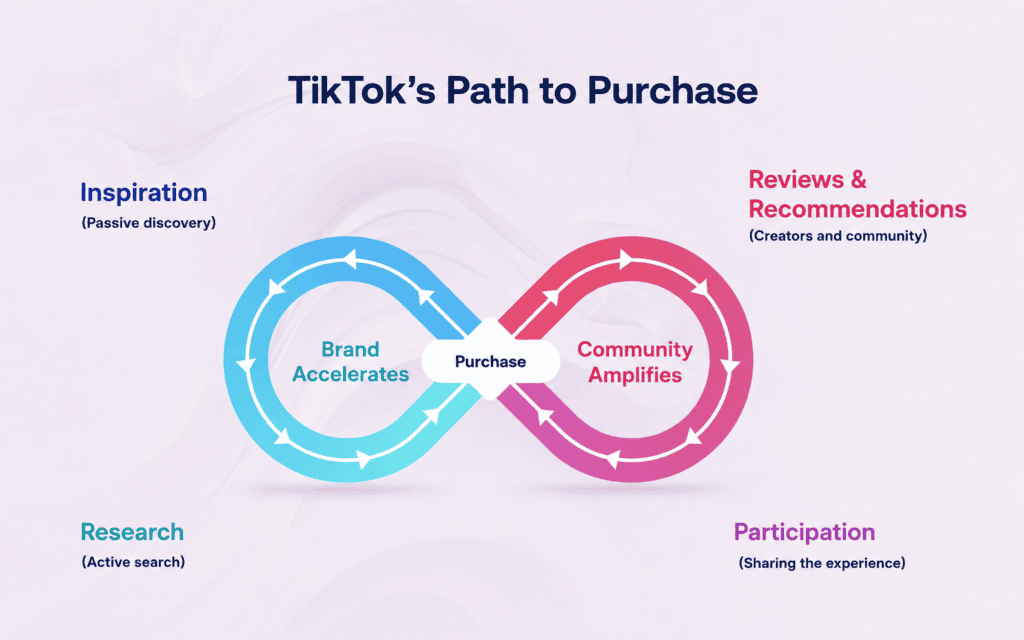
If you’ve watched someone demo a product on your For You Page and found yourself clicking “buy” before the video ended, then you already understand the essential mechanic of TikTok Shop. The platform didn’t invent impulse purchasing. But it sure did remove every piece of friction that used to slow it down, which means it’s a faster process for consumers and a more profitable one for brands.
What’s happening on TikTok right now is a compression of the entire purchase funnel into a single feed session:
- A user discovers a product through a creator video
- Taps the tagged item
- Completes checkout without ever leaving the app
The average time from scroll to purchase on TikTok Shop is under four minutes. On traditional ecommerce, that same journey takes eight to twelve.
That gap, when compounded across thousands of purchases, is making a significant impact, and the brands paying attention to it are building serious revenue.
TikTok Shop reached $33 billion in global GMV in 2024. U.S. sales surged 120% year over year in the first half of 2025, and the number of larger brands with at least $30 million in annual revenue grew 95% during the same period. Those metrics demonstrate the dinosaur-sized footprint of a platform that has moved from cultural curiosity to legitimate sales infrastructure in under two years.
Key Takeaways
- TikTok Shop collapses the purchase funnel. Discovery, consideration, and conversion happen in a single in-app session. Friction that exists on traditional ecommerce simply doesn’t exist here.
- The algorithm rewards content, not catalogs. Products that demonstrate visually, solve a specific problem, and arrive in the $20 to $50 price range convert at the highest rates. Simply listing a product is not a strategy on this platform.
- Creator volume outperforms creator prestige. Hundreds of mid-tier creators generating authentic content consistently outperforms a handful of celebrity placements. The affiliate model scales reach without requiring the brand to run every session.
- Live selling is building momentum, but video still leads. Pre-recorded creator videos now represent roughly two-thirds of TikTok Shop revenue in the U.S. Live selling is growing but functions differently than in the Southeast Asian markets where it originated.
- Structure is what separates a revenue channel from an inbox full of unread DMs. The brands winning on TikTok Shop have structured systems in place for creator outreach, content guidance, fulfillment, and measurement.
Why TikTok Shop Works Differently Than Every Other Commerce Channel
Every commerce channel that came before TikTok Shop required the customer to bring intent to the transaction. You searched because you wanted something. You visited a product page because you were already considering it. The ad for a competing product interrupted your attention and hoped to redirect it.
| Shopping/Funnel Stage | Traditional eCommerce/Social | TikTok Shop |
| Discovery | Ads or search click leads to a PDP on-site | Creator video in feed with product tag |
| Consideration | Multiple pageviews, comparison tabs, reviews | Demonstration happens inside the video itself |
| Checkout path | Site login, address, payment, potential redirects | One-tap add, saved info, in-app payment |
| Time-to-purchase | 8–12 minutes typical | Under 4 minutes typical |
| Conversion rate | ~1.9% (legacy social) | ~4.7% (TikTok Shop) |
| Attention cost | Interruptive ad must win focus | Content is the ad—no pattern break required |
TikTok Shop generates purchase intent inside the platform. The conversion rate on TikTok Shop sits at 4.7%, compared to 1.9% across other social platforms. That gap exists because the content that’s doing the selling, a creator demonstrating, reviewing, or reacting to a product in real time, is indistinguishable from the content the user came to watch. There’s no interruption to overcome. The product is already inside the entertainment.
This is why the category breakdown so clearly mirrors the leading content types natively on the platform. Beauty and personal care dominates, generating over $1 billion in U.S. revenue, with womenswear following at $621 million.
The Creator Model: Why Volume and Fit Beat Follower Count
The dominant creator strategy on TikTok Shop is not influencer marketing in the traditional sense but affiliate marketing at platform scale. And the math is a bit different. TikTok influencers with up to 50,000 followers have a 30.1% engagement rate for affiliate links, 1,57% higher than comparable Instagram influencers.
This is the central counterintuitive insight of the platform: the creators moving the most product are frequently mid-tier voices with highly engaged niche audiences, not celebrities with broad but diluted reach. A creator who has built trust with 25,000 people sharing a specific health concern, aesthetic, or interest converts at rates that no paid placement can match, because the recommendation lands with the authority of a peer, not the visibility of a sponsor.
The most successful brands on TikTok Shop have internalized this and built accordingly. Medicube, the top-selling merchant on U.S. TikTok Shop in 2025, generated nearly $100 million in revenue through a disciplined, platform-native growth strategy that leaned into creator partnerships, product innovation, and TikTok-native commerce moments. The brand scaled by identifying creators whose audiences mapped to their customer profile, seeding product consistently, and letting the content economics do the rest.
The affiliate model also changes how brands think about live selling. Rather than requiring the brand to host and manage live sessions itself, the live affiliate approach puts creators in front of their own audiences, featuring products naturally in sessions they already run. The brand scales reach without scaling operational complexity. The creator earns on conversion. TikTok’s algorithm rewards live activity with greater organic distribution, so the incentives stack in the same direction.
What the Data Says About What Actually Converts
Three product and content characteristics define the brands generating the most significant TikTok Shop revenue, and they show up consistently across categories and brand sizes.
Demonstrability. Products that can show (not tell) their value through transformation, mechanism, or before-and-after videos outperform those that require the viewer to imagine the benefit or extrapolate its relevance. This applies to beauty, fitness, food, apparel, and home goods alike.
Price point. The $20 to $50 range represents 58% of all TikTok Shop transactions. Below that, the margin story gets difficult. Above $50, consideration lengthens and impulse behavior fades. The sweet spot is real, and brands that have optimized their TikTok Shop catalog toward it report meaningful conversion improvements.
Content volume over content polish. The platform’s algorithm optimizes for recency and engagement, which means a steady stream of authentic creator content consistently outperforms periodic high-production placements. Maëlys, the body-care brand that won the 2025 Glossy Pop Award for Best Use of TikTok Shop, became the top-selling body-care brand on the platform by anchoring its strategy in authentic before-and-after transformation content backed by a creator incentive program with prizes up to $275,000 for hitting GMV thresholds. The content looked organic because most of it was.
How to Know if Live Selling is Right for Your Brand
No honest analysis of TikTok Shop can skip the live selling conversation, because the platform has pushed it heavily and the U.S. market has responded differently than anticipated.
Livestreaming has never accounted for more than 30% of U.S. TikTok Shop revenue share. Pre-recorded creator videos have steadily grown to represent two-thirds of TikTok Shop’s U.S. revenue. The live shopping behavior that dominates
TikTok in Southeast Asia reflects cultural familiarity with the format that the U.S. market hasn’t yet developed at scale. That doesn’t mean live selling doesn’t work here. There are instances where it can be very successful, but it isn’t the primary driver of conversion for most brands right now.
The live affiliate model described above threads this needle usefully.
Rather than requiring a brand to build a live-first strategy, it allows live selling to develop organically through creators who are already comfortable in front of a camera and already have audiences who show up for them. The brand benefits from the format without carrying its operational weight. It’s like finding Goldilock’s lovely happy medium.
What to Actually Do if You’re Considering TikTok Shop
- Start with product-market fit for the platform, not for your brand. The real question isn’t whether your brand belongs on TikTok. It’s whether your product can show its value in under 30 seconds and sell at a price point between $20 and $50. Products that pass that test have a real path to conversion. Products that don’t may need a different strategy. Find out where your products stand with our free social commerce audit.
- Build the affiliate infrastructure before you need it. The brands that scale on TikTok Shop are the ones that can manage creator relationships systematically: outreach, vetting, seeding, tracking, and payment. Setting up that infrastructure in advance prevents the chaos that kills momentum when creator interest arrives faster than you can respond to it.
- Measure at the creator and product level, not just the campaign level. Aggregate TikTok Shop numbers tell you whether the channel is working. Creator-level and product-level data tell you what to do next. Which creators are driving add-to-carts. Which products are converting at what price. Where the drop-off is happening. That granularity is what makes the system improvable.
- Treat content volume as a production goal. The algorithm rewards frequency. A pipeline of authentic creator content is a performance lever, and building it requires treating creator relationships as ongoing partnerships rather than one-off placements.
What Go Fish Clients Have Built on TikTok Shop
At Go Fish Digital, we specialize in helping ecommerce brands seize the platform by the algorithm and make the most out of their TikTok Shop presence.
- O2Trainer turned podcast audience segments and existing footage into a structured TikTok content and conversion strategy. The result: a 5% increase in TikTok Shop revenue in 60 days.
- Dave’s Sweet Tooth had creator interest but no system to act on it — over 1,200 unread messages and no affiliate infrastructure. Go Fish rebuilt it from the ground up and implemented a live affiliate model aligned to the brand’s distinct voice. TikTok now accounts for 40% of total sales.
- EZ Bombs is a food and beverage brand built for visual demonstration. With the right creative strategy and a structured shop ads approach, the brand broke TikTok’s Shop Ads record with a 30x ROAS in its first 90 days and became the number one food and beverage brand on TikTok Shop.
What connects these results is the same thing that separates TikTok Shop winners from TikTok Shop experimenters in general: the brands that scale have systems. Systems for creator identification, onboarding, and content guidance. Systems for measuring what’s working at the product and creator level. Systems for connecting TikTok performance to the broader revenue picture.
Ready to find out if TikTok Shop is the right channel for your brand? Request a free social commerce audit and we’ll tell you exactly where you stand.