



How to Test Programmatic Advertising Without Wasting Your Budget

Published: November 05, 2026
Share on LinkedIn Share on Twitter Share on Facebook Click to print Click to copy url
Summarize with ChatGPT

Programmatic advertising promises scalable reach and data-driven buying across the open web and connected TV. It also introduces complexity that can quietly drain budget if you test with too many variables, unclear goals, or weak measurement. This guide gives you a disciplined way to pilot programmatic so you get a clean read on performance with a capped downside.
The playbook is written for VP and Director-level leaders who control budgets and need evidence of incremental value. It is also tactical enough that a paid media manager can lift the steps, build a lean test, and report back confidently.
Go Fish Digital approaches programmatic as one component of a connected paid media strategy, not a silo. Our focus is tying channel tests to qualified actions, revenue, and decisions about future investment rather than surface-level media metrics.
Key takeaways
Use these directives to scope a focused, low-risk pilot.
- Run a programmatic pilot when Google and Meta show diminishing returns, you have steady conversion volume with clean analytics and a proven offer or landing page to reuse, and you need incremental reach or a CTV extension. Wait if search or paid social are not yet consistent.
- Budget for at least 30 conversions per audience or line item at your target CPA, include DSP, data, verification and brand safety, and creative costs, and run the pilot for 14–30 days to stabilize results.
- Pick one business objective and a single primary conversion, limit to one or two well-defined audiences with a bias to first-party segments, and choose display, native, or CTV units that map to the goal while avoiding budget scatter and excessive creative variants.
When a programmatic test makes sense, and when other channels should come first
Programmatic earns a test when core channels approach diminishing returns. Signs include rising CPAs despite steady conversion rates, impression share capped by auction limits, or audience saturation that no longer unlocks incremental volume. In B2B, watch for branded search maxed out and paid social lookalikes tapped with flat top-line contribution.
Readiness hinges on foundations. You should have clean analytics and event tracking, steady weekly conversion volume, and at least one proven offer or landing page that you can reuse to keep variables tight. A modest pool of first-party data, even if only site visitors or past purchasers, further improves signal quality.
Programmatic is especially useful to extend reach into your ICP beyond walled gardens or to extend TV into CTV with measurable outcomes. Defer testing if search and social are still inconsistent, if conversion tracking is incomplete, or if internal resources cannot monitor and optimize during the pilot window.
- Diagnostic signs of saturation: impression share above 85 percent in priority search campaigns with limited room to grow, frequency on Meta consistently above 3 per week with flat incremental conversion volume.
- Readiness checks: verify that primary conversion events fire in analytics and the DSP, confirm audience uploads meet privacy thresholds, and confirm you have at least two weeks of historical conversion data for context.
- High-potential scenarios: narrow B2B ICPs that rely on specialty publishers, seasonal spikes where CTV can amplify reach quickly, and geographies where walled gardens under-index.
- Defer scenarios: no proven offer or landing page, sub-10 weekly conversions on your primary action, or finance leadership requiring immediate payback without allowance for learning.
Start with one business objective and one primary conversion
Translate broad goals into a single pilot objective that defines success. For example, move from “grow revenue” to “drive incremental purchases from net-new customers” or from “fill pipeline” to “increase qualified demo requests.” This anchors audience, format, and creative decisions.
Match the objective to a primary conversion event. Upper-funnel CTV might optimize to completed views and site visits that later convert, while bottom-funnel display retargeting should optimize to purchases, bookings, or demo submissions. Define one north star metric and accept that secondary indicators are diagnostic, not success criteria.
Lock the hypothesis in writing: audience, channel, creative concept, target CPA or ROAS, and expected volume. This prevents goalpost shifts mid-test and simplifies executive reporting to a crisp yes or no on whether the pilot met the predefined bar.
Choose your initial audience and programmatic format
Select one or two audience cohorts to keep variables contained. Common choices include prospecting (net-new ICP lookalikes or contextual), retargeting (recent site visitors or cart abandoners), and customer expansion (existing buyers likely to purchase again or upgrade). Most first pilots lean on retargeting or a simple prospecting plus retargeting split.
Prioritize first-party data where possible. CRM lists, site visitors, and high-intent segments typically outperform third-party data and provide clearer measurement. If you need scale, layer contextual or privacy-safe third-party segments via the DSP, but avoid slicing audiences into micro segments that dilute learning.
Pick a format that matches the objective. Standard display and native excel at cost-efficient reach and traffic. CTV increases cross-device impact and can influence branded search, direct, and organic demand while offering measurable site lift when tied to analytics.
Structure the pilot to avoid scatter. With smaller budgets, bias toward retargeting to verify conversion efficiency. With room to invest, split spend between prospecting and retargeting so you can judge both reach and efficiency without introducing more than one or two formats.
- Audience sizing guidance: aim for prospecting segments in the 500k–5M range for display and 100k–1M for CTV; retargeting pools can be smaller but should consistently refresh from site traffic.
- Creative guardrails: prepare 2–3 display concepts in 2–3 core sizes plus one variation per audience, or two 15-second CTV cuts. Avoid more than six total variants in the pilot to protect learning.
- Inventory scope: start with reputable exchanges and premium private marketplaces where possible; expand to broader open exchange only after verifying quality and viewability in early results.
- Naming and governance: use a consistent naming convention that encodes audience, format, objective, geography, and creative concept so reporting and decisions remain unambiguous.
Build a realistic testing budget and timeline
Back into media spend from your target CPA and the need for meaningful volume. A practical rule is to plan for at least 30 conversions per audience or line item at your target CPA so algorithms can learn and you have enough data to judge efficiency.
Hypothetical example: if your target CPA is 100 and you plan two line items (prospecting and retargeting), fund for a minimum of 60 conversions. Media budget equals 100 x 60 or 6,000. Add non-media costs and fees before you finalize the number. Pressure test whether this upside and downside are acceptable given your risk tolerance.
Account for the full cost stack. This can include DSP fees, data segment fees, verification and brand safety, and creative production or adaptation for multiple formats. Some platforms have daily minimums that influence duration and pacing.
Run the pilot for 14–30 days to allow for learning, weekday and weekend patterns, and delayed conversions. Frame the spend internally as a capped experiment with predefined decision criteria so finance and leadership understand the purpose and boundaries.
- Define the primary conversion and target CPA or ROAS threshold the business will accept.
- Choose the minimum number of conversions per line item (target 30) and multiply by your target CPA to set base media spend.
- Add platform and data costs: estimate DSP tech fees as a percent of media, include third-party data CPM uplifts, and price verification and brand safety controls.
- Include creative costs for required sizes or CTV cuts, plus trafficking and QA time if billed.
- Check platform minimums and daily pacing to validate the test can run 14–30 days without starving delivery.
- Pressure test the total against risk tolerance, then set a hard cap and an interim check at the halfway point to consider early optimizations.
Define success metrics and reporting before launch
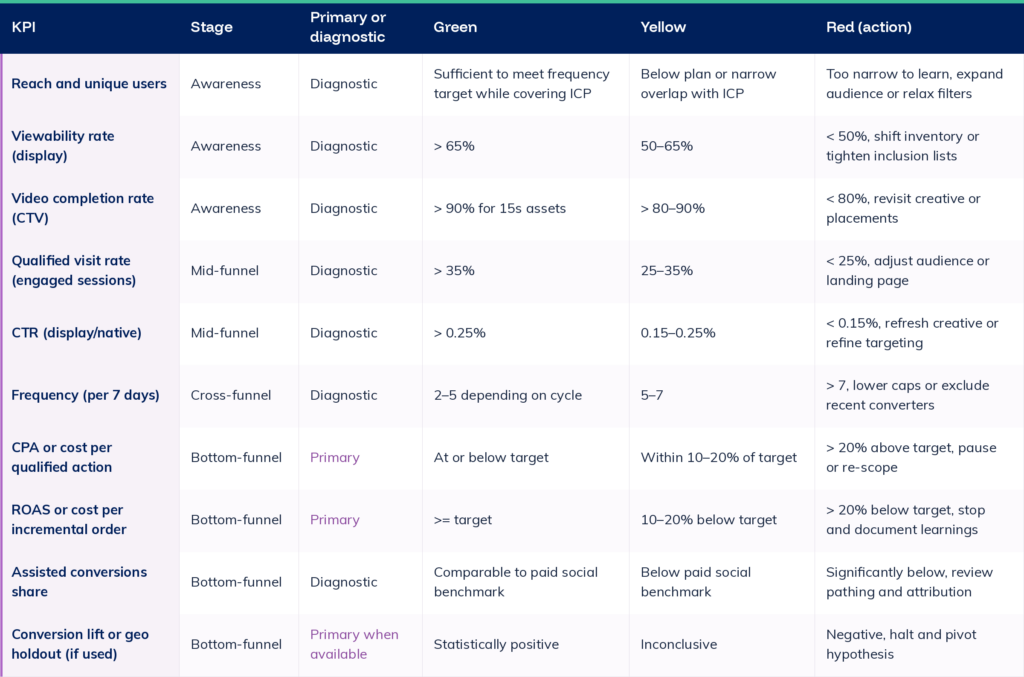
Build a KPI funnel tied to your objective. Upper funnel focuses on reach, viewability, and video completion rate. Mid-funnel emphasizes qualified visits and engaged sessions. Bottom-funnel evaluates CPA, ROAS, and contribution to revenue.
Distinguish success thresholds from diagnostics. For a conversion-focused pilot, CPA or cost per qualified action is the decision metric. Viewability, CTR, and time on site are diagnostic indicators to troubleshoot creative, landing pages, and audience quality.
Predefine green, yellow, and red ranges for your primary and secondary KPIs. This avoids post-hoc debates and accelerates decisions about scaling, optimizing, or stopping.
Integrate DSP and verification data with analytics so programmatic can be compared fairly with Google Ads and Meta. Use consistent UTM standards and ensure conversions reconcile across platforms and analytics before launch.
For a fuller picture of paid media performance, connect pilot results to incrementality, margin, and LTV/CAC so efficiency gains can be evaluated against business value.
Avoid common sources of wasted programmatic spend
Inventory quality can make or break a pilot. Use inclusion lists, contextual controls, and reputable exchanges to avoid buried placements that pad impressions without influence. Private marketplaces can provide higher viewability and brand-safe environments early on.
Balance brand safety settings. Too-lenient filters risk adjacency issues. Too-restrictive filters throttle scale and bias results. Start with a conservative profile and relax only after quality metrics and site engagement remain strong.
Fraud prevention matters, especially for CTV and open web display. Use third-party verification and pre-bid fraud controls to reduce invalid traffic and spoofed CTV inventory.
Operational hygiene protects measurement. Incorrect pixels, misconfigured events, and missing UTM parameters break attribution and undermine decision-making. Treat QA as a launch gate, not an afterthought.
- Adopt inclusion lists of premium domains and apps for week one, then expand based on viewability and engagement data.
- Enable pre-bid brand safety, suitability, and fraud filters in the DSP and validate sellers.json and ads.txt where available.
- Set frequency caps by audience and format, such as 2–3 per 7 days for prospecting display and 1–2 per 7 days for CTV, and exclude recent converters.
- Run creative and landing page QA across devices, confirm event deduplication in analytics, and test failover tags for verification.
- Use geo or time-based delivery checks to spot anomalous spikes that suggest invalid traffic.
- Document and enforce UTM standards that encode channel, campaign, audience, and creative for clean cross-channel comparisons.
Decide whether to scale, optimize, or stop your programmatic pilot
Use a traffic light framework anchored to predefined KPI thresholds. The decision is not to perfect performance but to determine whether programmatic deserves a next level of investment.
Green: CPA at or below target with healthy volume and stable quality metrics. Scale deliberately by expanding inventory and audiences in measured increments while maintaining controls and creative discipline.
Yellow: engagement looks promising but conversion efficiency misses the mark. Address bottlenecks with targeted changes to creative, landing pages, or audience definitions, then rerun within the original budget cap to validate progress.
Red: both efficiency and upstream engagement are poor. Stop, document learnings, and pivot the hypothesis rather than endlessly tweaking a failing setup. Always compare outcomes against Google Ads, Meta, and other incumbents to judge incremental value fairly, and hold a cross-functional review to lock the decision.
If CPA is within 10 percent of target and quality metrics are green, extend two more weeks and +20 percent budget. If CPA is 20 percent over target with weak engagement, stop and reallocate.
Sample programmatic testing framework and illustrative scenario
The framework ties together hypothesis, audience and format selection, target CPA, budget, duration, and decision rules. All numbers below are illustrative examples to show structure, not performance benchmarks.
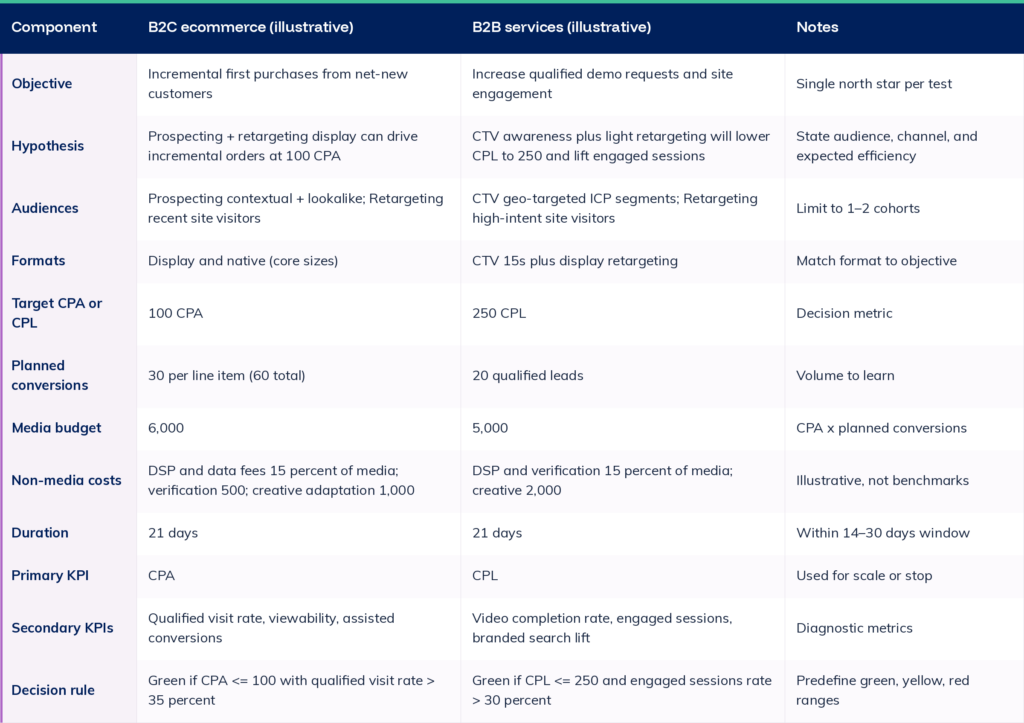
B2C example: a mid-market ecommerce retailer tests display prospecting plus retargeting. Target CPA is 100 for first purchases. Creative includes three display concepts across core sizes. The pilot allocates enough media to reach 30 conversions per line item and runs 21 days.
B2B variation: a healthcare services provider tests CTV for awareness and site engagement alongside a small display retargeting line item. Primary KPI is cost per qualified lead at 250 with secondary metrics of engaged sessions and branded search lift.
Next steps: evaluate a programmatic pilot with Go Fish Digital
A successful programmatic pilot starts with a clear business objective, a focused audience, and a measurement plan your team can trust. Go Fish Digital helps you evaluate whether programmatic is the right next investment, identify where it fits alongside your existing paid media channels, and build a test with defined budget limits and success criteria.
Our Shop Peoria campaign demonstrates how programmatic can contribute to measurable business outcomes within an integrated media strategy. Using custom audience segments and display ads across devices, the programmatic campaigns influenced approximately 85,000 visits to local businesses. The approach connected audience research and media targeting to an outcome that mattered to the community.
Book a 30-minute assessment with Go Fish Digital to review your readiness and scope a tightly defined pilot. We’ll help you select audiences and formats, establish a realistic budget, confirm tracking requirements, and define when to scale, optimize, or stop. From there, we’ll map a launch within 14–30 days, giving your team a practical path to testing programmatic with clear expectations and a capped investment.
