


TikTok Exchange Recap: What Brands Need to Know About Social Commerce in 2027

Published: October 27, 2026
Share on LinkedIn Share on Twitter Share on Facebook Click to print Click to copy url
Summarize with ChatGPT
TikTok is a home for discovery and a place businesses of all sizes can grow their brand and reach new audiences. What began as a platform for entertainment has become a serious retail channel, with millions of consumers now purchasing products directly through TikTok Shop.
For marketers, that growth brings new opportunities and some familiar challenges. How much should brands invest? What kind of creative actually influences purchasing decisions? How do you measure TikTok’s contribution when someone discovers a product on the platform but purchases it somewhere else?
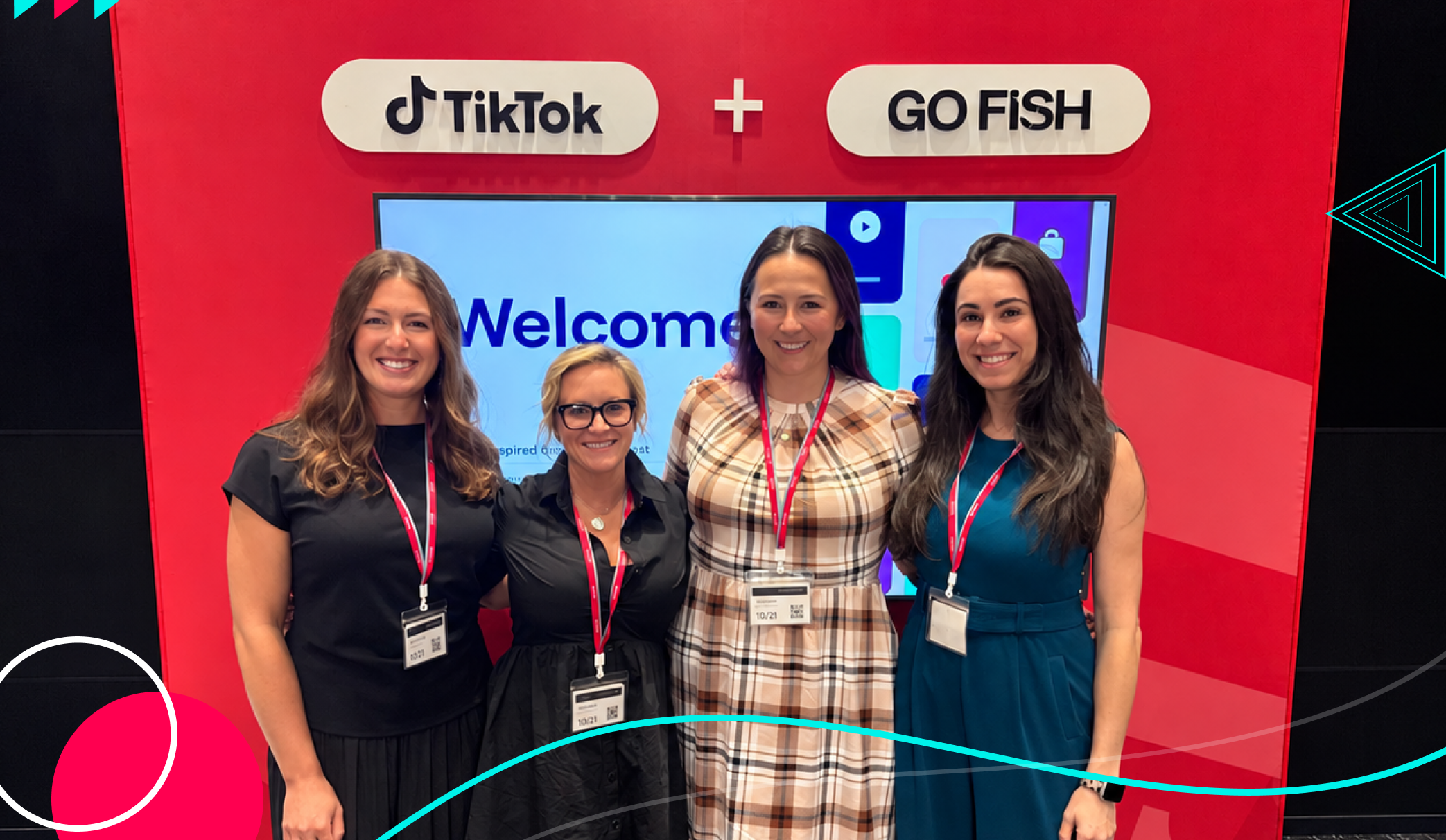
Those were some of the questions we explored at TikTok Exchange, where Go Fish Digital joined experts from TikTok and Cruva to discuss what social commerce looks like today and where it’s headed in 2027.
The event covered everything from building the business case for TikTok to launching on TikTok Shop, developing creator content, and measuring performance across multiple sales channels.
One theme came up throughout the conversations: TikTok can’t be evaluated in isolation. What happens on the platform can influence purchasing decisions across a brand’s entire business, even when the eventual sale happens somewhere else.
Here’s what brands should be paying attention to.
TikTok Shop has become too big for retailers to ignore
For years, brands approached TikTok primarily as an awareness channel. The goal was to introduce products, build an audience, and hopefully generate interest that would lead to a purchase later.
TikTok Shop has changed that relationship.
Consumers can now discover a product through a video, watch a creator demonstrate it, read reviews, and complete a purchase without leaving the app.
And the numbers show just how quickly that behavior is growing.
According to eMarketer research highlighted during TikTok Exchange:
- $23.4 billion in projected U.S. TikTok Shop sales for 2026, up 48% year over year.
- 57.7 million projected U.S. TikTok Shop buyers in 2026, representing more than half of all U.S. social commerce buyers.
- 61% of TikTok users discover new brands or products on the platform, according to TikTok-commissioned research conducted by Material.
But those numbers only tell part of the story.
Someone might discover a product on TikTok Shop while scrolling after dinner, look it up on Google the next morning, and eventually purchase it on Amazon.
TikTok is the discovery channel for the product, but Amazon gets credit for the conversion.
That’s one of the challenges brands need to consider when evaluating TikTok’s value. The platform can influence purchasing behavior well beyond the transactions that happen directly through TikTok Shop.
For a closer look at how brands are turning that interest into sales, our team explored the role of creators, product selection, and LIVE shopping in How Brands Are Driving Revenue with TikTok Shop.
Understanding the customer matters more than simply defining an audience
One of the more memorable examples from the event involved two children growing up in the same household.
They have the same parents, live in the same environment, and share many of the demographic characteristics marketers traditionally use to define an audience.
But their personalities couldn’t be more different.
One researches everything, reads reviews, and carefully considers decisions. The other is motivated by experiences, acts on impulse, and is more likely to follow whatever catches his attention.
The example was entertaining, but it illustrated something important about how people shop.
Two consumers who look nearly identical in an audience report can respond to completely different messages.
For one person, a detailed product demonstration might be what convinces them to buy. Someone else might be influenced by seeing a creator use that same product in a relatable situation.
Neither approach is necessarily better. They address different motivations.
At Go Fish Digital, we consider those motivations when developing TikTok strategies. Demographics help us understand who we’re trying to reach, but customer behavior helps determine what we should say and how we should say it.
That distinction becomes particularly important on a platform where creative plays such a significant role in finding and engaging the right audience.
As Cole Mancini, VP of Social Commerce at Go Fish Digital, explains in Demand Shaping in Social Commerce: What Brands Are Missing, brands need to establish what they want customers to understand before scaling creator content and paid media.
Without that foundation, brands can produce more content without necessarily making their message any clearer.
A successful TikTok Shop starts long before the first sale
It’s easy to focus on the exciting parts of TikTok Shop: creator partnerships, viral products, LIVE shopping, and the potential to reach millions of consumers.
But getting a product in front of an interested audience is only useful if the business is prepared to fulfill the order.
During the event, Cole Mancini, VP of Social Commerce at Go Fish Digital, and Mike Daley, Agency Partner Manager at TikTok, explored what brands need to consider before launching.
Inventory, fulfillment, customer support, product listings, and margins all play a role in whether a Shop can operate profitably.
Consider a brand launching a new product with a group of creators. The content performs well, demand increases, and orders start coming in faster than expected.
That’s a good problem to have until inventory runs out, shipping falls behind, or the cost of fulfillment and creator commissions starts eating into margins.
Those issues aren’t necessarily marketing problems, but they directly affect marketing performance and the customer experience.
Before launching on TikTok Shop, brands should have clear answers to several questions:
- Which products have enough inventory and margin to support additional demand?
- Can existing fulfillment operations handle increased order volume?
- Who manages customer questions, returns, and order issues?
- How will creator commissions, platform fees, and promotions affect profitability?
- Are product pages giving shoppers enough information to make a confident purchase?
Go Fish helps brands work through these considerations alongside their marketing strategy, so the business is prepared for the demand its campaigns are intended to generate.
For brands already selling on TikTok Shop, these same questions can help explain why performance has stalled. Sometimes the problem isn’t the advertising. It’s something happening after the customer shows interest.
Creative is one of the biggest challenges brands face on TikTok
Most marketing teams aren’t short on creative ideas. They’re short on the time and resources needed to produce, test, and refresh those ideas consistently.
TikTok makes that challenge especially apparent.
Creative can fatigue quickly, and the platform’s algorithm uses content engagement to help identify relevant audiences. That means brands need enough variation to understand which messages, formats, and approaches are working.
During TikTok Exchange, Lauren Lyster, VP and Head of Social at Go Fish Digital, explored the growing demand for performance creative and creator-led content.
But producing more content isn’t particularly useful if the team doesn’t have a way to learn from the results.
Imagine a brand testing five videos for the same product.
One opens with a customer problem. Another starts with a product demonstration. A third features a creator explaining why they use it. The remaining two focus on price and product benefits.
If the demonstration performs best, the next question shouldn’t simply be how to make more videos.
It’s worth understanding what made that particular video successful.
Was it the opening? The pacing? The clarity of the product benefit? Did it address a question consumers had before purchasing?
Those findings can inform the next round of creative and help the team avoid repeating tests that have already produced useful answers.
As we explored in What High-Performing Creative Actually Looks Like Right Now, creative performance depends on more than how polished an ad looks. Teams need to understand which messages and formats influence customer behavior.
Bringing performance creative and creator content together
At Go Fish, we use two complementary approaches to support TikTok creative.
Performance creative allows teams to produce and test variations of a concept more efficiently. That might mean changing a hook, adjusting the pacing, testing a different product benefit, or adapting an asset for another placement.
AI-assisted production can help with that process, while brand guidelines and product accuracy checks help maintain consistency.
Creator-led content serves a different purpose. It gives consumers an opportunity to see products demonstrated and discussed by people they may already follow or trust.
According to TikTok’s 2025 Creator Advantage research, creator ads generated 70% higher click-through rates and 159% higher engagement than non-creator ads at the same CPM.
Of course, not every creator is right for every brand.
Audience fit, communication style, reliability, and the ability to explain a product’s value all matter. So do usage rights and whether the content can be adapted for paid media.
Go Fish connects these two approaches through creative testing. We look at which creators, messages, formats, and product benefits perform, then use those findings to develop the next round of content.
Brands also need to consider how creator relationships evolve over time. As Cole explains in our work on demand shaping, giving creators a consistent story to work from can help improve the efficiency of affiliate programs.
The goal isn’t simply to generate more assets. It’s to make each round of creative more informed than the last.
The purchase doesn’t always happen where discovery begins
One of the more important topics discussed at TikTok Exchange was how brands measure performance.
For years, marketers have relied heavily on platform attribution to understand whether advertising is working.
But consumer behavior doesn’t always fit neatly into an attribution report.
A person might watch several TikTok videos about a product, search for the brand a few days later, compare prices, and eventually buy through Amazon or a physical retailer.
If the brand only looks at TikTok’s reported conversions, it may miss some of the demand the platform helped create.
That doesn’t mean every subsequent purchase should be attributed to TikTok Shop. It means brands need better ways to understand how different channels contribute to business results.
At Go Fish, we look at TikTok Shop within the broader commerce ecosystem, including direct-to-consumer websites, Amazon, retail media, and physical retail when relevant.
That requires more than one measurement method.
Platform reporting helps teams understand campaign activity and optimize performance. Incrementality testing can help determine whether advertising generated sales that wouldn’t otherwise have happened. Marketing mix modeling and brand lift studies can provide additional context for investment decisions.
These methods answer different questions, and using them together can produce a more complete understanding of performance.
For example, a campaign might show modest direct conversions through TikTok Shop while coinciding with increased Amazon sales and branded search activity.
Those changes are worth investigating, but they aren’t proof of causation on their own. Incrementality testing can help determine whether TikTok contributed to the increase.
This is particularly important for brands selling through multiple channels. Without a broader measurement strategy, marketing teams risk undervaluing channels that influence demand earlier in the purchasing process.
Making the business case for TikTok investment
Even with TikTok Shop’s growth, marketers still need to justify where they’re spending money.
That means answering questions that go beyond impressions, engagement, and platform ROAS.
How much incremental revenue is the investment generating? Are we acquiring new customers? What happens to contribution margin after advertising, creator commissions, and fulfillment costs? And how does TikTok influence sales across the rest of the business?
During the event, Go Fish outlined a phased approach to TikTok investment that allows brands to test, measure, and expand based on evidence.
The first phase focuses on establishing the Shop, creative production, creator partnerships, and a defined testing budget.
From there, brands can evaluate performance through conversion lift studies or other incrementality methods while examining results across their sales channels.
Once there’s enough evidence to support additional investment, teams can expand successful creative concepts, increase media activity, and continue testing.
This is also why we encourage brands to think beyond conversion-focused advertising alone.
In You Can’t GMV-Max Your Way to a Brand, Cole explains why TikTok Shop growth also depends on the activity happening earlier in the customer journey. Conversion campaigns can capture existing demand, but brands still need to introduce themselves to new customers and give people reasons to choose their products.
Our full-funnel TikTok marketing strategy connects that work across demand generation, demand shaping, and demand capture.
That broader approach also helps bring finance, marketing, and eCommerce teams into the same conversation.
A finance leader may care most about incremental revenue and contribution margin. An eCommerce team may focus on Shop sales and customer acquisition. Brand teams may be looking at reach, awareness, and branded search.
Those are all valid measures, but they need to be considered together.
Otherwise, it’s possible for one team to see a successful campaign while another concludes the investment isn’t working.
What brands should be thinking about for 2027
TikTok’s continued growth creates opportunities for brands at very different stages of social commerce.
Some are still deciding whether TikTok Shop makes sense for their products and customers. Others have launched but aren’t seeing the results they expected. More established sellers may be looking for ways to expand without sacrificing profitability.
The right next step depends on what’s already happening in the business.
For a brand preparing to launch, that might mean reviewing product eligibility, margins, fulfillment capacity, and customer demand before investing in creators or paid media.
For a brand struggling with performance, it may be worth examining whether the problem is creative, product presentation, pricing, or the shopping experience.
And for brands already generating sales, the opportunity may be improving measurement and understanding how TikTok activity influences purchases across other channels.
What became clear throughout TikTok Exchange is that social commerce now touches far more than the social media team.
It affects how products are discovered, how customers evaluate their options, where purchases happen, and how brands measure growth.
The businesses that understand those connections will be in a better position to make informed decisions about their TikTok investment in 2027.
Continue the conversation with Go Fish Digital
At Go Fish Digital, we help brands develop TikTok strategies that account for the full customer journey, from discovery and creative to commerce operations and measurement.
Whether you’re considering TikTok Shop for the first time or looking to improve an existing program, our team can help identify where the opportunities and challenges are.
