


Social Search Optimization: How Brands Get Discovered on Social

Published: October 16, 2026
Share on LinkedIn Share on Twitter Share on Facebook Click to print Click to copy url
Summarize with ChatGPT

A practical, leadership-ready guide to planning, producing, and measuring social search content across TikTok, Instagram, YouTube, and Pinterest—so high-intent shoppers discover your brand in-app and flow to your site to research and buy.
Social platforms now function as search engines. Shoppers type or speak questions directly into TikTok, Instagram, YouTube, and Pinterest to find answers, compare options, and decide what to buy—often before they ever touch Google. Social Search Optimization (SSO) is the discipline of making your content discoverable inside these in-app search experiences so qualified buyers find you at the moments that matter.
For Gen Z and Millennials, social search is a default behavior for product research, from “best carry-on for short trips” to “how to style wide-leg jeans” and “which vitamin C serum actually works.” Brands that structure their content with clear titles, captions, and demonstrations earn visibility, trust, and clicks to the website for deeper research and purchase.
Go Fish Digital’s point of view: social search belongs in the same planning conversation as SEO and eCommerce. The same customer questions that power keyword research, site content, and product pages should fuel your social topics, scripts, and captions. And measurement must go beyond followers or views to track discovery, qualified traffic, and revenue.
Key Takeaways
Use these to orient your strategy before diving into the playbooks below.
- Social Search Optimization makes content discoverable inside TikTok, Instagram, YouTube, and Pinterest so Gen Z and Millennials find your brand at high-intent moments and continue to your site to research and buy.
- Social algorithms rank results by reading captions, bios, and hashtags as keywords, transcribing audio and on-screen text, weighing watch time, saves, and shares, and using visual recognition—paralleling familiar SEO ranking signals.
- Measure discovery and revenue by tracking saves, shares, watch time, and the percentage of views from search or non-followers, and by connecting those posts to website analytics and eCommerce performance rather than likes alone.
What Is Social Search Optimization (SSO) and Why It Matters Now
Social Search Optimization (SSO) is the practice of structuring your social profiles and posts so they surface for relevant in-app searches. It complements SEO, which optimizes content for web search engines like Google. Where SEO targets web queries that load a results page, SSO targets the search experiences built into TikTok, Instagram, YouTube, and Pinterest.
Consumer behavior has shifted. People now ask product questions directly inside social platforms, looking for short videos, creator opinions, and real-life demos. Gen Z and Millennials increasingly bypass traditional web search to get trusted answers faster, in formats that feel native and authentic.
SSO captures these high-intent discovery moments closer to the point of purchase. There’s also a dual benefit: well-optimized social posts can rank on Google for certain queries, while Google results can drive viewers back into your social profiles—creating a reinforcing loop of discovery and trust.
- Example queries people type into social search: “best carry-on luggage for short trips,” “diff between retinol and retinal,” “quiet blender for small kitchen,” “white sneakers that don’t crease,” “how to clean a wool rug,” “iPhone 15 case with wallet,” “are linen sheets worth it?”
- Why this matters: these are purchase-adjacent moments. If your content speaks the question, shows the answer, and links to your site’s next layer of detail, you win discovery and revenue.
How Social Algorithms Decide What Shows Up in Search
Text matters. Captions, on-screen text, bios, and hashtags function like keywords and metadata. Clear, descriptive language that mirrors how people actually search helps platforms match your content to relevant queries.
Audio matters. Platforms transcribe speech and read on-screen text to understand topics. Say the keyword early (“Best carry-on for 2–3 day trips”) and reinforce it visually in the first frame. This helps both search and watch-time because users instantly know they’re in the right place.
Engagement quality matters. Watch time, rewatches, saves, shares, and comments signal content depth and usefulness—similar to SEO’s behavioral signals (dwell time, clicks, links). Optimize the hook, deliver the answer quickly, and give the viewer a clear next step to earn stronger engagement.
Visual recognition matters. Computer vision identifies products, scenes, and logos in images and videos. Help the system by filming in clear settings, showing the product prominently, and pairing visuals with aligned captions and audio so all signals point to the same topic.

Where Social Search Fits With SEO and eCommerce Strategy
SSO should live in the same planning meeting as SEO and eCommerce. The best social topics come from the same places your SEO and merchandising teams already mine: keyword research, on-site search logs, product reviews, and customer service transcripts. These sources reveal the precise questions buyers ask before they purchase.
Use those questions to script short, search-intent videos and carousels that capture in-app demand, then hand off to your website for specs, sizing, pricing, and conversion. Treat social discovery as the front door and your site as the showroom and checkout. A quick scenario: a shopper searches “retinol vs retinal for beginners” on TikTok, watches your dermatologist-led explainer, saves it, taps your link-in-bio to a comparison guide, then adds your starter serum to cart.
Break down silos. SSO, SEO, and eCommerce are one connected system with shared roadmaps and KPIs. When social posts answer the top questions, site content should provide the next layer and product detail. Measurement should track how discovery in social leads to qualified sessions and revenue, right alongside organic search and paid search.
- Use search keyword tools and on-site search to prioritize question-driven topics with revenue potential.
- Sync social scripts and captions with the exact wording buyers use; link each post to a matching product or guide page.
- Ensure PDPs and category pages answer the follow-up questions social viewers have (fit, compatibility, ingredients, warranty).
- Share dashboards across teams so everyone sees discovery, traffic quality, and sales—not just likes or ranking.
Turn Customer Questions into Social Search Content
Build a repeatable intake. Pull recurring questions from SEO research tools (e.g., SEMrush, Ahrefs), your site’s search bar, social comments and DMs, product reviews, and customer service or chat transcripts. Prioritize questions that recur, signal high intent, and align to profitable SKUs or categories.
Cluster questions into themes (e.g., “carry-on luggage sizing,” “vitamin C irritation,” “linen care”). Rank themes by purchase proximity and potential revenue. If a question often precedes a sale or reduces returns, it should be high on your list.
Translate questions into search-style titles, opening hooks, and captions. Plain language wins. Say the key phrase in the first 3 seconds, put it on screen, and write a caption that repeats the phrasing naturally. Promise the answer, deliver it quickly, then invite viewers to tap for the next layer of detail on your site.
Map every social asset to a corresponding page: a guide, PDP, comparison table, or quiz. That continuity lets viewers flow from discovery to decision to purchase—with measurement you can report on.
1. Mine inputs: export keyword gaps, People Also Ask, on-site search terms, top CS tickets, recurring review comments, and FAQs.
2. Score questions: intent (buying vs. browsing), frequency, potential revenue impact, and content difficulty.
3. Draft formats: “X vs. Y,” “Best for [use case],” “How to [task] without [pain],” “3 mistakes to avoid,” and short demos.
4. Script and shoot: say and show the keyword early; use clean, well-lit visuals; add on-screen text that mirrors the query.
5. Write captions and metadata: include the exact phrase, supporting synonyms, and a clear CTA to the matching site page.
6. Publish and connect: add UTM parameters; tag products; pin the post to your profile search hub; monitor comments for follow-ups.
Platform Playbooks: TikTok, Instagram, YouTube, and Pinterest
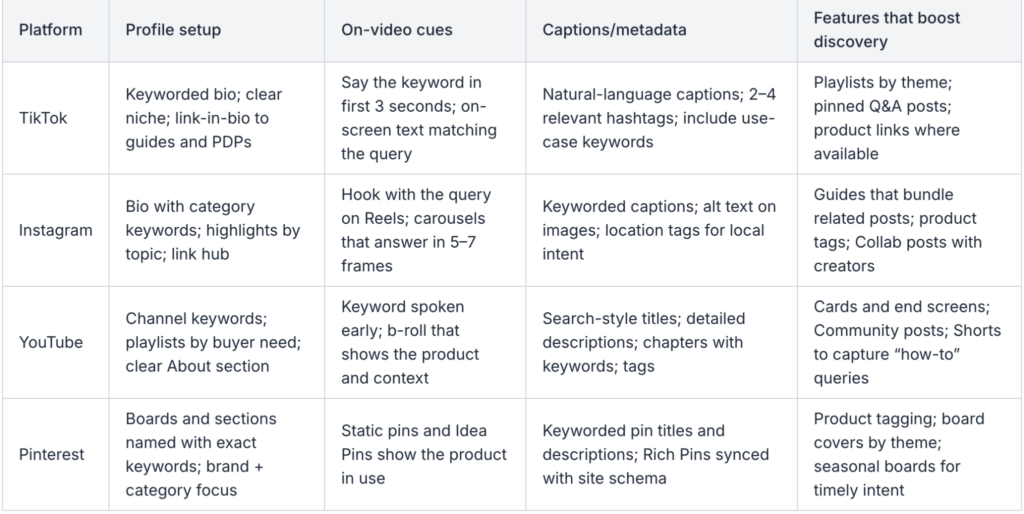
Each platform has a distinct search experience, but the principles stay consistent: speak and show the keyword early, use descriptive captions, and connect to the right next step on your site. Pick one or two primary channels based on your audience and buying journey before expanding.
TikTok favors fast clarity and strong watch-time. Say the query in the hook, put it on screen, and write a descriptive caption with natural-language keywords. Use playlists to group related questions and pin evergreen answers to the top of your profile.
Instagram relies on keyword-rich bios, alt text, and captions across Reels and carousels. Location tags help local discovery. Saveable carousels that answer a question succinctly can rank and circulate for months.
YouTube is the deepest search engine of the four. Use search-style titles, keyworded descriptions, chapters, and end screens that pass viewers to related answers and product pages. Pinterest organizes discovery around keywords and boards; Rich Pins and product tagging connect ideas to shoppable experiences.
Content That Helps People Compare Options and Decide What to Buy
Decision support content wins social search because it matches what buyers actually want: clear comparisons, real outcomes, and credible proof. Design formats that answer the question and reduce uncertainty.
Mix formats: how-tos, routines, and demos to show use in context; side-by-side comparisons (“X vs. Y”); and “which is right for you?” frameworks. Layer in creator or user-generated content (UGC) to add authentic perspectives and social proof.
Every post should connect to a relevant page on your site: a comparison guide, a PDP with specs and reviews, or a bundle page that simplifies choice. Use UTMs so you can measure which social answers drive the most revenue.
- Beauty: “Retinol vs. retinal: which for sensitive skin?” Dermatologist-led Reel + caption summary → comparison guide + beginner kit PDP.
- Fashion: “How to style wide-leg jeans for the office.” 3-outfit Reel, saveable carousel with links → jeans category + lookbook.
- Home: “Best cordless vacuums for small apartments.” 60-second TikTok demo + side-by-side specs overlay → category page with filters.
- Tech accessories: “Which iPhone wallet case actually holds 4 cards?” Creator test + drop test → specific PDP with capacity and warranty.
– UGC: “Real 4-week results using vitamin C serum.” Timelapse + testimonial → PDP reviews anchor + subscribe-and-save.
Measuring Social Search Discovery, Quality Traffic, and Sales
Move beyond vanity metrics. Likes and raw views don’t equal intent. For social search, prioritize discovery and quality signals alongside revenue. In native analytics, track saves, shares, average watch time, completion rate, and the percentage of views from search or non-followers.
Attribute impact to the website and eCommerce. Use UTMs and product tagging to connect posts to sessions, add-to-carts, and revenue. In your web analytics, report on sessions from social search content, bounce rate, engaged sessions, time on page, eCommerce conversion rate, and revenue per session.
Build executive-ready dashboards that align social search KPIs with SEO and paid search. Show how question-led posts drive discovery (search impressions/views), quality traffic (engaged sessions), and sales (orders, AOV). Include assisted conversions and view-through lifts where applicable to reflect multi-touch paths.
Acknowledge attribution realities. Some buyers will save a post, search your brand on Google later, and purchase via another channel. Use blended metrics and contribution analysis (e.g., last click vs. assisted revenue, brand search lift) to represent SSO’s role without over-claiming.
Likes are applause, not proof of intent.
Getting Started: A 90-Day Social Search Optimization Game Plan
Month 1: Align and audit. Convene social, SEO, and eCommerce. Audit profiles, bios, and top posts for search clarity. Pull questions from keyword tools, on-site search, reviews, and customer service. Prioritize 10–15 high-intent themes tied to key product lines. Define KPIs (saves, shares, watch time, search-driven views, engaged sessions, revenue).
Month 2: Produce and connect. Create a search-intent content series for 1–2 primary platforms. Script, film, and publish 2–3 posts per priority theme. Say and show the keyword early; write descriptive captions; tag products; link each post to a matching guide or PDP with UTMs. Build playlists/boards by theme and pin evergreen answers to profile hubs.
Month 3: Optimize and report. Test hooks, thumbnails, and first lines. Expand winning formats (X vs. Y, best-for-use-case, how-tos). Update captions to reflect comments and follow-up questions. Tighten dashboards to show discovery-to-revenue flow. Package insights for leadership and plan the next 90 days to scale the program without overwhelming the team or budget.
Frequently Asked Questions
What is Social Search Optimization and why does it matter now?
Social Search Optimization (SSO) is the practice of structuring social profiles and posts so they surface for relevant in-app searches on TikTok, Instagram, YouTube, and Pinterest. It matters because shoppers—especially Gen Z and Millennials—now search product questions directly inside social platforms. Brands that optimize for these high-intent moments win discovery, trust, and revenue, then guide viewers to their website for deeper research and purchase.
How do social algorithms decide what shows up in search results?
Platforms read captions, bios, and hashtags like keywords; transcribe audio and on-screen text; evaluate engagement quality (watch time, saves, shares, comments); and use visual recognition to understand what’s shown. Recency and profile authority also play a role. These signals mirror familiar SEO concepts such as title tags, content relevance, dwell time, and domain authority.
How should I measure the impact of social search beyond vanity metrics?
Track discovery and intent signals (saves, shares, average watch time, completion rate, percentage of views from search or non-followers) alongside web and eCommerce outcomes (engaged sessions, add-to-carts, conversion rate, revenue per session, assisted conversions). Connect social posts to site analytics with UTMs and product tagging, and report SSO contribution alongside SEO and paid search KPIs.
Which platforms should I prioritize for SSO?
Choose 1–2 platforms where your audience researches before purchase. If short-form demos drive your category, start with TikTok or Instagram Reels. If long-form education and evergreen search matter, prioritize YouTube. If your category is highly visual with planning behavior (home, fashion, recipes), invest in Pinterest. Expand only after you’ve built a repeatable workflow and clear KPIs.
How do I turn customer questions into effective social content?
Mine questions from keyword tools, on-site search, reviews, comments/DMs, and customer service logs. Cluster by theme, prioritize by intent and revenue impact, and translate each question into a search-style title, hook, and caption. Say and show the keyword early, demonstrate the answer clearly, and link to a matching site page that provides the next layer of detail.
Make Your Brand Easier to Find on Social
Your customers are searching on TikTok, Instagram, YouTube, and beyond. Is your brand showing up when they’re ready to make a decision?
Go Fish Digital can help you connect social search, SEO, and content strategy to improve discovery, bring qualified visitors to your website, and turn that interest into sales.
