

The Hidden Cost of Neglecting Internal Links in 2026

Published: July 22, 2026
Share on LinkedIn Share on Twitter Share on Facebook Click to print Click to copy url
Summarize with ChatGPT

Internal linking still gets treated like a technical cleanup task, but in 2026 it plays a direct role in how your site performs across search, AI-powered search experiences, and user journeys. When pages aren’t intentionally connected, authority gets split, key pages struggle to rank, and both search engines and AI systems have a harder time understanding what your site is about. The impact tends to show up quietly: lower organic visibility, weaker engagement, and missed conversions.
This article breaks down where that loss shows up, from rankings and AI visibility to user experience and conversion paths, and what changes when internal linking is handled with intent. You’ll also see how stronger internal linking improves crawl efficiency, reinforces topical authority, and supports clearer paths to conversion. Later sections cover best practices, common mistakes, and how a more strategic internal linking approach starts to pay off.
What Is Internal Linking?
Internal linking is the practice of connecting one page on your site to another page on the same domain. It helps search engines, AI systems, and users understand how your content fits together and where to go next. In an era of AI-enhanced search, those connections tell systems which pages form your expertise and which should be surfaced first.
Internal links differ from external links (backlinks). Backlinks help establish authority from other sites; internal links determine how that authority is distributed within your site. Both matter, but you control internal linking—and control is leverage.
Three primary types of internal links work together to create a navigable, crawlable site. When they’re missing or misused, you create orphan pages—URLs that have no links from other on-site pages—making them harder to find, crawl, and rank.
- Navigational links: Header, mega menu, sidebar, and breadcrumb links that outline your hierarchy and keep key pages within a few clicks.
- Contextual links: In-content links that connect related ideas, reinforce topic clusters, and move users toward deeper or later-stage resources.
- Footer links: Utility and trust links (e.g., contact, policies, core categories) that reinforce structure without overwhelming users.
Internal Links Are a Critical Ranking Signal in 2026
Internal links do more than help users click around. They shape how search engines and AI systems understand your site. They guide crawlers through your content, signal which pages matter most, and influence what gets indexed, surfaced, and ranked. Without a clear linking structure, important pages get buried, and strong content can go unseen.
They also control how authority moves across your site. When high-value pages link with intent, they pass relevance and weight to other pages, helping them perform. When that structure is missing, authority stays fragmented and priority pages struggle to gain traction.
In 2026, this matters even more because search is no longer just about rankings. AI-powered search experiences rely on clear relationships between topics, pages, and entities to determine what content best answers a user’s question. Internal links help define those relationships, reinforcing topical authority and making it easier for both search engines and AI systems to understand and surface your content.
| Aspect | Strong Internal Linking | Weak Internal Linking |
| Crawl discovery | High-priority pages are consistently reached via multiple paths; crawl budget is used efficiently. | Bots hit dead ends or loops; important URLs are missed or crawled infrequently. |
| Page importance signals | Many relevant internal links concentrate authority on pillars and revenue pages. | Signals are diffuse; priority pages struggle to accumulate enough internal support. |
| Topic/Entity clarity | Clusters and anchors define relationships across entities and subtopics. | Disconnected pages blur topical focus; AI systems lack clear context. |
| AI/SGE coverage | Pages are more likely to be referenced in AI overviews due to clear, reinforced relevance. | Pages are overlooked in AI answers because relationships aren’t explicit. |
| Indexation consistency | Stable indexation and fresher caches on key URLs. | Volatile indexation; stale caches on critical content. |
As John Mueller put it, “It’s something where internal linking is super critical for SEO. I think it’s one of the biggest things that you can do on a website to kind of guide Google and guide visitors to the pages that you think are important.”
That aligns with guidance from Google, which emphasizes that every important page should be linked from at least one other page, ideally in a way that helps users go deeper into the topic.
Put simply, internal linking is no longer just an SEO best practice. It’s foundational to how your site is understood, trusted, and surfaced across traditional search and AI-powered experiences.
The Hidden SEO Price Tag of Weak Internal Linking
Weak internal linking rarely causes a sudden drop in performance. It shows up over time. Pillar pages don’t gain traction, strong content stalls, and organic growth plateaus even when backlinks and content quality look solid on paper. The issue is distribution. Without a clear linking structure, authority isn’t passed where it needs to go, so priority pages never get the internal support required to compete.
This often leads to orphan pages or content that’s only lightly connected to the rest of the site. These pages are harder for search engines to find, crawl, and evaluate, which limits impressions, suppresses rankings, and drags down overall organic traffic.
Even when links exist, they’re not always helping. For example, linking a single word like “Tuscan” within “creamy Tuscan chicken” to a broad recipe roundup might be technically relevant, but it weakens the signal. Instead of reinforcing the full topic, it shifts authority to a loosely related page and breaks the connection between the keyword and the content.
Over time, these patterns add up. Link equity gets spread thin or sent in the wrong direction, topical clusters lose cohesion, and it becomes harder to establish authority around key themes. In 2026, where both search engines and AI systems rely on clear topic relationships, that lack of structure makes it harder to earn visibility. The result is measurable: fewer impressions, lower average positions, slower traffic growth, and missed opportunities to turn existing content into meaningful business results.
How Poor Internal Linking Hurts UX, Engagement, and Conversions
It also breaks the buyer journey. Informational content brings people in, but without strong internal links to product or service pages, that interest doesn’t turn into action. Users have to work to find what they need, and most won’t. You end up paying to acquire traffic that never converts.
There’s also a structure issue. As Mueller explained, “…if you do dilute the value of your site structure by having so many internal links that we don’t see a structure anymore, then that does make it harder for us to understand what you think is important on your website.” In other words, both too few links and too many unfocused ones can create the same problem.
That same structure doesn’t just influence how people and search engines navigate your site. It also affects how AI systems interpret and surface your content. As AI-powered search becomes a bigger part of the discovery process, internal linking helps reinforce topical relationships and guide AI toward your most important pages. In our Winning with GEO report, we recommend refining internal linking alongside structured data and authoritative content to strengthen the signals AI systems use when deciding what to cite in AI-generated answers.
When internal linking is handled with intent, the experience improves quickly. Users find relevant content faster, move more naturally from research to decision, and convert at a higher rate. It also creates a stronger content ecosystem that helps both traditional search engines and AI better understand your site. That means more value from the traffic you already have, greater visibility across evolving search experiences, and lower pressure on paid acquisition to fill the gap.
Internal Linking Best Practices for SEO in 2026
Internal linking needs to be intentional and scalable, especially as sites grow and search behavior shifts toward AI-driven answers. The goal is simple: make it easy for search engines, AI systems, and users to understand what your site is about, what matters most, and where to go next. Here’s what that looks like in practice:
Build around clear topic clusters: Structure your site so core topics are anchored by pillar pages, with supporting content linking back to them. This helps reinforce ownership of a topic and gives both search engines and AI systems a clean way to interpret your content.
Link supporting content to revenue pages, and back: Blog posts and guides shouldn’t sit in isolation. They should point users toward product or service pages where it makes sense, while those pages link back to deeper content that builds trust and answers questions.
Use anchor text that reflects intent: Keep it natural, but specific. Anchor text should describe what the user will find and reinforce the topic of the page you’re linking to. Avoid vague links or overloading exact-match keywords.
Keep important pages within reach: Priority pages shouldn’t be buried several clicks deep. A strong structure keeps key pages accessible within a few clicks from the homepage, making them easier to crawl, rank, and navigate to.
Maintain links as your site evolves: Internal linking isn’t set once and forgotten. As new content is published or pages are updated, links should be revisited to keep clusters intact, prevent orphan pages, and ensure authority continues to flow to the right places.
Use contextual linking to drive next steps: The strongest links are placed where they make sense in the user journey. For example, a product page that links to related items or complementary products can increase session depth and support cross-sell, while also distributing authority across those pages.
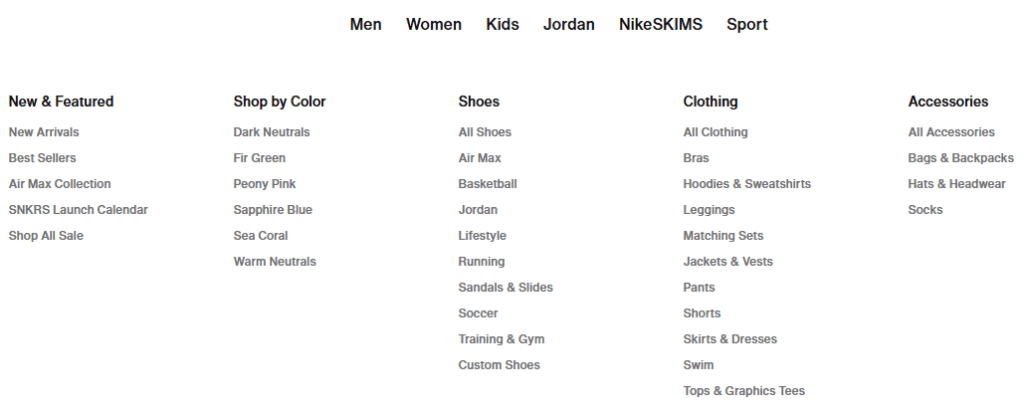
The example below demonstrates how navigational internal linking supports a clear site architecture. Organizing products into categories and subcategories makes it easier for users to browse the site while helping search engines understand the hierarchy and importance of key pages.

Example: The screenshot below shows the main navigation of an ecommerce website. This example of navigational internal linking organizes products into clear, structured categories and subcategories. By surfacing these sections directly in the main menu, the site signals their importance within the overall architecture while helping users quickly navigate based on what they’re shopping for.
In 2026, internal linking needs to be planned, not patched in later. Search engines and AI systems rely on structure to understand your site, so links act as the connective layer that holds everything together. For content-heavy sites, this is core infrastructure. Without it, even strong content struggles to perform.
Below are four priorities to focus on:
1. Build a Clear, Hierarchical Site Architecture
Start with a logical site hierarchy that groups related content into categories, subcategories, and pillar pages. Every page should have a clear purpose and fit naturally within the broader structure of your site. This helps search engines understand how topics relate to one another while making it easier for users to find what they need. As your site grows, a well-planned architecture also prevents content from becoming isolated or competing against similar pages.
2. Connect Supporting Content to Revenue-Driving Pages
Informational content shouldn’t exist in isolation. Blog posts, guides, and resource pages should naturally link to relevant product, service, or category pages where users can take the next step. At the same time, those commercial pages should link back to supporting resources that answer questions, build trust, and strengthen topical relevance. This creates a connected content ecosystem that supports both SEO performance and conversions by guiding users from research to decision.
3. Use Descriptive Anchor Text
Anchor text should clearly describe the page being linked to rather than relying on generic phrases like “click here” or “learn more.” Descriptive anchors provide additional context to search engines about the destination page while helping users understand what they’ll find before they click. Keep anchor text natural within the surrounding copy and focus on accurately describing the linked content instead of forcing exact-match keywords.
4. Keep Important Pages Within Three Clicks
Your highest-priority pages should be easy for both users and crawlers to reach. If key product, service, or category pages require several clicks to access, they may receive less internal authority and be crawled less efficiently. Use navigation, breadcrumbs, related content modules, and contextual links to keep important pages within two or three clicks of the homepage. A shallow click depth improves discoverability, strengthens internal link equity, and creates a better overall user experience.
When to Lean on Tools or an Agency for Internal Linking Strategy
There’s a point where internal linking stops being a quick fix and starts becoming a real operational challenge. It usually shows up in a few ways: content keeps growing but performance stalls, key pages aren’t gaining traction, or teams don’t have a clear view of how everything connects. At that stage, manual updates and one-off audits aren’t enough to keep up.
Tools can help you find opportunities faster. Crawlers and analysis tools surface orphan pages, weak clusters, and missed links. Resources like How To Find Internal Linking Opportunities With Screaming Frog and How to Find Internal Linking Opportunities Using Screaming Frog’s N-gram Analysis are good starting points for identifying gaps
Extensions like N-gram by Go Fish Digital can also help at the page level by showing how terms are used and where links could be added.
But tools alone don’t solve structure. They can tell you where links are missing, not how your site should be organized or which pages should carry the most weight. That’s where strategy comes in, deciding what gets prioritized, how topics are grouped, and how users should move from discovery to conversion. It often requires coordination across content, SEO, and product or marketing teams, which is where things tend to slow down internally.
This is where an agency can step in with a different role. Not just executing links, but designing the system behind them. That includes building out topic clusters, aligning internal links to revenue goals, and creating workflows that scale as new content is published. The focus shifts from fixing pages to improving how the entire site performs.
The upside is measurable. Stronger internal linking can recover missed organic traffic, improve how users move through the site, and increase conversions from the traffic you already have. It also reduces the ongoing lift on internal teams by turning what’s often a reactive task into a structured, repeatable process.
See Where Your Internal Linking Is Holding You Back
Internal linking is one of the most overlooked drivers of SEO performance, but it’s rarely the only issue affecting your organic growth. Technical SEO, content gaps, crawlability, AI visibility, and site architecture all work together to determine how well your site performs in search.
If your rankings have stalled or you’re unsure where your biggest opportunities are, a comprehensive SEO audit can uncover what’s limiting your performance. Our award-winning team analyzes your site’s technical health, content strategy, competitive landscape, and internal linking structure to identify the highest-impact opportunities for increasing visibility, traffic, and conversions.
Schedule your free SEO audit to receive actionable recommendations, AI visibility insights powered by our proprietary ecommerce SEO tools, and expert guidance tailored to your business goals.
Frequently Asked Questions
What is internal linking in SEO?
Internal linking connects pages within the same domain. It guides users and crawlers, concentrates authority on priority pages, clarifies topic relationships, and improves crawlability, indexation, and conversions.
Are internal links good for SEO?
Yes. Internal links are a major lever you control. They help distribute authority, signal page importance, reinforce topic clusters, and improve rankings, AI/SGE visibility, and user journeys.
How should I structure internal links for SEO in 2026?
Design hierarchical architecture with clear pillar pages and supporting content. Keep key pages within two to three clicks of the homepage, use natural, descriptive anchors, and maintain links as content and priorities evolve.
How many internal links should a page have?
There’s no fixed number. Include enough links to guide users and reinforce clusters without diluting structure. Focus on relevance, clarity, and reducing click depth for important pages.
Which tools help with internal linking SEO?
Use Screaming Frog for crawling and orphan detection; the N-gram by Go Fish Digital extension for anchor insights; Yoast SEO Premium and Link Whisper for suggestions; Semrush and Ahrefs for internal link opportunities and monitoring.

About Kalina MacKay
Kalina MacKay oversees owned media at Go Fish Digital, including the digital PR, SEO, email marketing, and ORM teams. With natural passion, Kalina has a track record of creating innovative, newsworthy content that creates massive buzz and drives record results. She has produced and pitched campaigns that have been featured in the Washington Post, Forbes, Business Insider, Cosmopolitan, and countless other reputable outlets.