


ChatGPT Ads Are Here: What Marketers Need to Know

Published: August 26, 2026
Share on LinkedIn Share on Twitter Share on Facebook Click to print Click to copy url
Summarize with ChatGPT
People don’t use ChatGPT the same way they use a traditional search engine.
Someone might search Google for “best running shoes for flat feet.” In ChatGPT, they might explain that they’re training for their first half marathon, run mostly on pavement, want to spend less than $150, and found their last pair too heavy.
That conversation gives ChatGPT more context about what the person is actually trying to solve.
There’s a lot more information in that conversation for an advertising platform to work with.
OpenAI began testing ads in ChatGPT in the U.S. in February 2026. Since then, the company has continued developing ChatGPT Ads, including tools for advertisers to create campaigns and measure performance.
ChatGPT Ads put paid media into a place where people are already researching products, asking follow-up questions, comparing options, and working through decisions. Marketers now have to figure out where that fits within the customer journey and whether the additional conversational context can make advertising more relevant.
Here’s what we know so far.
How Do ChatGPT Ads Work?
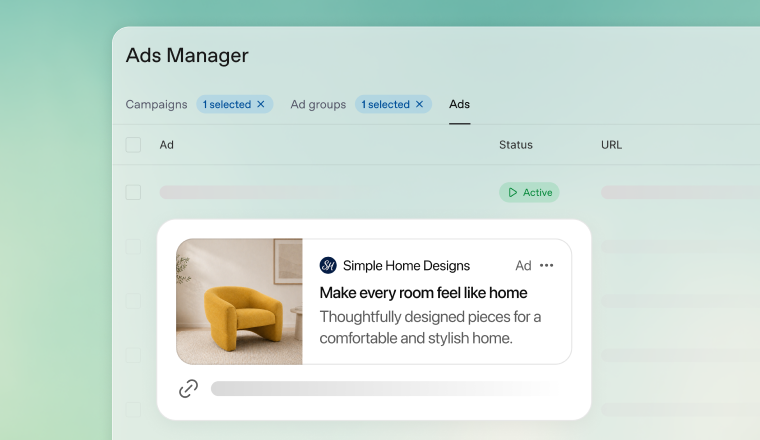
ChatGPT Ads are sponsored placements that can appear below ChatGPT responses for eligible users. Ads are selected based on factors including conversational context, advertiser inputs, creative, and landing-page relevance.
According to OpenAI’s documentation, advertising operates separately from ChatGPT’s answers. Advertisers can’t pay to influence which brands or products ChatGPT recommends organically.
So it’s possible for a brand to show up in a ChatGPT response without advertising. It’s also possible to advertise alongside a conversation without being mentioned in the answer itself.
OpenAI says its ad system can consider several signals when deciding which eligible ad to show:
- The context and intent of the current conversation.
- The advertiser’s landing page.
- Ad titles and copy.
- Advertiser-provided context hints and targeting selections.
- Select signals from a user’s broader ChatGPT experience when ad personalization is enabled.
Advertisers can also provide context hints describing conversations, topics, or keywords where their product or service may be useful. OpenAI notes that these aren’t exact-match keywords and don’t guarantee placement within a specific conversation.
For teams used to organizing paid search campaigns around keywords, this requires some adjustment.
How Are ChatGPT Ads Different From Search Ads?
The biggest difference is the amount of conversational context available around a user’s intent. Paid search often begins with an individual query, while ChatGPT can draw on the details someone shares throughout a conversation.
Think about someone shopping for a new mattress. Their Google history over a few days might look something like this:
- Best mattress for side sleepers.
- Memory foam vs. hybrid mattress.
- Mattress for back pain.
- Best king mattress under $2,000.
- Mattress reviews.
A ChatGPT user could provide most of that information in one conversation. They might explain how they sleep, what’s wrong with their current mattress, how much they want to spend, what their partner needs, and which brands they’ve already ruled out.
The intent isn’t necessarily stronger. There’s simply more context available around it.
OpenAI has described this as an opportunity to reach people while they explore, compare, and decide. For advertisers, the interesting question is how useful that additional context becomes for targeting and performance.
ChatGPT Ads vs. Search Ads vs. Organic AI Visibility
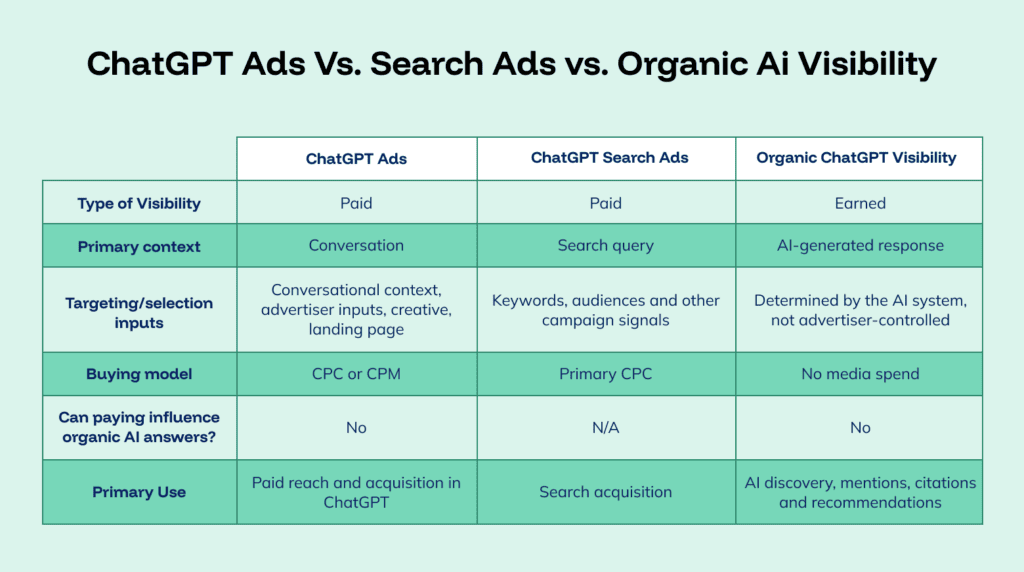
The comparison is useful because ChatGPT now creates room for paid and organic visibility within the same customer experience.
Context Hints Add Another Layer to Targeting
One of the more interesting features in ChatGPT Ads is context hints.
Context hints allow advertisers to describe the conversations, topics, or keywords where their offering may be relevant. They aren’t exact-match keywords and don’t guarantee an ad will appear in a particular conversation.
- For an eCommerce brand, that might include product attributes, budgets, use cases, comparisons, or common objections.
- An insurance company might look at the life events, coverage questions, financial concerns, and comparison criteria that come up before someone evaluates policies.
- A B2B SaaS company could focus on the operational problem someone is trying to solve, their existing technology, implementation concerns, company size, or alternatives they’re considering.
This is where customer research becomes particularly useful. Search data can tell you what people type into Google. Sales calls, customer interviews, reviews, support tickets, community discussions, and on-site behavior can help fill in the circumstances around those searches. These sources are useful for understanding customer language and decision-making, regardless of whether an AI platform currently cites them frequently.
Ad Creative Has to Make Sense in the Conversation
OpenAI’s creative guidance for ChatGPT Ads recommends clear, specific messaging that explains what a product offers, who it’s for, and when it might be useful.
That guidance fits the environment.
If someone has spent several minutes explaining exactly what they need, an ad that says “Discover the Difference” isn’t adding much.
An ad that clearly explains why a particular product or service fits the situation has a better chance of being useful.
OpenAI also recommends creating distinct ad variations rather than making minor changes to the same message. Different creative can address different needs, use cases, or customer situations.
The destination matters too. Sending every ChatGPT Ads click to a homepage throws away much of the relevance that got the click in the first place. Product pages, category pages, comparison content, FAQs, buying guides, service pages, and other specific resources may make better landing pages depending on the conversation.
How Are ChatGPT Ads Bought and Measured?
ChatGPT Ads currently support CPC and CPM buying models, with campaigns optimized around either clicks or reach. Advertisers can measure impressions, clicks, spend, CTR, average CPC, average CPM, and conversions.
OpenAI says its system uses a relevance-weighted, second-price auction when selecting among eligible advertisements.
Advertisers can also add UTM parameters to destination URLs and track ChatGPT Ads traffic in their existing analytics platforms.
Most of this will look familiar to performance marketers. What we don’t have yet are mature benchmarks for how ChatGPT traffic behaves across industries and use cases.
A $5 click from ChatGPT and a $5 click from Google aren’t automatically equivalent. The user may be at a different point in the buying process, and the behavior after the click may look different as a result.
For early campaigns, we’d pay attention to conversion rate, lead or revenue quality, landing-page engagement, assisted conversions, and incremental reach alongside the standard platform metrics.
Paid and Organic AI Visibility Need to Be Measured Separately
Paid AI visibility is exposure purchased through advertising, while organic AI visibility comes from a brand being mentioned, cited, surfaced, or recommended within an AI-generated response.
OpenAI says advertising doesn’t influence ChatGPT’s answers. Paying for ChatGPT Ads won’t make a brand more likely to be recommended in an organic response.
A company might be mentioned or cited in the answer because ChatGPT considers it relevant. It might appear as a sponsored placement. In some conversations, it could do both.
For brands already investing in generative engine optimization (GEO), this distinction matters for measurement.
If branded visibility increases after launching ChatGPT Ads, teams need to know how much came from paid placements and how much came from organic mentions, citations, or recommendations.
Establishing an organic AI visibility baseline before testing ads can make that much easier to understand.
ChatGPT Doesn’t Fit Neatly Into One Marketing Team
There’s another practical issue companies will have to work through: ownership.
SEO teams typically manage organic search. Paid media teams manage search advertising. Content teams build educational and decision-stage resources. Brand teams manage positioning. Analytics teams measure what happens across all of them.
A ChatGPT conversation can touch several of those functions at once.
Someone can ask a question, receive information pulled from third-party sources, encounter brands within the answer, compare products, and see an ad without ever leaving the conversation.
Internally, those activities may sit with several different teams. The customer sees one experience.
Companies testing AI advertising will probably need more coordination between paid media, SEO, content, analytics, and brand than they’re used to with a traditional paid search campaign.
How We’d Approach an Early ChatGPT Ads Test
The performance data available today is still early and isn’t category-specific enough to make broad budget decisions. Running a controlled test against your own benchmarks will tell you more about how ChatGPT Ads perform for your business
- Choose a use case with clear intent. Start with a product, service, or audience where customers already spend time researching and comparing options.
- Document your current performance. Capture CPC, conversion rate, CPA, revenue or lead quality, and landing-page engagement from the channels you’re most likely to compare against.
- Map the conversations that happen before the conversion. Look at search data, sales conversations, reviews, FAQs, support tickets, customer research, and other first-party information. What does someone need to know before they’re comfortable buying?
- Build different ads for different situations. Give the platform genuinely different messages to work with instead of several versions of the same headline.
- Send people somewhere useful. Match the destination to what the person was trying to accomplish in the conversation.
- Measure performance against your other channels. With CPC bidding and a Conversions API, advertisers can track performance beyond the initial click and compare ChatGPT Ads against other channels in their marketing mix.
The first round of testing should help marketers understand where ChatGPT shows up in their customers’ buying process. Testing is also more accessible now that OpenAI has reduced the minimum budget requirement to $0, removing the need for a large upfront investment. That gives advertisers more room to start small, compare performance against existing channels, and learn where ChatGPT fits in their media mix.
ChatGPT Ads FAQs
Can advertisers pay to appear in ChatGPT answers?
No. OpenAI says advertisements operate separately from ChatGPT’s answers. Paying for ChatGPT Ads doesn’t allow an advertiser to influence which brands, products, or services ChatGPT mentions or recommends organically.
Do ChatGPT Ads use keywords?
Advertisers can provide topics, keywords, and context hints to help OpenAI understand where an ad may be relevant. Context hints aren’t exact-match keywords and don’t guarantee placement within a specific conversation.
How much do ChatGPT Ads cost?
ChatGPT Ads support CPC and CPM buying models. Actual costs depend on the advertising auction and campaign. Advertisers should establish their own performance benchmarks as more campaign data becomes available.
Should brands use ChatGPT Ads or invest in GEO?
ChatGPT Ads and GEO serve different purposes. Ads provide paid exposure within ChatGPT, while GEO focuses on improving a brand’s organic visibility across AI-generated answers, citations, mentions, and recommendations. For many brands, the more useful approach will be measuring and testing both rather than treating them as interchangeable.
Where ChatGPT Ads Fit From Here
ChatGPT advertising is still early. Capabilities will change, more performance data will become available, and marketers will get a better sense of which products and customer journeys are a good fit.
There’s no reason to overhaul a paid media strategy because ChatGPT Ads exist. There is a good reason to start learning how customers use conversational AI when they’re researching your category.
That includes looking at the questions they ask, the comparisons they make, the sources AI platforms rely on, where your brand already appears organically, and which conversations have enough commercial intent to warrant a paid test.
OpenAI maintains a collection of ChatGPT Ads resources for advertisers as the platform develops.
For marketers testing the channel, the useful benchmark won’t be whether ChatGPT Ads can replace Google Ads. It’ll be whether they reach customers in relevant moments that your existing media mix isn’t reaching as effectively.
Considering a ChatGPT Ads test?
Start with the right use case, benchmarks, and measurement plan. Talk to our team about where ChatGPT Ads could fit into your media mix.
