



How To Build Content That Ranks in AI Search in Minutes

Published: June 13, 2026
Share on LinkedIn Share on Twitter Share on Facebook Click to print Click to copy url
Summarize with ChatGPT

Search behavior has shifted in a way that changes the calculus for content marketers and SEO teams. When someone asks Google, ChatGPT, or Perplexity a question today, they often get a generated answer before they see a single link. That answer is assembled from sources chosen by an AI system, and if your content is not in that set, you are invisible for that query.
Knowing how to create content that ranks in AI search means understanding what those systems are selecting for: extractability, clarity, depth, and demonstrated trustworthiness. This article breaks down how AI search engines work, what signals they evaluate, and the specific tactics that give your content the best chance of being cited.
What It Means to “Rank” in AI Search (And Why It’s Different)
In traditional search, ranking means your page appears as a blue link on a results page. In AI search, ranking means being selected as a source that feeds a generated answer. This shift is one reason many traditional SEO KPIs are becoming less reliable indicators of actual visibility and performance.
The distinction matters because you can rank highly in traditional search and still be invisible in an AI-generated response, and increasingly, that generated response is what users engage with first.
This shift has given rise to Generative Engine Optimization (GEO): the practice of structuring and writing content so that AI systems can extract, evaluate, and reuse it effectively. GEO is not a replacement for SEO; it is an extension of it, applied to a new layer of how search works. For teams looking to operationalize GEO, tools like Fan-Out Queries, Page Optimization, and ORM Configuration can help uncover content gaps, optimize pages, and monitor brand visibility in AI search.
The core difference between the two disciplines comes down to the unit of competition. Traditional SEO optimizes entire pages to rank for specific keywords. AI search evaluates individual passages within pages and pulls from multiple sources to construct a single answer. Your goal is not to be the top result; it is to be one of the trusted contributors whose content earns a place in the assembled response.
How AI Search Engines Work and Choose Content
To optimize for AI search, you need a working model of what happens between a user query and a generated answer. The process is simplified here, but the underlying logic is consistent across platforms.
AI search systems start by crawling web content and breaking it into smaller sections, often called passages or chunks. Each chunk is evaluated independently for relevance to a query, which means a single well-written section of your page can be selected even if the rest of the page is not especially strong for that topic. This is why structure and clarity at the paragraph level matters as much as the overall quality of a page.
Once relevant passages are identified, the system assembles an answer by drawing from multiple sources. The signals that determine whether your content makes the cut include:
- Relevance: How closely the passage addresses the specific query, not just the general topic.
- Clarity: Whether the answer is stated directly and without unnecessary qualification.
- Depth: Whether the content addresses the full scope of what the user is asking, including context and follow-up questions.
- E-E-A-T: Signals of experience, expertise, authoritativeness, and trustworthiness — the same signals Google’s quality raters assess for traditional search.
- Freshness: Whether the content reflects current, accurate information, especially on topics that change frequently.
The concept worth internalizing here is “citation-worthy content”: a passage so complete and credible that it could stand alone as a reliable answer to the question, even stripped of the surrounding page. That is the standard AI systems are effectively applying when they select content to cite.
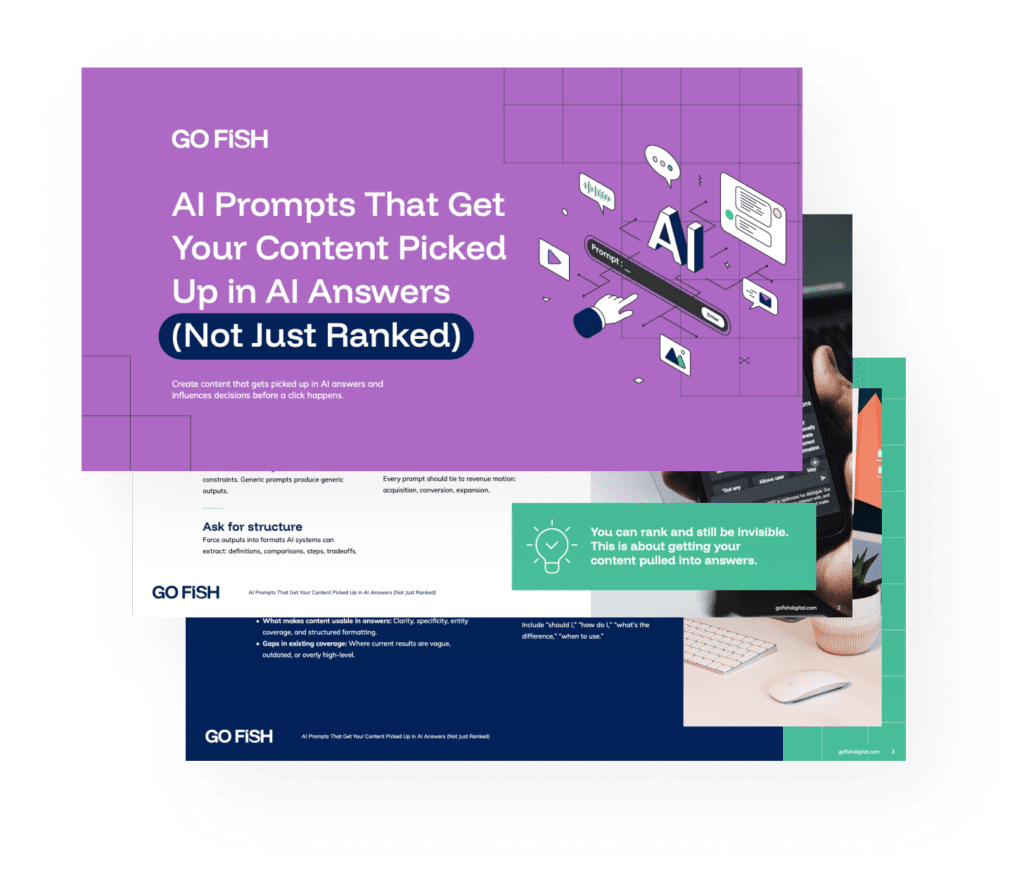
If you’re looking for practical frameworks to make content more extractable and citation-worthy, download our guide to AI prompts that help content get picked up in AI-generated answers.
Core Principles of Content That Gets Cited in AI Search
No single tactic produces AI search visibility. What does work is a consistent combination of clarity, depth, and trust built into every piece of content you publish. The following principles are drawn from how AI systems extract and evaluate content — not from speculation, but from the observable patterns in how AI-generated answers are assembled.
Lead With the Answer, Then Expand
AI systems are looking for the answer to the user’s question. If your content buries the key point after three introductory sentences, the system may move on before reaching it. The better approach is to state the direct answer at the top of each section, then follow it with supporting context, examples, or nuance.
This is also better for users. Most readers scanning an article want to confirm quickly that a section contains the information they need before committing to reading all of it. Leading with the answer serves both audiences: the AI extracting a passage and the human deciding whether to keep reading.
Make Content Easy to Extract and Reuse
AI systems process content in sections. A page with clear heading hierarchy, short paragraphs, and well-defined subsections gives those systems more obvious entry points for extraction. A page built around long, undifferentiated prose makes that job harder, and the content is less likely to be selected as a result.
Each section of your content should be self-contained enough to make sense without requiring the reader to have consumed everything that came before it. If understanding your H3 requires memory of a specific sentence from three paragraphs earlier, the section is not as extractable as it could be. Write each major section as if it might be the only part someone reads.
Go Deep on Topics (Not Just Keywords)
Thin content, such as a short page that answers only the surface-level question, performs poorly in AI search because it cannot address the follow-up questions that users frequently have. A page on “what is anchor text” that stops at the definition will lose to a page that also explains how anchor text affects ranking, how to write it well, and what to avoid.
This does not mean writing longer for its own sake. Depth means covering the full logical scope of a topic: the definition, the mechanism, the application, the common mistakes, and the relationship to adjacent concepts.
This approach can have a significant impact on visibility. For example, when we helped MoneyGeek reorganize more than 4,000 pages around stronger topical alignment, clearer entity relationships, and deeper subject coverage, the site saw a 75% increase in clicks and more than 26 million impressions.
Build Trust Signals Into the Content
AI systems draw on E-E-A-T signals when evaluating whether content is citation-worthy. In practice, this means content that makes claims without support is less likely to be selected than content that backs those claims with data, references credible sources, or demonstrates firsthand knowledge of the subject.
Clear authorship helps too. A byline with a brief author bio, a named brand with a documented track record in its field, and content that cites verifiable sources all contribute to the trust signals that make a page more likely to earn a place in a generated answer. Accuracy matters especially for topics that change. Outdated claims undermine the trust signals that freshness and fact-checking reinforce.
Reinforce Context With Entities and Relationships
In SEO and GEO, entities are the specific people, places, tools, organizations, and concepts that populate a topic. When you reference them by name and explain how they relate to each other, you give AI systems a richer map of what your content is actually about beyond just the keywords present on the page.
A page about content strategy that references tools like Google Search Console and Semrush, concepts like topical authority and search intent, and platforms like Google and Bing is more contextually grounded than one that uses only generic language. This is not about name-dropping; it is about writing with precision. The more clearly your content situates itself within the actual ecosystem of a topic, the more confidently AI systems can match it to relevant queries.
Structuring Content for AI Search Visibility
Structure is not just a readability concern; it directly determines whether AI systems can identify and extract the relevant portions of your content. A page that buries its best answers inside undifferentiated paragraphs will underperform a page with identical information that is cleanly organized.
The most effective structural choices for AI search visibility are the same ones that make content easier for humans to scan: question-based headings that match how users actually phrase queries, short sections focused on a single idea, and clear visual separation between distinct points. When each section answers one question completely, the AI system has an obvious, self-contained passage to extract.
Consider the difference in extractability between these two approaches to the same information:
- Poor structure: A dense paragraph that discusses metadata in general terms, mentions title tags and descriptions somewhere in the middle, notes that character limits exist, and eventually gets to the point that these elements affect click-through rates. No clear question is answered.
- Optimized structure: An H3 reading “How long should a meta description be?” followed by a direct answer (around 155-160 characters), one sentence explaining why (truncation in search results), and a bullet list of three formatting tips. The question is answered in under 100 words.
The second version gives an AI system everything it needs to cite your content for that specific query. Lists and definitions work especially well here because they are easy to extract with context intact. Consistent formatting across your site also helps. When your pages follow predictable patterns, AI systems learn to find the answer-bearing sections faster.
Matching Content to Conversational Search Intent
Traditional keyword targeting optimizes for short, often fragmented queries: “meta description length” or “best CMS for SEO.” AI search changes that pattern. Users ask AI tools full questions: “What should my meta descriptions say to improve click-through rates?” or “What’s the difference between a technical SEO audit and a content audit, and which one should I do first?” The specificity is higher, the phrasing is more natural, and often multiple sub-questions are embedded in a single prompt.
Content that performs in this environment is content written for the actual question behind the query, not just the keywords in it. The most reliable way to identify those questions is to look at the sources where they naturally appear: autocomplete suggestions and “People also ask” boxes in Google, internal site search logs, customer support ticket summaries, and sales call notes. These surfaces reveal the language your actual audience uses when they are genuinely trying to solve a problem.
Once you have a clear primary question, map out the follow-up questions that naturally arise from it and address them within the same piece of content. A guide to creating a content calendar should anticipate questions about frequency, format, team workflow, and tool selection — not because those are separate keyword opportunities, but because they are the next logical things a reader will want to know. Satisfying that full arc of intent in a single piece of content makes it more likely to be the definitive source an AI system reaches for.
Using Schema and Technical SEO to Support GEO
Schema markup is metadata embedded in a page’s code that tells AI systems and search engines what kind of content they are looking at and how its parts relate to each other. It does not guarantee inclusion in a generated answer, but it reduces the ambiguity AI systems face when interpreting your content, and less ambiguity means a higher likelihood of correct extraction and citation.
The schema types most relevant for AI search visibility are:
- Article schema: Signals that a page is editorial content, identifies the author, and indicates when the piece was published and last updated. Useful for building the freshness and authorship signals that support E-E-A-T.
- FAQPage schema: Explicitly marks question-and-answer pairs within a page, making it straightforward for AI systems to identify and extract complete Q&A units without inference.
- HowTo schema: Structures step-by-step processes in a machine-readable format, which is especially useful for instructional content where the sequence of steps matters.
JSON-LD is the preferred implementation method. It lives in a script tag in the page’s head and does not require changes to the visible HTML structure. It is readable by AI systems without affecting how the page renders for users, which makes it the least disruptive way to add structured data to existing content.
Beyond schema, the technical fundamentals still matter. AI systems cannot index what they cannot crawl. Content that lives inside JavaScript-rendered components, behind login walls, or in PDFs without HTML equivalents is less accessible than standard HTML pages. Fast load times and mobile-friendly design contribute to crawlability and quality signals. Clean URL structures and logical site architecture help AI systems understand how your content is organized and which pages carry the most authority.
Building Authority Across Your Site and the Web
AI systems do not select sources randomly from the pool of pages that could answer a query. They weight toward sources that are widely recognized, frequently cited, and consistently accurate across a topic area. That is an authority problem as much as a content problem, which means the off-page and structural work that builds domain authority in traditional SEO also builds citation likelihood in AI search.
On your own site, the primary lever is topical depth: a cluster of well-linked pages covering a subject from multiple angles signals to AI systems that your domain has genuine expertise in that area, not just a single page optimized for a popular keyword.
This approach doesn’t just improve traditional search visibility. It also helps AI systems better understand the relationships between topics and recognize expertise at the entity level. For example, our work with Murphy & Prachthauser combined content optimization, semantic alignment, and authority-building efforts to significantly increase visibility and strengthen recognition across search and AI-driven discovery experiences.
Internal linking connects those pages into a coherent topic structure, which helps AI systems map the relationship between your content and the broader subject it covers.
Off your site, the signals are backlinks and brand mentions from credible, relevant sources. A mention in an industry publication, a citation in a research roundup, or a feature in a respected newsletter all contribute to the web of corroboration that AI systems use to validate sources. This takes time to build, and it compounds: a site with a strong backlink profile from authoritative sources becomes progressively more likely to be cited, because the citation itself reinforces the signals that prompted the original selection.
Keeping Content Fresh and Measuring AI Search Impact
AI-generated answers carry an implicit promise of accuracy. When a user asks ChatGPT or Google AI Overviews a question, they expect the answer to reflect current information.

Content that was accurate two years ago but no longer is creates a liability: it may still be cited, but it damages the credibility of the source when the answer turns out to be wrong. Keeping high-priority content current is part of earning and maintaining AI search visibility.
The practical approach is a tiered content maintenance schedule: identify the pages most likely to be cited in AI answers — typically your highest-traffic pages, your most linked-to pages, and your pages targeting time-sensitive topics — and build a quarterly or semi-annual review cycle around them. Adding a clearly visible “last updated” date to those pages also reinforces the freshness signal for both AI systems and users.
Measuring AI search visibility directly is still limited. Most platforms do not yet expose clean data about when your content was cited in a generated answer. The best available proxies are:
- Organic traffic and impressions: A drop in click-through rate on queries where your impressions remain stable can indicate that AI Overviews are absorbing clicks that previously went to your link.
- Referral traffic from AI tools: Some AI tools, including Perplexity, pass referral traffic. Monitoring that source in analytics can give you a partial picture of AI-driven visits.
- Brand mention monitoring: Tools that track brand mentions across the web can sometimes surface citations in AI-generated content published on third-party sites.
- Manual testing: Regularly querying ChatGPT, Perplexity, and Google AI Overviews for your target topics and checking whether your content is cited or referenced remains the most direct method available.
As measurement tools mature, these proxies will be supplemented by more direct signals. For now, combining traffic analysis with regular manual checks gives you the clearest picture of where you stand.
This is one of the key challenges uncovered during an AI search readiness audit, where teams evaluate how well their content aligns with AI retrieval and citation systems.
How AI Search Changes SEO (But Doesn’t Replace It)
The fundamentals of SEO, like producing accurate, useful content that earns trust and authority over time, are exactly what AI search systems reward. The core discipline has not changed. What has changed is the emphasis placed on certain elements within that discipline.
Structure and clarity matter more than they did when ranking algorithms evaluated pages primarily as whole documents. Answering questions directly matters more than constructing content around keyword density. The ability to satisfy a full arc of user intent in a single piece of content matters more than optimizing individual pages for isolated queries. None of these are new ideas in SEO, but AI search makes them more consequential.
GEO is best understood as an additional lens applied to content strategy, not a separate practice that competes with SEO. A page optimized for traditional search is well-structured, authoritative, thorough, and technically sound, and is also well-positioned for AI search. The investment compounds across both channels.
How Go Fish Digital Helps Brands Win in AI Search
Most brands are not losing ground in AI search because their content is bad. They are losing ground because their content is not structured, cited, or authoritative enough to compete in an environment where AI systems are making the selection decisions. That is a solvable problem, but it requires working across content strategy, technical SEO, and authority building simultaneously.
Go Fish Digital works with brands at each of those layers. On the content side, that means auditing existing pages for extractability and E-E-A-T gaps, building topic cluster structures that signal deep subject expertise, and producing content designed to satisfy full user intent rather than isolated queries. On the technical side, it means implementing the structured data that helps AI systems interpret your content accurately, ensuring crawlability, and maintaining the site architecture that supports authority signals.
Authority building is where the long-term competitive gap gets created. Earning coverage in relevant publications, securing citations from credible sources in your industry, and building the off-site corroboration that AI systems use to validate sources — this is the work that compounds over time and makes your content progressively harder to displace in generated answers.
If your team is navigating the shift to AI search and wants a clear picture of where your current content stands, what gaps exist, and what to prioritize, that is exactly the kind of work we do. Reach out through our contact form and we’ll dig into the specifics with you.
Key Takeaways
Creating content that ranks in AI search requires a shift in focus from keyword rankings to citation potential. AI systems don’t evaluate pages the same way traditional search engines do; they evaluate passages, extract answers, and assemble responses from multiple sources.
To improve your chances of being included:
- Structure content around real questions and provide direct, answer-first responses.
- Make content easy to extract with clear headings, short sections, lists, tables, and FAQs.
- Build depth by covering related questions, entities, and supporting concepts, not just target keywords.
- Strengthen trust signals through expertise, data, citations, and accurate, up-to-date information.
- Use schema and technical SEO to help AI systems understand and retrieve your content.
- Invest in topical authority through internal linking, comprehensive topic coverage, and credible third-party mentions.
The fundamentals of good SEO still matter, but AI search rewards content that is clear, complete, trustworthy, and easy to reuse. Brands that optimize for both search engines and AI systems will be better positioned to earn visibility, citations, and conversions as search continues to evolve.
Building content that performs in AI search requires more than publishing new pages. It requires understanding how AI systems retrieve, evaluate, and cite information. If you’re looking for help improving visibility, strengthening topical authority, or building an AI search strategy, the team at Go Fish Digital can help.
Frequently Asked Questions About Ranking in AI Search
What is Generative Engine Optimization (GEO)?
GEO is the practice of optimizing content for inclusion in AI-generated search results — structuring, writing, and positioning content so that AI systems are more likely to extract and cite it in their answers. It builds on traditional SEO by adding specific attention to extractability, conversational intent, and the trust signals that AI systems weight most heavily. GEO is not a separate discipline from SEO; it is SEO extended to account for how AI-powered search works.
Can you optimize website content specifically for AI tools like ChatGPT?
Optimization is not platform-specific. The signals that lead to citation in ChatGPT, such as clear structure, direct answers, strong E-E-A-T, and topic depth, are largely the same signals that lead to citation in Google AI Overviews and Perplexity. Content optimized for these principles performs better across AI tools broadly, rather than requiring separate strategies for each platform.
What types of content perform best in AI search?
FAQs, how-to guides, definitions, and structured explanations consistently perform well because they are built around discrete questions with clear answers; exactly the format AI systems find easiest to extract and reuse. That said, format matters less than whether the content directly answers the question being asked. A well-structured narrative explanation can outperform a poorly written FAQ if it answers the query more completely.
How do you measure visibility in AI-generated results?
Direct tracking is still limited. The most reliable approach combines monitoring organic traffic trends and click-through rates for signs of AI Overview cannibalization, tracking referral traffic from AI tools that pass it (such as Perplexity), and manually testing your target queries in major AI platforms to see whether your content is being cited. As platforms develop better attribution tools, more direct measurement will become available.
About Josh Kimble
Since 2021, Josh has helped brands grow through smart, data-driven SEO. With experience both in-house and agency-side, he partners with companies across industries to uncover new search opportunities and turn them into measurable success.