

ChatGPT Ads: What to Check Before You Launch

Published: October 23, 2026
Share on LinkedIn Share on Twitter Share on Facebook Click to print Click to copy url
Summarize with ChatGPT
A shopper asks ChatGPT for a moisturizer that works under makeup. They add a budget, mention that fragrance bothers their skin, and explain that their current cream pills beneath sunscreen.
Your ad appears. The shopper clicks.
The product page promises hydration and glowing skin. But it doesn’t explain whether the formula contains fragrance, how to layer it with other products, or what texture to expect. The shopper opens the ingredient list, searches the reviews, and keeps looking.
The ad earned consideration. The page hasn’t given them enough information to choose.
Before advertising on ChatGPT, confirm that your offer fits a specific buyer need, your landing page answers the questions behind that need, and your tracking captures a meaningful business outcome. Review organic AI visibility separately because buying an ad doesn’t influence ChatGPT’s answer.
At Go Fish Digital, we examine the ad, the destination, and the brand’s presence in AI answers against the same buyer question. Those findings inform the strategy, while paid performance and organic AI visibility need separate measures.
Understand what the ad can contribute
A ChatGPT ad gives a brand a paid opportunity to be considered. It doesn’t purchase a place in the answer.
As OpenAI states in its published guidance, “Ads do not influence the answers ChatGPT gives you.”
In the Go Fish Digital and OpenAI roundtable, Abhilash Edathil, who works on OpenAI’s monetization team, illustrates that distinction with a Japan travel-planning demo. As he explores Tokyo and Kyoto for a December trip, a sushi booking ad appears. He hasn’t asked about food in that conversation, but previous questions about sushi help explain the placement’s relevance.
“Ads don’t inform the answers,” he explains.
The example shows why campaign planning should consider the person’s wider task. Someone researching a moisturizer may also be deciding how it fits into a routine, whether it duplicates something they own, and whether the price makes sense for daily use.
Your team should be able to explain where its offer belongs in that decision and what evidence gives someone a reason to consider it. Our guide to how ChatGPT Ads work covers the platform and campaign considerations in more detail.
Start with a need your product can credibly address
“People interested in skincare” is too broad to guide a useful test.
A shopper looking for a lightweight moisturizer to wear under makeup has different questions from someone replacing a rich night cream. Both might consider the same brand, but they need different information.
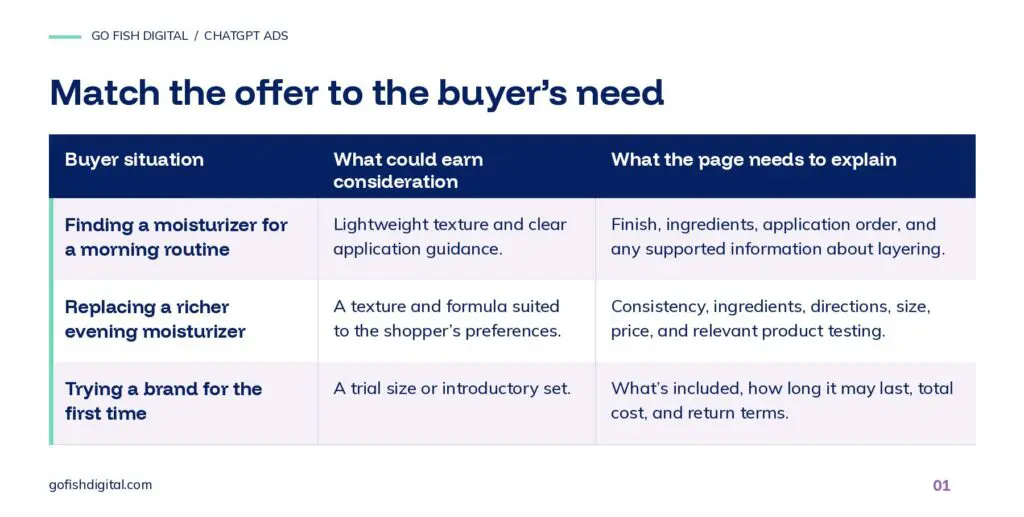
For the morning-routine shopper, texture, finish, and application guidance could determine the choice. Someone trying the brand for the first time may care more about a trial size, what’s included, and return terms.
Before building ads, review customer questions, product reviews, support tickets, and return reasons. Look for the details people repeatedly need before purchasing.
Then connect each situation to a message, supporting evidence, and destination. An ad about a trial set should lead to a page that explains the set. An ad about a specific formula should make that formula easy to evaluate.
OpenAI’s context hints let advertisers describe when an offer may be relevant. They guide matching; they don’t guarantee placement in a particular conversation.
Keep the message within what the product and its evidence support. A shopper’s concern doesn’t give the brand grounds to promise a treatment outcome or assume the product will suit everyone.
Check the information behind the promise
“Start with your website because you can control it,” says Patrick Algrim of Go Fish Digital.
For our moisturizer shopper, that means checking more than whether the page says “lightweight.” Can they find the full ingredient list? Does the page explain the finish and application? Are product images showing the texture, or only the packaging?
A page can describe a product accurately and still omit the detail that determines the purchase.
Before launch, follow the ad through to the destination and check:
- The promise. Can visitors quickly find what the ad says they’ll find?
- The product details. Are ingredients, size, directions, texture, and relevant limitations easy to find?
- The evidence. Are claims supported, with enough context to understand what any testing established?
- The purchase terms. Are shipping costs, returns, subscription conditions, and one-time purchase options clear where applicable?
- The path. Do the page, cart, checkout, and redirects work on mobile and desktop?
- The consistency. Do product pages, FAQs, and relevant feeds agree on the formula, price, size, and availability?
Technical access needs checking too. OpenAI’s advertiser guidance explains the crawler access required for reviewing ad destinations.
At Go Fish Digital, Barracuda supports research into related buyer questions and content gaps. Strategists review those findings to decide where an answer belongs.
For a beauty brand, the useful change might be clearer application guidance on a product page, an explanation of a reformulation, or a comparison between two products in the same range. Publishing another skincare article won’t resolve a missing ingredient list at the point of purchase.
Check how AI answers describe your products
Your ad may appear beneath an answer that names another brand. A shopper might also click your ad, read the product page, and return to ChatGPT to ask how it compares.
That makes organic AI visibility useful to examine alongside the paid opportunity. But one answer provides a limited view.
“A single answer does not give you the whole story,” says Ashish Jacob, GEO Search Manager at Go Fish Digital.
Go Fish Digital’s analysis of 4,599 ChatGPT responses explored that issue. The study covered 73 fixed questions asked daily over 63 days for one anonymized client.
In 60% of day-to-day comparisons with previous-day mentions, at least half of those recorded mentions were missing from the following day’s list. Yet the same five names ranked in the top five across both halves of the study.
The study measured recorded mentions, which could differ from the saved answer text. Mentions weren’t necessarily recommendations, and the findings cover one client’s question set. They don’t establish health and beauty category performance, ChatGPT Ads results, or effects on purchases.
For a readiness review, repeat a consistent set of relevant buyer questions and examine three things: whether your product appears, whether the information is accurate, and how it’s presented alongside alternatives.
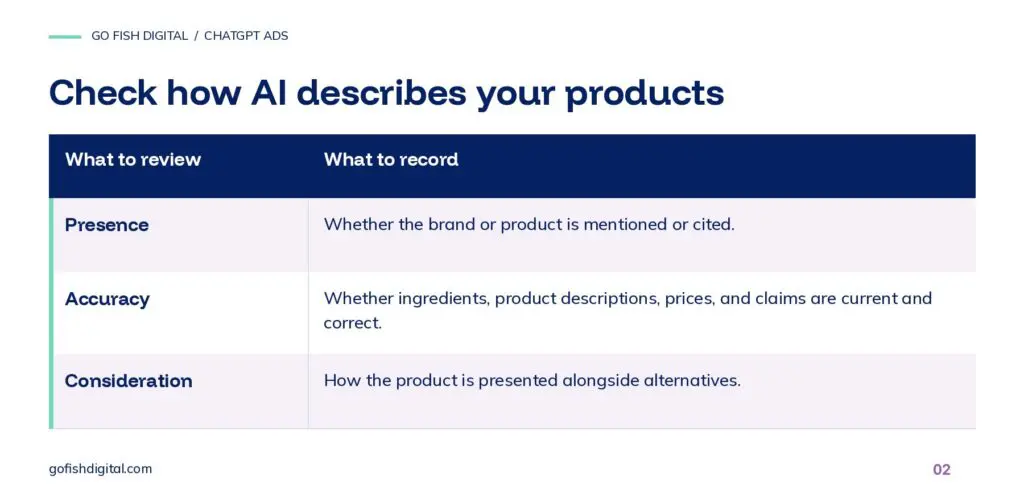
A product might appear frequently while being described using an old formula or a discontinued size. Counting mentions alone would miss that problem.
Record those differences and investigate whether they persist. Paid clicks won’t tell you whether they’ve improved.
For a more detailed review, see how to diagnose whether AI recommends your brand.
Define a worthwhile purchase before judging the test
An introductory offer can generate orders without producing the economics a brand needs.
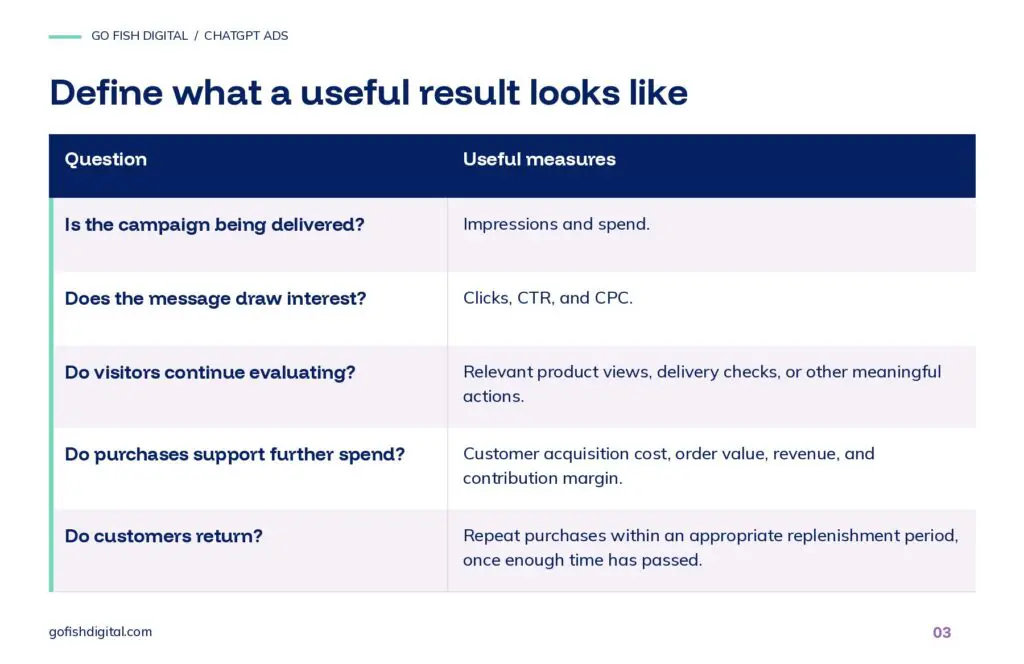
Before launch, decide what would justify another test. That might be first-time customer purchases at an acceptable acquisition cost, orders with sufficient margin, or purchases of a particular product range.
Use supporting measures to investigate performance, from delivery and clicks through to purchases and repeat behavior.
Test tracking parameters and conversion events before spending. OpenAI provides guidance on conversion measurement through its Pixel and Conversions API.
If the offer includes a subscription, distinguish the initial purchase from later retention. A discounted first order doesn’t establish that someone will remain a subscriber.
Agree on the channel’s intended contribution before reallocating budget. Brooke Osmundson makes that point in her Search Engine Journal analysis of questions to answer before shifting spend to ChatGPT Ads.
Know what would make you launch, fix, or pause
Readiness isn’t a total score. A checkout problem or an unsupported product claim can matter more than several completed setup tasks.
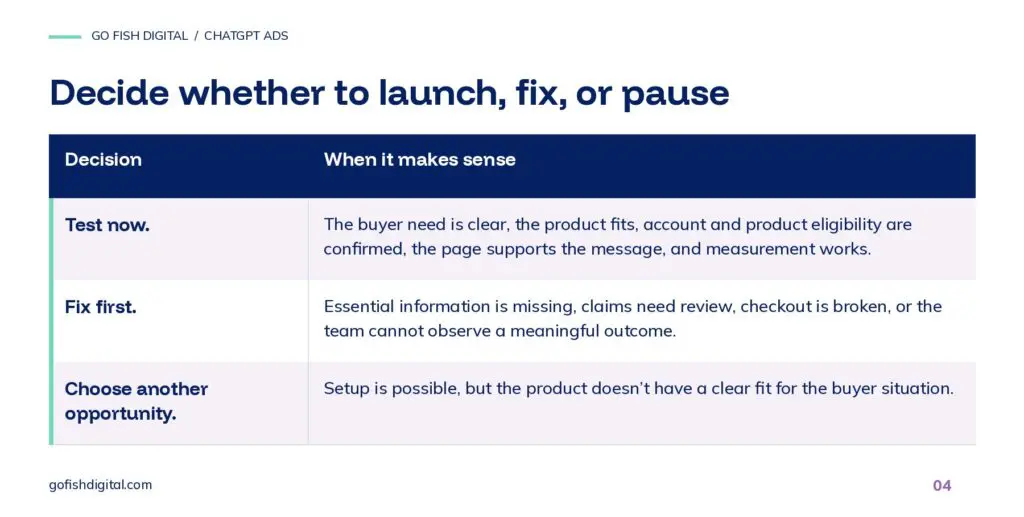
You’re ready to test when the buyer need is clear, the product fits, eligibility is confirmed, the destination supports the message, and measurement works. Missing information or broken tracking needs fixing first. If the offer doesn’t suit the buyer situation, choose another opportunity.
Keep the first test focused: one product or collection, a few distinct buyer situations, a budget limit, and a review date that fits the expected purchase volume.
If shoppers click but rarely add to cart, inspect the expectation created by the ad and what they find on the page. If they add to cart but don’t purchase, examine the checkout experience and costs revealed there. Those patterns guide an investigation; they don’t establish the cause on their own.
Assign an owner to the most important gap and record when it will be reviewed. The readiness check should leave the team knowing what happens next.
Common questions about ChatGPT Ads readiness
Does buying ChatGPT Ads improve organic AI visibility?
Buying an ad doesn’t influence ChatGPT’s organic answer. Measure paid campaign performance and organic AI visibility separately.
What should brands fix before launching ChatGPT Ads?
Address missing product information, unsupported claims, inconsistent details, checkout problems, and incomplete measurement. Confirm current product and account eligibility before planning the campaign.
How should a DTC brand assess ChatGPT Ads readiness?
Check whether you have a clear buyer need, a suitable product, an eligible account, a useful landing page, working purchase measurement, and a decision rule for expanding, revising, or pausing the test.
Get a clearer view before launch
Go Fish Digital can help you review how your brand appears in AI answers, identify gaps in the information shoppers need, and plan a focused ChatGPT Ads test.
Request an AI Visibility Audit to understand where your brand stands and what to address first.
