



Online Reputation Management Checklist for Q1 2027

Published: September 28, 2026
Share on LinkedIn Share on Twitter Share on Facebook Click to print Click to copy url
Summarize with ChatGPT

People researching your brand have more places to look than they did even a year ago. They can search your name, read reviews, compare you with competitors, check Reddit, or ask an AI assistant whether your company is reputable and worth considering.
That makes Q4 a good time to see what they’re finding before you head into the new year.
Online reputation management prioritizes how your brand appears across search results, reviews, third-party sites, AI answers, and other places people use to research you. For more background, check out our guide explaining how online reputation management works.
This checklist breaks the work into four phases you can complete over 12 weeks, with a baseline you can use to measure progress in Q1.
Key Takeaways
- Set a baseline before making changes. Capture screenshots of branded search results, review profiles, and AI answers so you know where you’re starting.
- Prioritize what customers are most likely to see. Incorrect information, weak ratings, unanswered reviews, and negative page-one results should move up the list.
- Include AI answers in your reputation audit. Track what AI tools say about your brand, whether it’s accurate, and the sources they use.
- Strengthen the sources shaping your reputation. Keep your own site and profiles current with consistent information and pay attention to third-party sources appearing in search and AI answers.
- Give reputation management an owner and a schedule. Reviews, search results, brand mentions, and AI answers can all change.
- Measure again in Q1. Compare your results with the baseline you captured in Q4.
What Changed in Online Reputation Management This Year
The places people use to research brands online are changing.
According to BrightLocal’s 2026 Local Consumer Review Survey, the percentage of consumers using tools like ChatGPT for local recommendations increased from 6% to 45% year over year. 42% said they trust AI recommendations as much as traditional reviews.
Expectations around reviews have changed too.
The percentage of consumers who require at least a 4.5-star rating increased from 17% to 31%. 68% now expect at least 4.0 stars, compared with 55% the year before.
Recent reviews also carry more weight. 74% of consumers said they only consider reviews written within the last three months, while 32% look for reviews from the last two weeks.
Response time is another factor. 19% expect a same-day response from businesses, up from 6%, and 81% expect a response within a week.
Consumers are also spreading their research across more platforms. The average consumer now uses six review sites. Google’s share of review reading dropped from 83% to 71%, while Apple Maps usage increased from 14% to 27%.

There are compliance considerations as well. The FTC’s Rule on the Use of Consumer Reviews and Testimonials took effect in October 2024, creating federal penalties for practices including fake reviews and certain forms of review manipulation.
For brands, reputation management now means keeping track of what people find across search, reviews, third-party sources, and AI platforms like ChatGPT and Perplexity.
Before You Start: Set Your Reputation Baseline
Before changing anything, document what your reputation looks like today. This gives you something concrete to compare against when you review performance in Q1.
Search your brand name using a logged-out or private session and screenshot the full first page. Record the date, market/location, device, browser, and query. For local brands, repeat the check from each priority market.
You can also score your branded search results by identifying positive, neutral, and negative results and weighting them based on where they appear.
Your baseline should also include AI answers. Ask ChatGPT, Perplexity, Gemini, and Claude the same question, such as:
“Is [brand] reputable?”
Save the answer and record any citations or source links shown; if none are shown, note that the response was uncited. If a Google AI Overview appears for a relevant branded query, capture that too.
For review platforms, record your current star rating, number of reviews, date of the most recent review, and typical response time.
Here’s what a simple baseline could look like:

Make the baseline specific and dated. That way, when Q1 ends, you can see exactly what changed.
Phase 1: Audit What’s Actually There, Weeks 1–2
Use the first two weeks to get a complete picture of what’s showing up before deciding where to spend your time.
Capture Your Branded Search Results
Search for:
- Your brand name.
- Your brand name + “reviews.”
- Your brand name + “complaints.”
- Your brand name + “scam.”
- Your top executives.
- Your core products or services.
Capture the first two pages of results. Someone seriously researching a company may go beyond page one, especially if they’re looking for reviews or potential problems.
Check Google Autocomplete suggestions for your brand name and People Also Ask results. Note the sources Google uses to answer questions about your company.
Flag anything negative, inaccurate, outdated, or associated with another business with a similar name.
Audit What AI Assistants Say About Your Brand
AI tools can surface different information about the same company, and that information isn’t always current or accurate. Running the same questions across several tools makes those differences easier to spot.
Try prompts such as:
- “What does [brand] do?”
- “Is [brand] reputable?”
- “[brand] vs. [competitor].”
- “Best [category] in [location].”
Run the prompts across ChatGPT, Google AI Overviews when available, Perplexity, Gemini, and Claude.
For each answer, document:
- What the platform says about your brand.
- Whether the information is accurate.
- Which sources appear in or support the answer.
Pay particular attention to outdated leadership information, incorrect services, old pricing, wrong locations, or confusion with similarly named businesses.
The sources are useful too. If third-party sites repeatedly appear when AI systems describe your company, add them to your audit. Also note whether your own website appears.
AI outputs can vary based on the wording of the question, location, session, available sources, and when you run the query. Use the same core prompts each time so your monthly checks are easier to compare.
Inventory Your Review Surfaces
Review activity doesn’t stop at Google.
Depending on your business, customers may also use Facebook, Yelp, Apple Maps, Tripadvisor, BBB, G2, Healthgrades, Angi, Houzz, Avvo, Glassdoor, Indeed, or other industry-specific platforms.
For each relevant profile, record:
- Star rating.
- Number of reviews.
- Date of the most recent review.
- Whether the profile is claimed.
- Typical response time.
BrightLocal found that 47% of consumers won’t use a business with fewer than 20 reviews.
We’ve also covered some of the less obvious places your brand reputation is being shaped that you probably aren’t checking.
Set Up Brand Alerts
Set up monitoring during the audit so you’re collecting information while you work through the rest of the checklist.
Free tools such as Google Alerts and Talkwalker Alerts can cover basic brand mentions. Paid options include Brand24, Sprout Social, Semrush Brand Monitoring, and Ahrefs Alerts.
Consider monitoring:
- Your brand name.
- Common misspellings.
- Executive names.
- Product names.
- “[Brand] review.”
- “[Brand] complaint.”
- “[Brand] lawsuit.”
- “[Brand] alternative.”
It also helps to centralize notifications so the person responsible for monitoring doesn’t have to check several dashboards every day.
Automated alerts won’t catch every mention. Reddit threads, forums, untagged social posts, closed communities, and video reviews can be easy to miss, so include a manual check in your monthly process.
Benchmark Three Competitors
Run the same search and AI audit for your three closest competitors.
Pay attention to where they appear that your brand doesn’t. This might include publications, directories, comparison pages, review sites, or sources cited in AI answers.
Add those sources to your list for Phase 3. You’ll have a much more relevant set of targets based on what’s already visible in your market.
It’s also worth comparing review counts and ratings. A 4.2-star rating can mean something very different in a category where competitors average 3.8 than in one where everyone else is above 4.7.
Phase 2: Fix the Highest-Cost Problems First, Weeks 3–6
By the end of the audit, you’ll probably have a long list of things you could address. Give each issue a score so the most important ones rise to the top.
Score Reputation Problems
Score each issue from one to three across four factors:
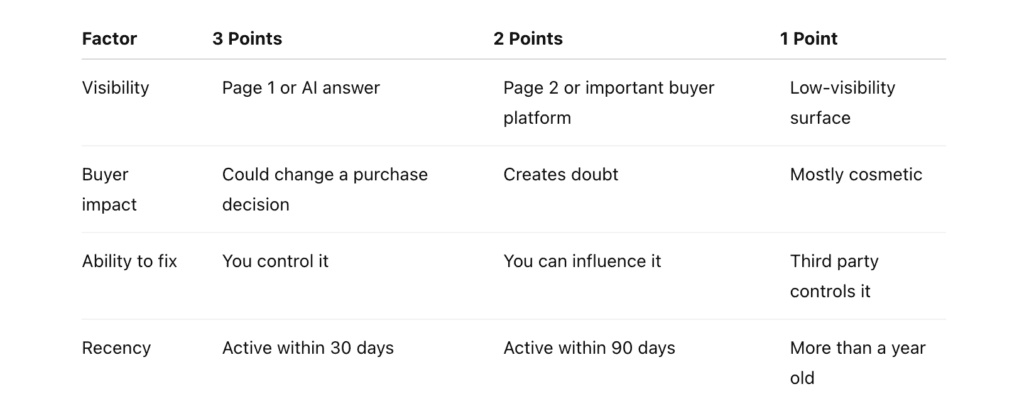
Add the scores together. Anything scoring 10 or higher should be addressed first.
This gives your team a consistent way to prioritize issues based on visibility, impact, and what you can realistically change.
Correct Inaccurate Brand Information
Review the basic information customers and platforms use to identify your business:
- Business name.
- Address.
- Phone number.
- Hours.
- Business category.
- Founding year.
- Leadership information.
Keep these details consistent across your site and third-party profiles.
Important company information should also appear as regular text on your website rather than being available only inside images or PDFs. Verify your Organization schema and claim any relevant profiles that are still unclaimed.
Clear Your Review Response Backlog
Review responses affect how potential customers interpret feedback about your company.
BrightLocal found that 80% of consumers are more likely to use a business that responds to all reviews, while 42% are unlikely to choose one that never responds.
Responses should reflect what the customer actually said. Half of consumers said generic or templated replies make them less likely to choose a business.
For a negative review, acknowledge the specific concern without getting into a public argument. Give the reviewer a clear way to reach someone who can help and move any detailed resolution offline.
Be careful about including customer, client, or patient information in public responses.
Once you’ve worked through older reviews, set an internal response-time goal. Twenty-four hours is a reasonable standard for many teams.
Address Ratings Below 4.0
Sixty-eight percent of consumers in BrightLocal’s 2026 survey said they would only use a business with at least four stars.
Look first at important profiles that fall below that threshold. Calculate how many additional reviews you’d need to improve the average, then work backward to a realistic weekly review-request goal.
Review requests work best when they’re connected to a real customer interaction, such as a completed purchase, service, or appointment. Email and SMS automation can help make the process consistent.
The platform you prioritize should depend on where the gap exists. If your Google profile is healthy but another platform customers frequently use is weak, that platform may deserve more attention.
Make sure any review-request process follows the rules of the platform you’re sending customers to.
Phase 3: Strengthen the Sources People Find, Weeks 7–10
The first two phases should give you a good picture of the information people encounter when researching your brand. Now you can work on the gaps.
Improve the Pages Customers Need
Go back to the questions and inaccuracies you found during the audit.
Can someone easily find accurate information about:
- What your company does?
- Who you serve?
- How pricing works?
- Who leads the company?
- Where you operate?
- Your policies or services?
Make sure important pages answer those questions clearly and early.
Your About page, leadership pages, product or service pages, and FAQs are worth reviewing regularly because they contain many of the basic facts other sources may use when describing your company.
Update existing pages when information changes. Old leadership, pricing, product, or location information can continue showing up long after your business has moved on.
Complete Important Third-Party Profiles
Review the third-party sites that appeared during your audit.
Depending on your business, that could include LinkedIn, Crunchbase, industry directories, professional associations, marketplaces, or review platforms.
Complete the profiles that customers actually use and keep basic company information consistent across them.
Where the platform allows it, link back to the most relevant page on your site.
Focus Outreach on Sources Already Showing Up
Your Phase 1 audit should have given you a list of publications, directories, comparison sites, and other third-party sources appearing for your brand, your competitors, or relevant AI questions.
Use that list to guide outreach.
Industry interviews, original research, useful expert commentary, and contributed articles can all create additional sources that explain who you are and what you do.
Prioritize sites that are relevant to your customers and already visible in your category.
Phase 4: Build a Repeatable Process, Weeks 11–12
Use the final two weeks to decide how you’ll keep track of your reputation once Q1 starts.
Assign Owners and a Cadence
A simple schedule could look like this:
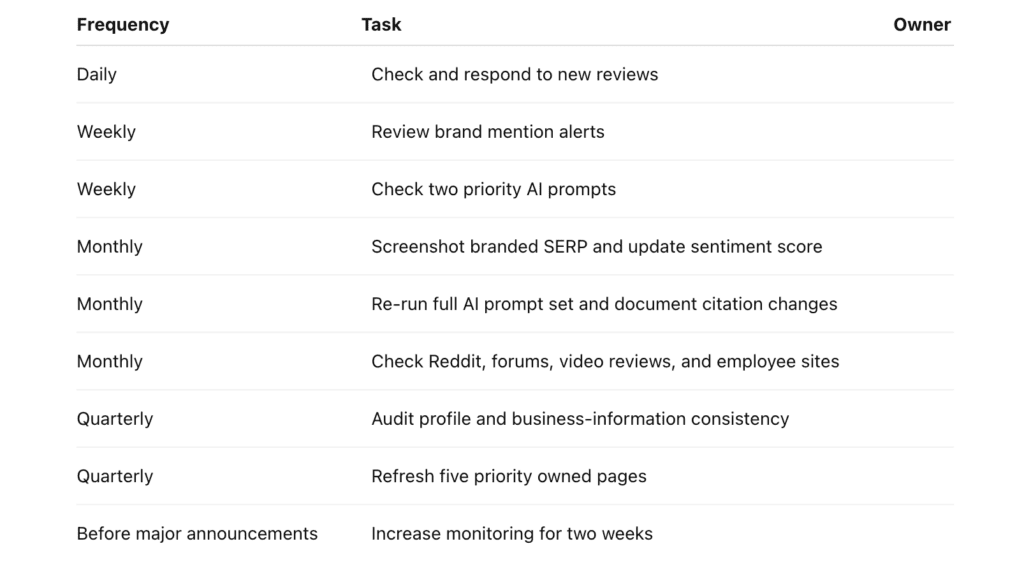
Fill in the owner column before you’re finished. It should be clear who is responsible for each task and how often it needs to happen.
Create a Crisis One-Pager
Document the basics of how your company will respond if a reputation issue develops:
- Who needs to know.
- Who decides whether a public response is necessary.
- Who approves statements.
- Who has access to important platforms.
- How scheduled marketing can be paused.
- What information a holding statement needs to contain.
Include the places where issues tend to surface early in your industry. Reddit, Glassdoor, TikTok, industry forums, review platforms, or another community may give you an earlier signal than a general brand alert.
Having this documented ahead of time means the team can spend its time dealing with the actual issue instead of figuring out who has the password or who needs to approve a response.
Set Your Q1 Reputation KPIs
Finish by recording the metrics you’ll review in Q1.
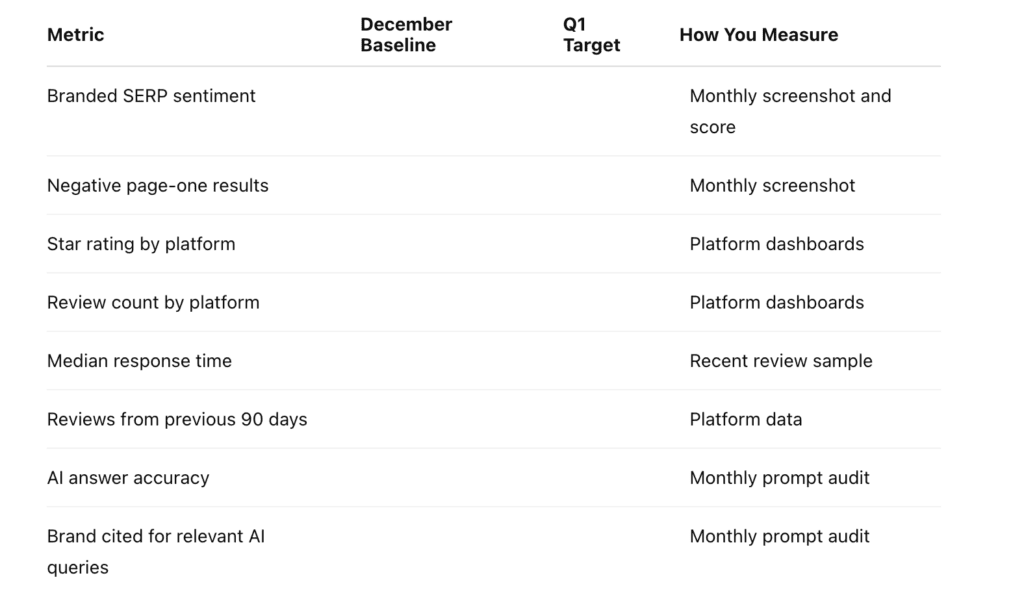
The AI metrics make it possible to track something more useful than a general idea of “AI visibility.” You’re looking at whether information about the company is accurate, whether that changes over time, and which sources continue to appear.
How This Checklist Changes by Business Type
The same general process works across businesses, but the surfaces that deserve the most attention will vary.
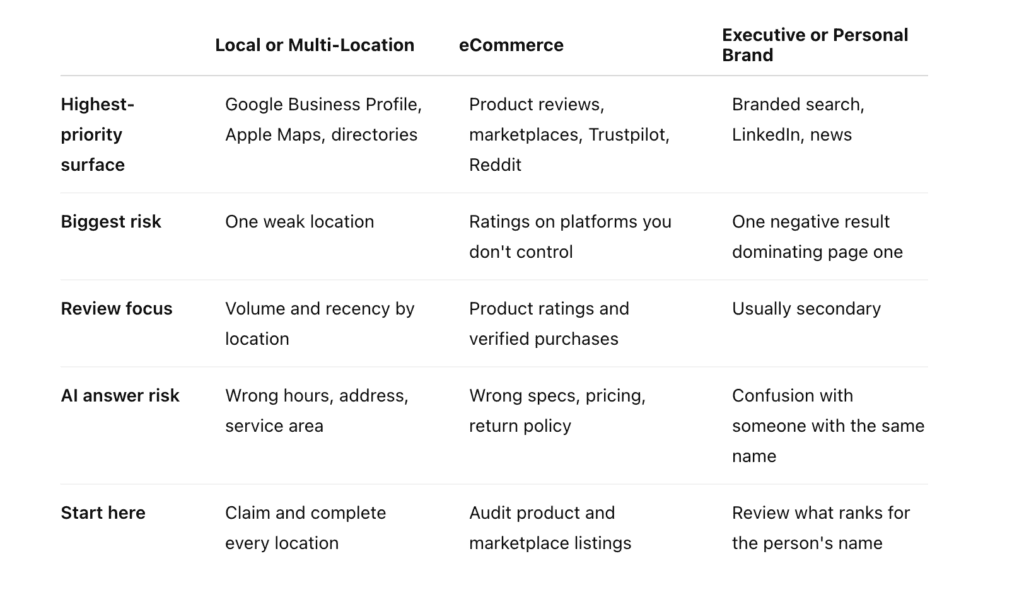
Multi-location businesses should look at individual locations as well as the companywide average. A strong overall rating can hide a location that’s creating problems.
For eCommerce brands, product reviews and marketplace listings often sit on platforms the brand doesn’t directly control. That makes it especially important to understand which third-party sources customers are seeing.
Executives and personal brands usually have a different problem. Search results for the person’s name, news coverage, LinkedIn, and possible confusion with people who share the same name tend to matter more than traditional customer reviews.
Common Online Reputation Management Mistakes
Treating ORM as review management. Reviews matter, but customers may also encounter search results, news coverage, Reddit discussions, employee sites, third-party profiles, and AI answers while researching a company.
Adding reviews without looking at the rating. If an important profile is sitting at 3.6 stars, calculate what it would take to improve the average and build your review plan around that.
Only responding when someone leaves a negative review. Consistent responses show that the company is paying attention to customer feedback overall.
Using the same review response every time. Templates can give your team a starting point, but the response should reflect what the reviewer actually said.
Letting reviews get stale. A profile may have hundreds of reviews and still look inactive if very few are recent.
Reporting negative reviews that don’t violate a policy. Check the platform’s rules before flagging a review and document the specific policy you believe it violates.
Checking your reputation once a year. Reviews, branded search results, third-party coverage, and AI answers can all change throughout the year.
Leaving AI monitoring without a clear owner. Add the prompts that matter to your brand to the same monitoring process you use for search and reviews.
What You Can and Can’t Do When Asking for Reviews
The FTC’s Rule on the Use of Consumer Reviews and Testimonials took effect October 21, 2024.
The rule prohibits practices including buying or selling fake reviews, paying for reviews conditioned on positive or negative sentiment, certain undisclosed insider reviews, and suppressing legitimate negative reviews.
Businesses can ask customers to share an honest review.
If an incentive is involved, it can’t be expressly or implicitly conditioned on the review being positive or receiving a particular star rating. Depending on the circumstances, the relationship may also need to be disclosed under the FTC’s Endorsement Guides.
Individual platforms have their own requirements too. Google and Yelp, for example, have different rules around review solicitation, and both prohibit incentivized reviews.
Check the policies of each platform included in your review-request process before automating it.
The FTC’s maximum civil penalty is currently $53,088 per violation, although courts consider statutory factors and can impose lower penalties.
This isn’t legal advice. Questions about whether a specific review program complies with federal law or platform requirements should go to qualified counsel.
Frequently Asked Questions
How long does it take to improve your online reputation?
Some reputation metrics can change fairly quickly. Review response times and new review activity can improve within weeks. Changing the results that appear on the first page of a branded search usually takes longer, often several months, because those results depend on what search engines choose to rank.
Can you get a negative Google review removed?
Google may remove a review if it violates its content policies, including certain forms of fake engagement, harassment, conflicts of interest, or off-topic content. A legitimate negative opinion usually won’t qualify for removal. In those cases, the business can respond publicly and try to resolve the underlying issue with the customer.
Is it legal to offer customers a discount for a review?
Federal rules allow incentives for reviews in some circumstances, but the incentive can’t depend on the customer leaving a positive review or particular star rating. Disclosure requirements may also apply. Platform policies can be stricter. Google Maps and Yelp prohibit incentivized reviews, so businesses shouldn’t use incentive-based review offers on those platforms.
How do I find out what ChatGPT or Google’s AI Overview says about my business?
Run a consistent set of questions about your brand across AI tools. Include your brand name, “Is [brand] reputable?”, competitor comparisons, and relevant category questions. Record what each tool says, whether the information is accurate, and which sources appear. Repeat the same audit regularly so you can see how the answers change.
How many reviews does a business need?
There isn’t one review count that works for every business. BrightLocal found that 47% of consumers won’t use a business with fewer than 20 reviews, while 74% only consider reviews from the previous three months. Look at volume, recency, rating, and what customers expect in your category.
What’s the difference between online reputation management and SEO?
SEO focuses on improving organic search visibility to attract relevant traffic and conversions. Online reputation management focuses on what people find when researching a specific brand, including branded search results, reviews, third-party coverage, and AI answers. The two often use similar content and search tactics, but they’re measured differently.
Should you handle reputation management in-house or hire an agency?
An in-house team can manage reputation when the number of platforms and reviews is reasonable and the brand isn’t dealing with a significant search or reputation issue. Outside support can help when negative results are prominent, multiple locations need monitoring, a crisis is active, or the team needs deeper analysis of search and AI visibility.
Looking for Online Reputation Management Support?
This checklist is workable for an in-house team, but a thorough audit can get complicated when search results, review platforms, third-party sources, and AI answers all show something different.
Go Fish Digital’s online reputation management services help brands understand what’s shaping their reputation across search and AI and where they should focus first.
About Bari Eisenberg
As Director of SEO at Go Fish Digital, Bari brings more than 12 years of experience across SEO and online reputation management. She leads SEO strategy for clients ranging from local businesses to international brands, with expertise in technical SEO, content strategy, AI search and generative engine optimization, competitive analysis, and data analysis. Her work focuses on connecting organic search strategy to broader marketing and business goals.
Outside of work, she competes in Hunter/Jumper horseback riding competitions along the East Coast.