




Demand Shaping in Social Commerce: What Brands Are Missing

Published: September 17, 2026
Share on LinkedIn Share on Twitter Share on Facebook Click to print Click to copy url
Summarize with ChatGPT

Most creator programs I see struggling aren’t short on creators. They’ve usually got plenty. What they’re missing is a shared story for those creators to tell.
Brands tend to focus on two parts of social commerce: generating demand through ads and creators, then capturing it through a shop, product page, or retargeting campaign. But there’s an important layer between the two.
Someone has to shape what customers understand about the brand before they’re ready to buy.
Demand shaping is the process of creating a consistent brand story across paid, organic, affiliate, retail, email, and other channels before a customer reaches the point of purchase.
Without it, brands can put more creators, content, and media into market without necessarily making the overall program more effective.
What Is Demand Shaping?
Demand shaping is the messaging architecture underneath everything a brand puts into market.
It includes the brand’s point of view, the messages customers need to understand, and the creative guardrails that keep those messages consistent regardless of who’s creating the content.
A creative brief might guide a single asset or campaign. Demand shaping gives all of those assets a common foundation.
Over time, that consistency influences what customers remember about the brand, what they trust, and what they prefer when they’re ready to buy.
What Happens When Brands Skip Demand Shaping?
The cost of inconsistent messaging rarely shows up neatly in one report.
Instead, it appears across the business. Acquisition costs increase because each campaign has to reintroduce the brand. Branded search can remain weak. Creators struggle to explain what makes the product different. Samples go out without producing enough useful content or sales.
Each problem can look relatively small on its own. Together, they make the entire program less efficient.
There’s also broader evidence that relevance matters. McKinsey found that faster-growing companies generate 40% more of their revenue from personalization than slower-growing companies.
For social commerce teams, consistent messaging is part of creating that relevance.
Why Demand Shaping Matters for Affiliate and Creator Programs
Affiliate programs tend to expose the problem quickly.
Brands often scale the number of creators before they’ve clearly defined what those creators should communicate. Every creator is left to figure out the angle, what to emphasize, and how to explain the product.
Across a handful of creators, that may not seem like a major issue. Across hundreds, the brand can end up with hundreds of slightly different stories in market.
Adding more creators won’t solve that problem.
Before increasing volume, brands need a clear story creators can understand, adapt, and repeat in their own voice.
What Happens When You Shape Demand First?
We took this approach with a wellness brand launching on TikTok Shop.
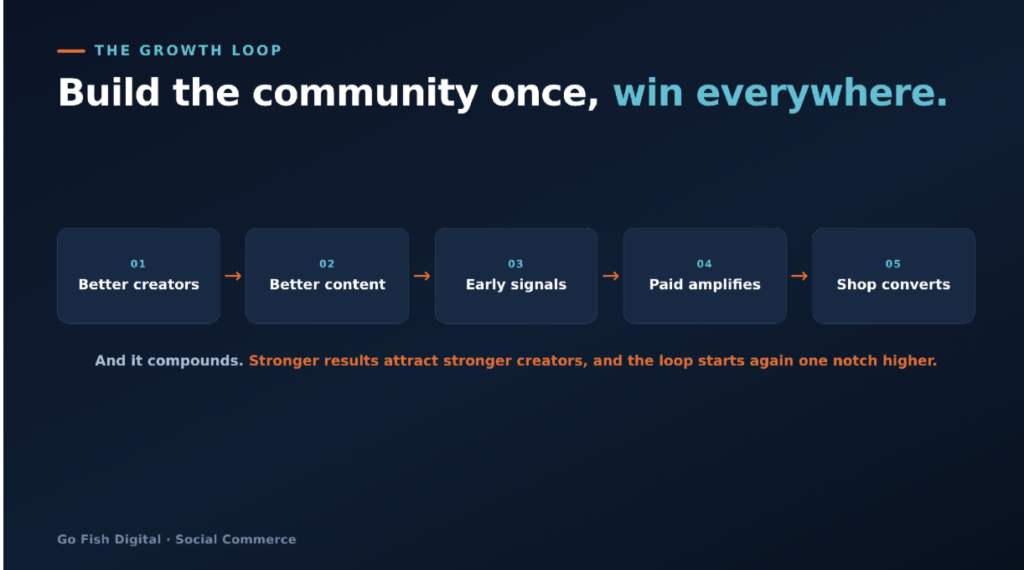
Rather than immediately opening affiliate and sending samples at scale, we spent the first month building the foundation. We hand-picked creators, developed an ambassador network, created structured briefs, used retainer pay, and got genuine creator content into market before pushing for sales.
Then we opened affiliate to many of the creators we’d already been working with.
Over nine months, affiliate GMV grew roughly 36x from month one, while GMV per sample increased from about $12 to $180.
The improvement didn’t come from sending dramatically more product. It came from giving samples to creators who already understood the brand and knew how to talk about it.
We’ve seen a similar pattern with a leading supplement brand. Once the messaging and creator strategy were established, the brand generated more affiliate GMV while sending 55% fewer samples.
That matters when you’re evaluating the economics of a creator program. More creators and more samples aren’t necessarily the answer. Better output from each creator can be far more valuable.
How Demand Shaping Can Support Conversion and LTV
Demand shaping often gets categorized as a branding exercise, but its impact goes further.
When customers encounter the same core message across creators, ads, search, retail, and the product experience, there’s less work left to do at the point of conversion.
The impact can also cross platforms. Someone might first encounter a product on TikTok, search the brand later, read reviews, see a retargeting ad, and eventually purchase through another channel.
If you’re only measuring TikTok’s contribution inside TikTok, you’re likely missing part of the picture.
That’s why demand shaping should ultimately be evaluated against broader business signals, including branded search, conversion, creator efficiency, repeat purchases, and lifetime value.
How to Start Shaping Demand
You don’t need a six-month brand exercise before launching a social commerce program.
Start by getting three things clear:
- Your brand’s point of view.
- The two or three messages most likely to matter to your customer.
- The creative guardrails creators and paid media teams need to tell a consistent story.
Once those are established, you can scale creator volume and media behind them.
Frequently Asked Questions
What Is Demand Shaping in Social Commerce?
Demand shaping is the messaging architecture, brand point of view, and creative guidance that keeps paid, organic, affiliate, retail, and other channels reinforcing the same core story.
Why Does Demand Shaping Matter for TikTok Shop?
TikTok Shop relies heavily on creator content and product discovery. Clear messaging gives creators a stronger foundation for explaining the product while helping the brand maintain consistency as its creator program grows.
How Is Demand Shaping Different From a Creative Brief?
A creative brief usually guides a specific asset or campaign. Demand shaping establishes the broader story that individual briefs and assets should reinforce.
Does Demand Shaping Only Apply to TikTok?
No. Customers move between social platforms, search, retail, reviews, websites, and other touchpoints. Demand shaping helps maintain a consistent message across those interactions.
How Do You Measure Demand Shaping?
Look beyond channel ROAS. Depending on the program, useful signals can include branded search, conversion rate, GMV per sample, creator efficiency, retail sell-through, repeat purchases, and customer lifetime value.
Shape Demand Before You Scale
If your affiliate program keeps adding creators and samples without improving efficiency, look at the message before adding more volume.
Go Fish Digital helps brands build social commerce programs that connect creator strategy, affiliate, paid media, and TikTok Shop around a clearer customer story.
About Cole Mancini
Cole Mancini is a social commerce and creator marketing leader with deep experience building strategies that turn social influence into measurable business growth. As VP of Social Commerce at Go Fish Digital, she leads the agency’s social commerce practice across TikTok Shop, creator and affiliate marketing, and content, while collaborating closely with paid media teams to connect creative, commerce, and performance strategy. Her background spans agency leadership, entrepreneurship, and scaling high-growth teams and programs, giving her a unique perspective on the evolving intersection of social, performance marketing, and commerce.