

How to Diagnose Whether AI Actually Recommends Your Brand (Step-by-Step GEO Audit)

Published: August 20, 2026
Share on LinkedIn Share on Twitter Share on Facebook Click to print Click to copy url

You did everything right for classic SEO: targeted the right keywords, earned solid backlinks, and kept your technical setup clean. Yet when a buyer asks an AI assistant what to choose, your brand doesn’t make the cut—or worse, a competitor gets the recommendation and the link. This is the moment many teams realize that ranking and being recommended are now two different outcomes.
This article turns a core slice of our on‑demand workshop, The GEO Gap: How to Diagnose What’s Hurting Your AI Search Visibility, into a practical self-serve process. You’ll learn how to test whether AI actually recommends your brand, score the answers with a simple framework, find out why competitors get cited instead, and measure your AI Share of Voice so you can track progress over time.
Key Takeaways
- Start fresh, logged‑out sessions in ChatGPT, Gemini, Claude, Perplexity, and Copilot, then run a broad “best [category]” query and a specific buyer‑need prompt to see if, how, and where your brand appears.
- Score each response for appearance, recommendation strength, link or citation, head‑to‑head win, and description accuracy, then use the total (5, 4, 2–3, 0–1) to gauge urgency and prioritize fixes.
- Build a prompt library, run it across AI tools, count brand recommendations to compute your AI Share of Voice percentage, and use LLM mention‑tracking tools like Loamly, Peec AI, Otterly AI, or Semrush to monitor over time.
Part 1: Workshop — See How AI Treats Your Brand
Step 1: Start with a clean conversation
Open ChatGPT, Gemini, Claude, Perplexity, or another AI assistant.
Use temporary chat, private mode, or a new account session where possible. This limits the influence of your previous conversations, brand history, and personalization.
You want the model’s view of the market, not its view of you.
Step 2: Ask the broad category question
Use this prompt and record whether your brand appears:
“What are the best [products or services in your category]?”
Examples:
- What are the best vegan skincare products for acne-prone skin?
- What are the best protein powders that have a mint chocolate flavor?
- What are the best car insurance companies if you have bad credit?
Step 3: Add the real customer problem
Now ask a follow-up using the same category, but add the type of detail a real buyer would include:
“We are/I am a [type of customer] dealing with [specific problem or constraint]. What [product or service] should we/I look at?”
Example:
“We are a club soccer team working with a limited budget. Which companies should we consider for printing our uniforms?”
The list may change once the assistant has to solve a specific problem. That change is the point of the exercise.
Step 4: Score the answer
Do not stop at whether your brand appeared. Review the answer using these five checks:
1. Do you appear? Is your brand included in the answer at all?
2. Are you picked? Is your brand actually recommended, or is it only one name in a longer list?
3. Do you get the link? Does the mention include a clickable link or citation to your website?
4. Do you win the head-to-head? Choose one competitor from the answer and ask:
“Compare [your brand] and [competitor]. Which one would you recommend for [specific customer need]?”
5. Are you described correctly? Check whether the answer accurately describes your products, services, audience, pricing, features, and positioning. Flag anything outdated, incomplete, or incorrect.
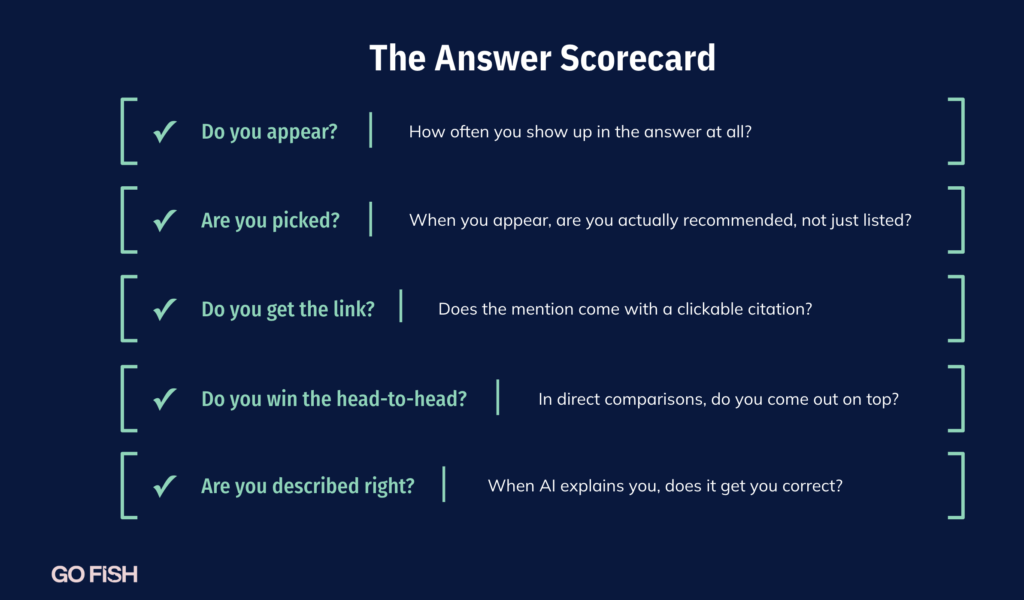
| Five checked – No action: You appear, are accurately described, and are being recommended. Four checked – A small gap. Worth a quick pass. Two to three checked – A real gap. Work through Part 2. Zero to one checked – Your brand is effectively invisible in this AI answer. Prioritize it with Part 2. |
Step 5: Repeat the test
One answer is not enough to establish a pattern. AI responses can change between platforms and between runs.
Repeat the test:
- In at least two different AI assistants.
- More than once using the same prompt.
- With both a broad category question and a specific customer problem.
- With at least one direct competitor comparison.
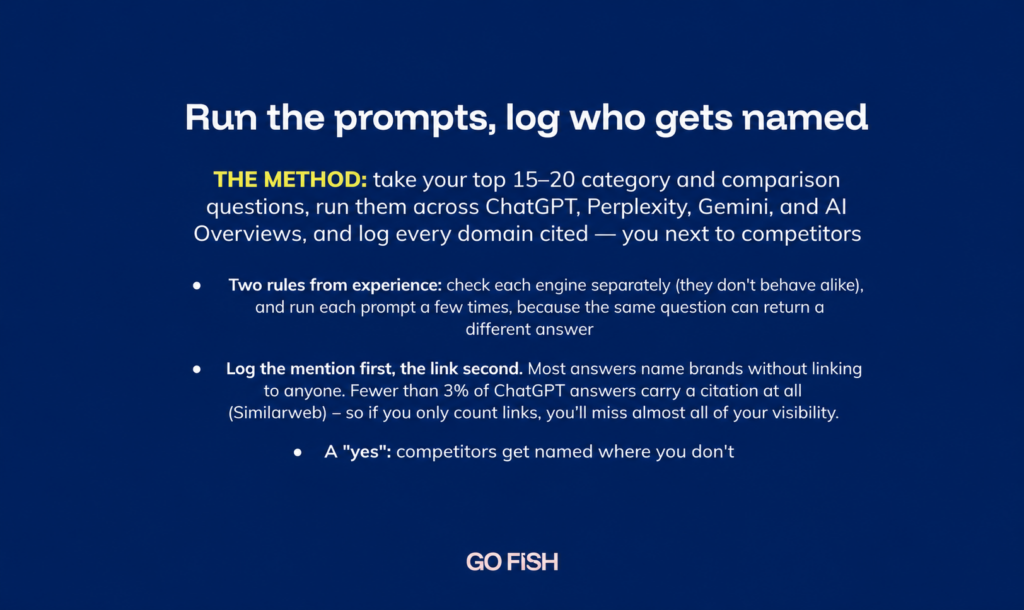
Track which brands appear, which ones get recommended, whether they receive a link, and how they are described.
You are not trying to find a fixed AI ranking. You are looking for patterns in where your brand appears, where it disappears, and where competitors are consistently winning.
Part 2: Compare — See Why the Cited Source Won
If Part 1 showed that a competitor was recommended instead of you, received the link, or appeared when your brand did not, the next step is to understand why.
This diagnostic assumes the baseline AI-readiness work, including site structure, technical setup, and digital PR, is already done. If it isn’t, start with our AI Performance Review Checklist first.
Before you dive in, confirm your page is actually eligible to be cited: make sure it loads normally, isn’t hidden behind a login, and has a real webpage version, not just a PDF. If you’re not sure how to check this, ask your web team for help.
Then identify the page AI cited instead of yours. Open it side by side with your own, and work through the checks below.
| Check | What to Compare | If the Cited Source Wins, Fix This |
| Who answered more directly? | Read the first two sentences of your section and the cited source’s, back to back. Which one answers the actual question first? | Move the direct answer to the first sentence of the section; cut the windup before it. |
| Whose evidence was stronger? | Compare the strongest proof point in each: a stat, a named source, a direct quote. Which one is more specific and verifiable? | Replace a vague claim with a specific, sourced proof point, ideally a stat or a named source. |
| Which passage stood on its own? | Read only that one passage with no title, no intro, no surrounding page. Does it still make complete sense on its own? | Rewrite the section so it can stand alone: name the subject directly instead of leaning on “this” or “it.” |
| Which had clearer authority signals? | Check bylines, credentials, publishing entity, and structured data on each page. Which one reads as more authoritative to a machine parsing it cold? | Add author credentials, clarify the publishing entity, or mark up the page with schema. |
| Which was easier to cite? | If you were the AI system, which passage would you rather quote word-for-word? | Tighten the passage into one self-contained, quotable statement instead of a paragraph that needs trimming. |
Freshness matters too:
- Keep time-sensitive details current.
- Show a visible last-updated date.
- Re-run this comparison after any edit.
- Check back on a regular cadence; manual checks are the most direct way to confirm this without dedicated tooling.
Do This at Scale
Go Fish’s AI-powered marketing intelligence platform, Barracuda, runs this type of diagnostic at scale. Barracuda’s Content Similarity module breaks a page into sections, scores how well each one matches what someone is actually asking, and flags precisely where a “ranking” page is falling short, no manual checklist required.
Ready to go beyond the individual tests in this article? Our free GEO Scorecard provides a deeper look at how your brand performs across AI search and helps surface the visibility gaps that could be holding back mentions, citations, and recommendations.
