



How to Build a Scalable Multi-Location SEO Strategy

Published: June 12, 2026
Share on LinkedIn Share on Twitter Share on Facebook Click to print Click to copy url
Summarize with ChatGPT

When customers search for a nearby store, office, clinic, or service provider, they expect the right location to appear quickly with accurate details. For growing businesses, that becomes harder to manage across dozens or hundreds of markets. A single wrong URL, outdated listing, thin location page, or inconsistent business name can create confusion for search engines and customers.
A scalable multi-location SEO strategy creates a repeatable framework for organizing locations, building useful local pages, managing business listings, targeting localized keywords, and tracking results by market.
As search engines place greater emphasis on proximity, business data, and local intent, these fundamentals play an increasingly important role in local visibility and customer acquisition.
Key Takeaways
- Use a subfolder-based architecture (e.g., /locations/state/city/location) with a clear region–city–location hierarchy and purposeful internal linking to consolidate authority, guide crawlers and users, and roll out updates across hundreds of pages efficiently.
- Publish templated yet unique location pages with accurate NAP, hours, directions with embedded Google Maps, local photos and staff bios, location-specific FAQs, optimized titles/H1s/meta, internal links, LocalBusiness schema, and a minimum of 400–600 words of useful local content.
- Create and verify a separate Google Business Profile with a unique local phone number for each branch, fully optimize categories, descriptions, photos, services, and attributes, link to the matching location page with UTM-tagged URLs, and maintain consistency via bulk spreadsheet uploads or the Google Business Profile API synchronized with on-site NAP and other listings.
How Search Engines Understand Multi-Location Businesses
Search engines evaluate individual pages, but they also look at how those pages connect to the larger business. For multi-location brands, that means each location page needs to support a clear relationship between the main brand, the services or products offered, and the specific market that location serves.
Site architecture, internal linking, and consistent business data help reinforce those relationships. Together, they show search engines which pages represent the overall brand, which pages explain core offerings, and which pages are tied to specific locations.
Key signals search engines use to understand multi-location businesses include:
- Brand entity vs. location entity: The main brand builds overall authority, while each location confirms a distinct local presence.
- Product and service relevance: Location pages should make it clear which services or products are available in that specific market.
- Proximity and local relevance: Search engines use location data to determine which business result is most relevant to a nearby user.
- Connected page relationships: Links between location hubs, city pages, service pages, and individual location pages help clarify how the business is organized.
- Consistent business data: Matching names, addresses, phone numbers, hours, and URLs across location pages and listings build trust.
- Clear hierarchy: A logical structure makes it easier for search engines to interpret the brand’s footprint and understand which page should rank for each market.
Recommended Site Structure for Multi-Location Businesses
For businesses with multiple physical locations, a hub-and-spoke structure is usually the most scalable approach. The hierarchy may vary based on how many locations the business has and how concentrated they are in certain regions, but the goal is the same: create a clear path from broad location discovery to specific local destination pages.
The Locations Hub Page
The locations hub is the top-level discovery page for the brand’s local footprint. This is typically a page like “Our Locations” or “Find a Location,” and it should help users quickly find the right office, store, clinic, or branch. For search engines, this page creates a central place to understand that the business serves multiple markets.
This page also plays an important internal linking role. Because it links down to state, regional, city, or individual location pages, it can help distribute authority throughout the location structure and make deeper local pages easier to crawl. As users move through the hierarchy, the content becomes more specific, helping them navigate from a broad locations overview to the exact office, store, or branch they need.
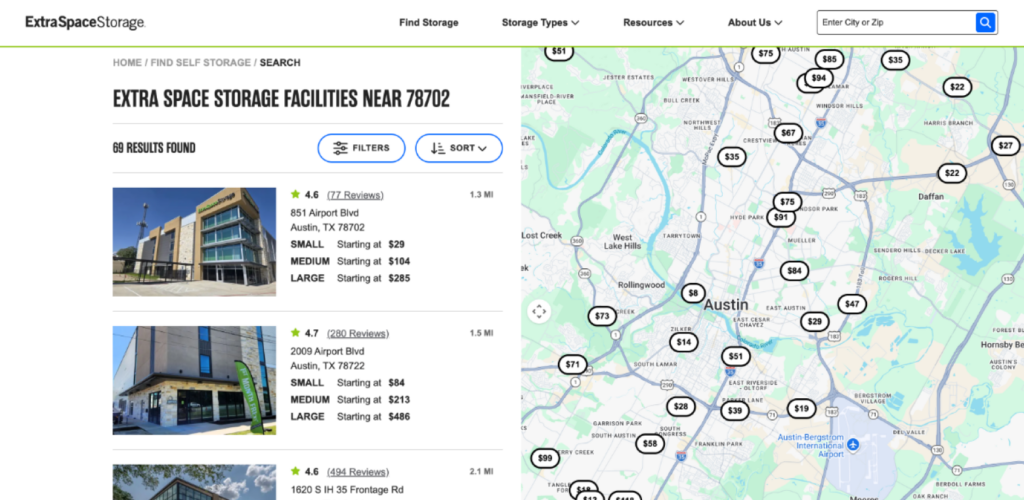
For example, Extra Space Storage’s location finder demonstrates this approach by helping users narrow from a broader market search into individual city-area storage facilities and their corresponding location pages. For businesses with a larger geographic footprint, additional layers such as state, regional, or city-level index pages can further organize these locations and provide more context for both users and search engines.
A strong locations hub page should include:
- A clear overview of where the business operates.
- A regional or national map, when relevant.
- Search or filter functionality for larger location sets.
- Links to all individual locations or to state/city-level index pages.
- Brief supporting copy that explains the brand’s geographic presence.
- Clear calls to action, such as “Find a Location,” “Get Directions,” or “Schedule an Appointment.”
State or Regional Index Pages
Speaking of state or regional index pages, these are useful when a business has enough locations that one main locations page becomes too broad. They create an intermediate layer between the main locations hub and more specific city or location pages.
These pages help organize the site by geography and give search engines more context about how the business scales across different markets. They can also support broader state- or region-level searches when there is enough demand.
A state or regional index page should include:
- Introductory copy about the business’s presence in that state or region.
- Links to relevant city-level pages or individual location pages.
- A supporting map or grouped list of locations.
- State- or region-specific details when useful.
- Internal links back to the main locations hub.
Example structure:
- /locations/
- /locations/north-carolina/
- /locations/north-carolina/raleigh/
- /locations/north-carolina/raleigh/address/
This structure keeps the hierarchy organized and gives each geographic layer a clear role.
City-Level Index Pages
City-level index pages are helpful in dense markets where a business has multiple locations within the same city or metro area. They give users a single place to compare nearby options and help search engines understand how locations are clustered within a specific market.
These pages can also reduce confusion when several nearby locations serve similar searches. Instead of forcing every location page to compete for the same city-level terms, the city page can act as the broader market page while individual location pages target more specific neighborhoods, addresses, or service areas.
A city-level index page should include:
- Introductory copy about the business’s presence in that city or metro.
- Links to all relevant location pages in the market.
- Location summaries with address, hours, or key details.
- A supporting map.
- Neighborhood references where they are genuinely useful.
- Links to relevant services available in that market.
For example, a business with multiple Atlanta locations may use a city-level page for Atlanta and individual pages for Buckhead, Decatur, Midtown, or other nearby areas.
Individual Location Pages
Individual location pages are the primary destination pages for local intent. Each page should give users the information they need to choose that specific location and give search engines enough detail to understand its relevance, proximity, and relationship to the broader brand.
These individual pages should also reflect the actual offerings of that location. If one office offers a specific service, amenity, practitioner, menu item, or appointment type that another does not, that distinction should appear on the page. These details help users make decisions and give search engines more location-specific context.
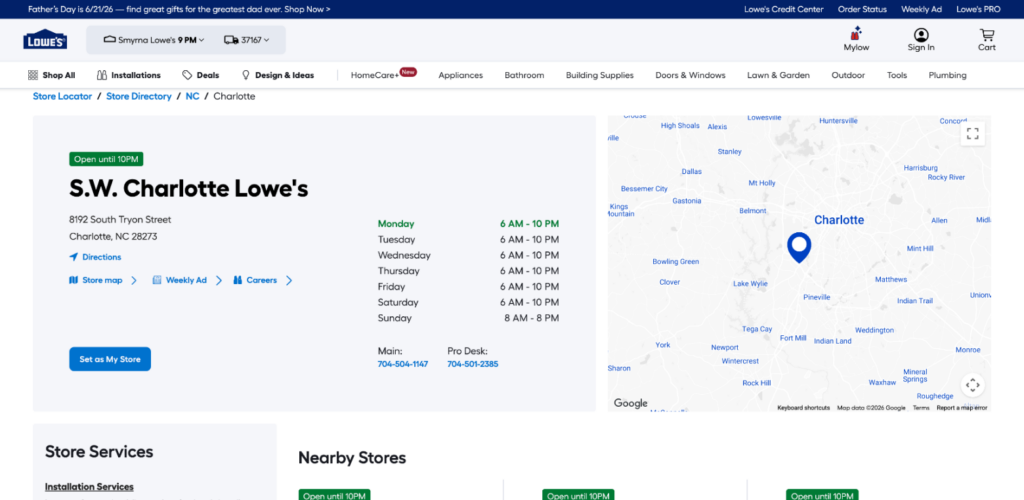
Lowe’s provides a good example of this approach.
Within the same market, individual store pages highlight details that help users choose the most appropriate location. In the example above, the S.W. Charlotte Lowe’s page includes store-specific information such as address, hours of operation, contact numbers, available services, and nearby store alternatives. The page also highlights services available at that location, including installation services and in-store or curbside pickup.
These location-specific details help users determine which store best meets their needs while giving search engines clearer signals about the location’s relevance, offerings, and relationship to nearby stores within the same brand network.
Every individual location page should include:
- Business name
- Exact location name, if relevant
- Full NAP: name, address, and phone number
- Hours of operation
- Get directions functionality
- Embedded map
- Primary phone number for that location
- Unique location-specific title tag and H1
- Core services or products offered at that location
- Details about what makes the location unique
- Local images
- Testimonials or reviews tied to that location
- Staff, practitioner, or team information where relevant
- Location-specific FAQs
- Local business schema
- Clear conversion elements, such as appointment buttons, quote forms, calls, or directions
A strong location page supports both ranking and conversion. It should align with the corresponding Google Business Profile and other local listings, including the same NAP details, business category, hours, and destination URL. This consistency helps reinforce trust across the local search ecosystem.
Keyword Localization for Multi-Location SEO
Once your location hierarchy is in place, keyword localization helps align each page with the searches happening in that market. Multi-location businesses typically target four types of local searches:
- Geo-modified queries (e.g., “dentist in Raleigh”)
- Service or product + location queries (e.g., “emergency dentist Raleigh”)
- Implicit local queries (e.g., “dentist”)
- Near me queries (e.g., “dentist near me”)
These keyword groups should map directly to the location structure you’ve established. Individual location pages typically target the most specific local searches, while city and regional pages can support broader geographic terms.
Location-modified and service + location keywords are often the clearest indicators of local intent because they tell search engines both what the user needs and where they want to find it. Searches such as “storage units in Austin,” “physical therapy Buckhead,” or “dentist in Raleigh” typically align with:
- Individual location pages
- City-level landing pages
- Service + location pages, where appropriate
When targeting these terms:
- Match keyword targets to actual location pages.
- Align keywords with services offered at that location.
- Prioritize markets with meaningful search demand.
For businesses with multiple locations in the same market, more granular targeting can help reduce keyword overlap. For example, a business with several Atlanta-area locations may target neighborhoods such as Buckhead, Decatur, or Midtown rather than having every location compete for the same Atlanta keywords.
Not every local search includes a city name. Queries like “storage units,” “coffee shop,” or “dentist near me” are heavily influenced by proximity and local relevance signals. These searches are not optimized through exact-match keyword usage alone.
Strong performance for implicit local and near me searches is often supported by:
- A fully optimized Google Business Profile
- Accurate and consistent location data
- Proximity to the searcher
- Strong location pages
- Mobile-friendly experiences
Near me visibility is ultimately a product of local relevance and entity alignment, not just keyword placement.
Listings Management for Multi-Location Businesses
Your location architecture doesn’t stop at your website.
Search engines also use business listings across the web to validate location information and confirm that each office, store, or branch is a legitimate local entity. Consistent information across these platforms reinforces the location structure you’ve built on-site and helps strengthen trust, relevance, and visibility in local search results.
For most multi-location businesses, the highest-priority listings include:
- Google Business Profile
- Apple Business Connect
- Bing Places
- Yelp
- Industry-specific directories relevant to your business
These platforms act as reference points across the local search ecosystem. When business information is consistent across listings and location pages, search engines have greater confidence in the accuracy of that data.

As the number of locations grows, listings management becomes less of a setup task and more of a governance function. Maintaining hundreds or thousands of listings requires standardized processes to ensure information remains accurate and aligned across every platform.
Some key best practices include:
- Maintain one master source of truth for NAP and location data.
- Standardize naming conventions across all locations.
- Link each listing to its corresponding location page rather than the homepage.
- Keep hours, services, and attributes updated.
- Use location-specific images whenever possible.
- Regularly audit for duplicate, outdated, or incorrect listings.
The larger the business footprint, the more important governance becomes. Small inconsistencies can quickly multiply across dozens of locations, making it harder for search engines to trust location data and harder for customers to find accurate information.
How to Set Up Keyword Tracking and Location Monitoring at Scale
Once your multi-location SEO strategy is in place, tracking and reporting help validate whether it’s working. Local rankings can vary significantly based on a searcher’s location, device, and search history, so rank tracking should be viewed as a directional measure of visibility rather than an exact science.
The goal is to identify trends, compare performance across markets, and uncover opportunities for improvement.
Setting Up Keyword Tracking
Keyword tracking should reflect how customers search in each market. At a minimum, businesses should track rankings at the city level, with ZIP-code tracking layered into priority markets where proximity plays a larger role in visibility.
Tracking should also be segmented by device, particularly mobile versus desktop, since local search behavior often differs between the two.
To keep reporting organized, consider tagging keywords by:
- Market
- Service
- Page type
- Location cluster
Additional best practices include:
- Using a consistent keyword set across comparable markets.
- Grouping keywords by location.
- Tracking both organic rankings and Local Pack visibility.
- Focusing on trends over time rather than individual ranking fluctuations.
Rankings should be monitored at the city level whenever possible. Our location-based search study found significant ranking variation between state-level and city-level searches, reinforcing the need for market-specific tracking rather than relying on a single national or regional ranking.
How to Monitor Near Me Performance
Near me searches behave differently than traditional local keywords because rankings can change dramatically based on where the search takes place. A business may rank highly for a query in one part of a city and much lower just a few miles away.
To better understand these shifts, track near me keyword variations explicitly and monitor rankings from multiple locations within the same metro area. Mobile tracking should be prioritized since near me behavior is heavily mobile-driven and often tied to immediate action.
To validate whether visibility is translating into engagement, pair rank tracking with Google Business Profile performance data such as:
- Website clicks
- Phone calls
- Direction requests
- Booking or appointment actions
Near me tracking should be treated as a visibility trendline rather than a fixed-rank exercise.
Market and Location-Level Reporting
Multi-location SEO performance should be evaluated at the market and location level, not just at the domain level. This makes it easier to identify which locations are improving, which locations need attention, and where future investment may have the greatest impact.
Key reporting layers often include:
- Google Business Profile interactions (clicks, calls, and directions)
- Localized landing page traffic and conversions
- Location-modified keyword performance
- Near me query trends
- Local Pack visibility
To improve location-level attribution, use UTM parameters on all Google Business Profile links, including website, appointment, and menu URLs. Each location should use a unique campaign parameter so traffic and engagement can be segmented accurately within GA4.
Reporting should ultimately help answer questions such as:
- Which locations are gaining visibility?
- Which locations are underperforming?
- Which markets justify deeper investment?
- Are local pages and Google Business Profiles aligned with the right intent?
- Which locations are generating traffic but struggling to convert?
Common Multi-Location SEO Mistakes That Break Scale
A multi-location SEO strategy is only as strong as the systems supporting it. As the number of locations grows, small issues can quickly compound into larger visibility, reporting, and management challenges.
Some of the most common mistakes include:
- Creating thin location pages with little more than an address and contact information.
- Building a poor location hierarchy that makes it difficult for users and search engines to navigate between regions, cities, and individual locations.
- Linking Google Business Profiles to the homepage instead of the corresponding location page.
- Neglecting internal linking between location, city, regional, and service pages.
- Allowing duplicate, outdated, or conflicting business listings to remain live across directories.
- Failing to use UTM parameters on Google Business Profile links, limiting visibility into location-level traffic and conversions.
- Treating near me optimization as a keyword exercise rather than a proximity and relevance exercise.
These issues can make it harder for search engines to understand the business footprint, connect users to the right location, and accurately measure performance by market. Establishing clear processes for site architecture, listings management, internal linking, and reporting helps create a framework that can scale alongside the business.
Final Takeaways
Scalable multi-location SEO is ultimately about building a system that helps search engines understand where your business operates, what each location offers, and which location is most relevant to a user’s search.
That process starts with a strong location structure, followed by clear contextualization through location pages, internal linking, and business listings. From there, keyword localization helps align pages with local search demand, while ongoing tracking and reporting provide the insights needed to refine performance over time.
Businesses that succeed with multi-location SEO rarely do so because they have the most pages. They succeed because they have a repeatable framework for managing locations, maintaining accurate business data, and creating useful local experiences at scale. The stronger the foundation, the easier it becomes to expand into new markets while maintaining visibility across existing ones.
Building and maintaining a scalable multi-location SEO strategy requires more than creating additional location pages. It requires a framework that connects site architecture, local content, business listings, and reporting into a system that can grow alongside the business.
If you’re evaluating your current location strategy or planning an expansion into new markets, the Go Fish Digital team can help identify opportunities to improve local visibility at scale.

About Katie Rupe
Katie Rupe is an SEO Strategist focused on organic visibility, content strategy, and measurement. She helps brands adapt to changes in search behavior by connecting technical SEO, content quality, and performance reporting.