




Borrowed Brilliance: Why Destination Marketing is Really About Building Confidence

Published: August 04, 2026
Share on LinkedIn Share on Twitter Share on Facebook Click to print Click to copy url
Summarize with ChatGPT

By Mya Surrency, Founder, Go Fish Tourism + Business Events Kelley Stauffer, SVP of Integrated Media, Go Fish Digital

Reflections From Destinations International Trends Week
As part of Destinations International’s June Trends Week, we hosted a session called The Messy Middle: What Destination Marketers Can Learn From Real Estate’s Long Buying Cycle.
On the surface, comparing destination marketing to real estate may seem unusual. One industry helps people decide where to host meetings and events. The other helps people decide where to live.
Different products. Different audiences. Different outcomes. Yet the more we explored the comparison, the more we realized they share something remarkably important:
- Neither decision happens quickly
- Both require research
- Both involve multiple stakeholders
- Both carry risk
- And perhaps most importantly, both require confidence
That realization led us to a larger question that has continued to shape our thinking long after the webinar ended:
What if destination marketers aren’t competing for awareness at all? What if we’re actually competing for confidence?
Key Takeaways
- RFPs mark the end of the journey, not the start
- Destination marketing and real estate share the same buyer psychology
- Confidence, not information, is now the competitive advantage
- The Confidence Curve isn’t linear. Planners revisit and re-validate
- Marketing builds confidence. Sales activates it
- AI raises the bar on trust, not just visibility
The Industry’s Obsession With the Wrong Finish Line
For years, meetings and conventions marketing has focused heavily on measurable actions.
- Request for proposals (RFPs)
- Leads
- Inquiries
- Site visits
- Closed business
Those metrics matter. They always will. But they also represent one of the final steps in a much longer journey.
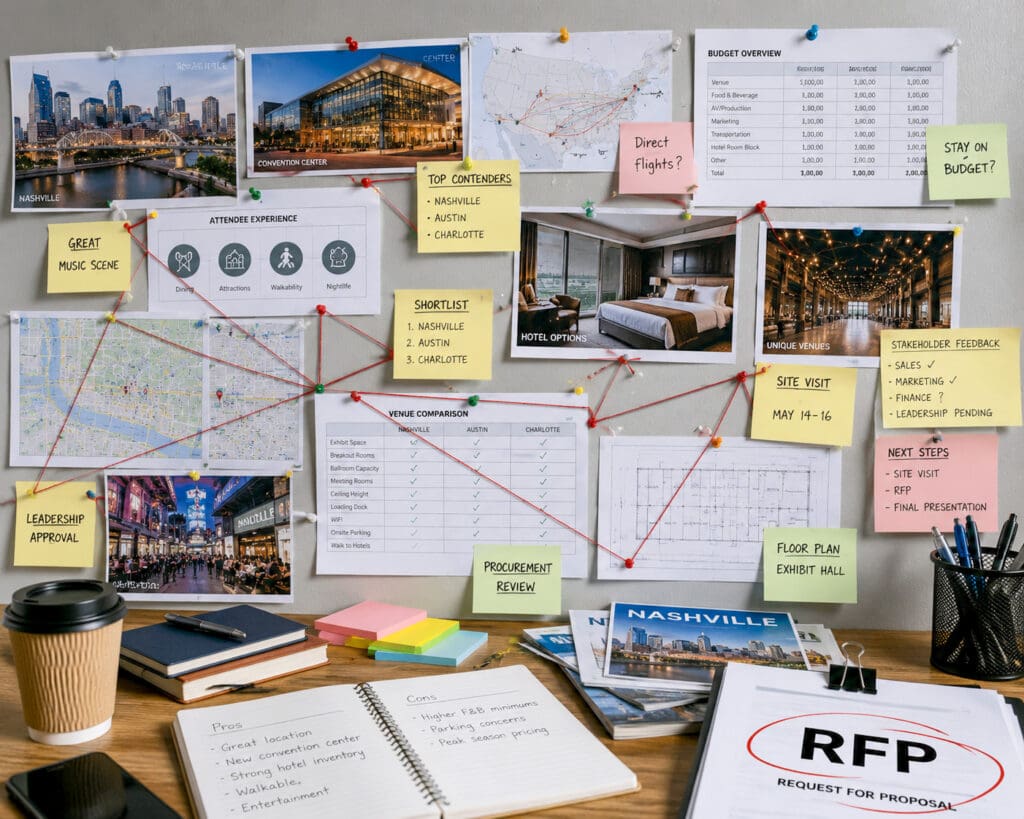
By the time a meeting planner submits an RFP, they have likely already:
- Researched multiple destinations
- Compared venue options
- Evaluated accessibility and costs
- Considered attendee experience
- Gathered feedback from stakeholders
- Consulted leadership, procurement, finance, or board members
- Narrowed their shortlist several times
The visible action is often one of the last steps in the process. The real decision-making starts much earlier.
The challenge is that most destination marketing efforts are still measured primarily at the end of the journey rather than throughout it.

Borrowed Brilliance From an Unexpected Place
The reality that younger planners are starting in new spaces makes early visibility essential. If they’re building shortlists before speaking with destination representatives, DMO marketing has to show up before the RFP stage, not just once the planner is ready to One of the principles behind our Borrowed Brilliance series is simple:
Some of the best ideas for destination marketing come from outside the destination industry.
When we began examining the buyer journey for Teravalis, one of the largest master-planned community developments currently underway in the United States, we found striking similarities to the way meeting planners evaluate destinations.
Teravalis isn’t simply selling homes.
It is asking people to buy into a vision.
Prospective buyers evaluate:
- The community
- The location
- Future growth
- Lifestyle fit
- Long-term value
- Family considerations
- Personal confidence in a major life decision
The journey often takes months or years.
Buyers move back and forth between discovery, evaluation, validation, hesitation, and action.
Sound familiar?
Meeting planners do exactly the same thing. The products are different. The decision dynamics are not.

The Confidence Economy
One of the biggest takeaways from our webinar was a realization that extends beyond destination marketing. Today’s buyers operate in what we believe is a Confidence Economy.
Information is everywhere. Answers are available instantly. Artificial intelligence (AI) can compare options, summarize destinations, and generate recommendations within seconds. Access to information is no longer the competitive advantage.
Confidence is.
Meeting planners are not simply choosing a destination. They are choosing a destination they can confidently recommend. After all, every planner understands the reality of professional risk.
- When an event succeeds, everyone celebrates.
- When an event struggles, everyone remembers.
- That pressure changes how decisions are made.
The planner isn’t just asking:
“Which destination is best?”
They’re asking:
- “Which destination can I confidently defend to my stakeholders?”
- “Which destination will make attendees happy?”
- “Which destination will help me achieve my objectives?”
- “Which destination feels like the safest recommendation?”
The destination that answers those questions most effectively gains an advantage long before an RFP is submitted.
Introducing the Confidence Curve
Traditional marketing funnels suggest buyers move neatly from awareness to consideration to conversion.
Reality is far messier.
At Go Fish Tourism + Business Events, we’ve begun thinking about this process differently.
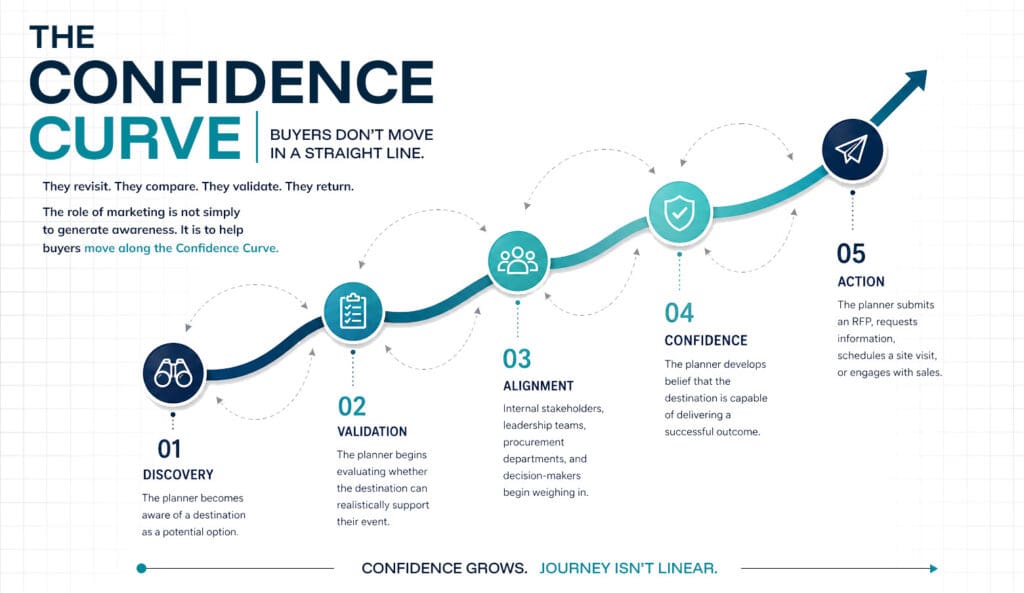
We call it the Confidence Curve.
Discovery
The planner becomes aware of a destination as a potential option.
Validation
The planner begins evaluating whether the destination can realistically support their event.
Alignment
Internal stakeholders, leadership teams, procurement departments, and decision-makers begin weighing in.
Confidence
The planner develops belief that the destination is capable of delivering a successful outcome.
Action
The planner submits an RFP, requests information, schedules a site visit, or engages with sales.
The important thing to remember is that buyers rarely move through these stages in a straight line.
- They revisit
- They compare
- They validate
- They return
The role of marketing is not simply to generate awareness. It is to help buyers move along the Confidence Curve.

Marketing Builds Confidence. Sales Activates Confidence.
Perhaps the most important lesson we borrowed from real estate is that sales and marketing cannot operate independently in long buying cycles.
The traditional model says:
- Marketing generates leads
- Sales closes business
The reality is much more connected.
- Marketing shapes perception
- Marketing creates familiarity
- Marketing answers questions
- Marketing reduces uncertainty
- Marketing builds confidence
- Sales activates that confidence through conversations, relationships, and conversion
The strongest destination organizations understand that every marketing touchpoint should make the eventual sales conversation easier.
Not because marketing replaces sales. Because marketing prepares buyers for sales.

Why AI Makes This More Important, Not Less
Google coined the term “Messy Middle” to describe the continuous cycle of exploration and evaluation that consumers go through, where purchasing decisions are shaped long before a conversion ever occurs. Artificial intelligence is making the Messy Middle even messier.
Planners can now:
- Compare destinations through AI tools
- Generate destination shortlists
- Review venue summaries
- Explore alternatives
- Validate recommendations
All of this can be done without ever visiting a destination website. As information becomes easier to access, trust becomes more valuable. As answers become commoditized, differentiation becomes more important. As discovery becomes automated, confidence becomes the true competitive advantage.
The destinations that win in an AI-powered world will not necessarily be the destinations with the largest budgets.
They will be the destinations with the clearest story, strongest proof points, and most consistent presence across every touchpoint where confidence is built.

The Future Belongs to Destinations That Build Confidence
If there was one message we hoped attendees took away from our Trends Week session, it is this:
The future of destination marketing will not belong to the organizations that generate the most impressions.
It will belong to the organizations that build the most confidence.
- Confidence among planners
- Confidence among stakeholders
- Confidence among attendees
- Confidence among partners
Through Borrowed Brilliance, we’ll continue exploring lessons from industries facing similar challenges because the most valuable insights don’t always come from inside our industry.
Sometimes the best ideas are borrowed.
The competitive advantage comes from knowing how to apply them.
And in today’s destination marketplace, the organizations that learn how to build confidence earlier, more consistently, and more intentionally will be the organizations that ultimately win.
FAQs
What is the “Messy Middle” in marketing?
The Messy Middle is a term coined by Google to describe the non-linear stage between initial interest and a final decision, where buyers loop between researching and evaluating options before committing. It’s why traditional, linear marketing funnels increasingly fail to reflect how people actually decide.
How can destination marketers start building confidence earlier in the buyer journey?
Start by mapping content and proof points to each stage of the decision, not just the RFP. That means earned media and reviews for Discovery, case studies and testimonials for Validation, and sales-ready materials that help planners defend the choice internally during Alignment.
How do you measure marketing success when RFPs come months after first contact?
Track leading indicators earlier in the journey, such as returning site visitors, planner guide downloads, and branded search volume, rather than waiting on RFP volume alone. These signals show whether confidence is building before a planner is ever ready to act.
Does the Confidence Curve apply beyond meetings and business events?
Yes. Any high-consideration purchase with multiple stakeholders and a long timeline, such as real estate, enterprise software, or healthcare decisions, follows a similar pattern of nonlinear research and validation before action.
How can marketing and sales teams align around a shared buyer journey?
Give sales visibility into what content a prospect has already seen, and give marketing visibility into the objections sales hears most. When both teams work from the same map of the buyer journey, conversations move faster because less has to be explained from scratch.