


The Integrated Buyer Journey: How AI, Social, Search, and Paid Media Now Drive Discovery

Published: March 17, 2026
Share on LinkedIn Share on Twitter Share on Facebook Click to print Click to copy url
Summarize with ChatGPT
The Buyer Journey Has Changed: How Discovery Now Happens Across AI, Social, Search, and Paid Media
Marketing teams still tend to plan around channels.
SEO drives search traffic. Paid media drives conversions. Social builds awareness.
But buyers don’t move through those steps in order anymore.
Someone might see a product in a TikTok video, search the brand later, read an AI summary, skim reviews, and finally buy it on Amazon.
Discovery now happens across AI answers, social feeds, search results, paid media, and marketplaces before someone ever lands on a brand website.
When those touchpoints tell different stories, buyers hesitate.
When they reinforce each other, trust builds quickly.
That shift is forcing marketing teams to rethink what the buyer journey actually looks like.
What Is the Integrated Buyer Journey?
The integrated buyer journey describes how customers discover, evaluate, and purchase products across multiple platforms before making a decision.
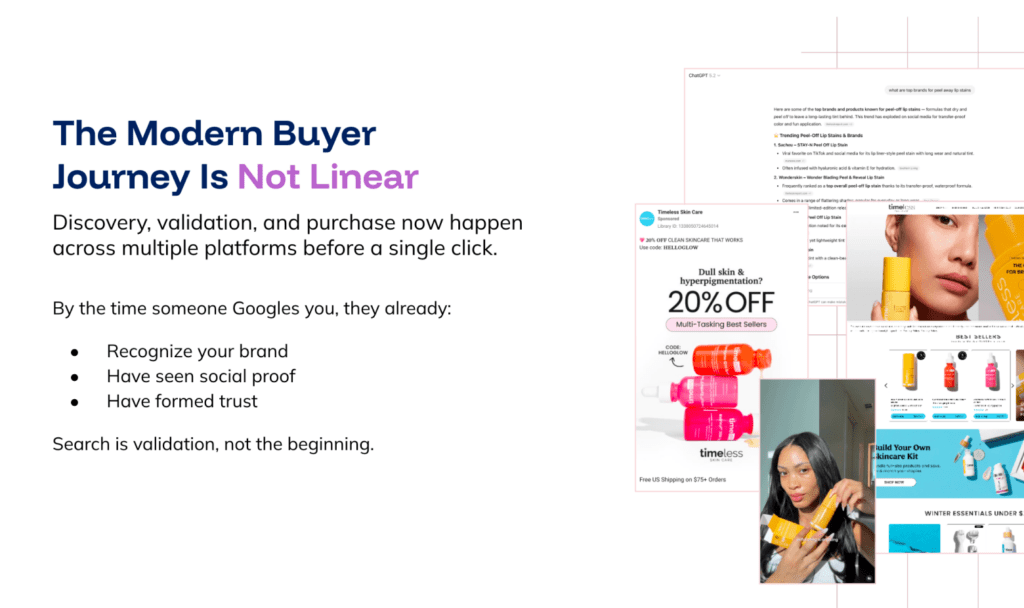
Instead of starting with search, buyers now encounter brands through social media, AI-generated answers, creator recommendations, and paid media.
Search often becomes the moment where buyers validate a brand rather than discover it for the first time.
Why the Traditional Marketing Funnel Is Breaking Down
For years, marketing strategies assumed people started with search.
They had a problem. They typed a query. They compared results.
Today buyers often encounter a brand long before they search for it.
A typical path might look like this:
- Someone sees a product in a creator video.
- Later they search the brand name.
- Google shows an AI summary.
- They skim reviews.
- They click a paid result.
- They buy on Amazon.
Search still matters.
But increasingly, it’s not discovery. It’s validation.
AI Search Is Becoming a Major Discovery Channel
Consumers are increasingly asking questions in tools like ChatGPT, Gemini, and Google AI Overviews before they ever visit a website.
These systems summarize information and surface brands directly in the answer.
That changes how brands get discovered.
Research shows:
- 59% of Americans now use generative AI when researching purchases
- 83% of active AI users rely heavily on AI-generated answers
- 1 in 4 shoppers prefer ChatGPT product recommendations
If a brand isn’t included in those answers, buyers may never encounter it in the first place.
For a deeper look at how AI discovery works, see our guide: AI Search Executive Brief: How GEO & PR Drive Revenue and Reduce CAC.
Why SEO Now Includes Generative Engine Optimization (GEO)
Ranking in search results still matters.
But AI summaries are changing how users interact with search.
When an AI overview appears in Google, many users never click a result at all.
This is where Generative Engine Optimization (GEO) comes in.
GEO focuses on structuring content so AI systems can understand it, summarize it, and reference it when answering questions.
Instead of focusing only on keywords, GEO prioritizes:
- clear, structured content
- strong topical authority
- third-party credibility signals
- consistent brand references
SEO now supports both traditional rankings and AI discovery surfaces.
How Social Media Introduces Brands Before Search
Social platforms have quietly become one of the biggest discovery engines.
People don’t open TikTok or Instagram planning to shop. They open them to scroll.
But discovery happens there constantly.
Creator content introduces products through real-world context:
- morning routines
- product demonstrations
- before-and-after examples
- lifestyle content
These formats feel authentic because they show real usage rather than marketing claims. Creators often compress the time between discovery and serious consideration. They introduce the brand and demonstrate how it fits into real life.
Where Paid Media Fits in the Buyer Journey
Paid media is often treated as the first moment a buyer meets a brand. In reality, it’s frequently the moment they act on interest that already exists. By the time someone clicks a paid ad, they may already have:
- seen social content
- heard about the brand from a creator
- encountered it in an AI-generated answer
Paid media performs best when it reinforces what buyers already believe. If messaging shifts dramatically between discovery and paid ads, trust drops quickly.
Learn more about our paid media approach here.
Why Messaging Consistency Drives Conversion
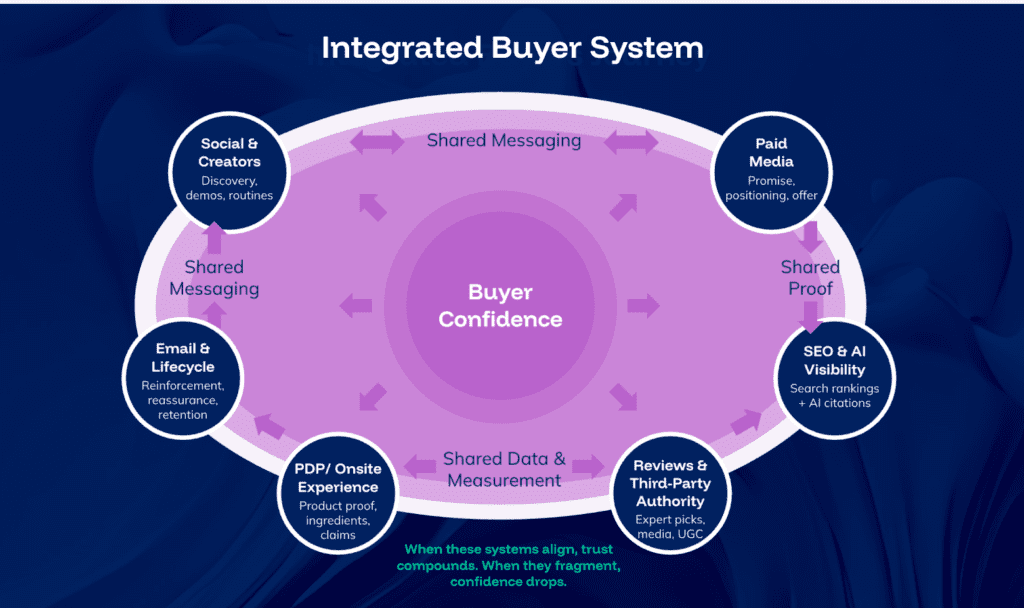
One of the most common problems in modern marketing is inconsistency. Different teams control different channels, and each channel tells a slightly different story. Social might emphasize lifestyle benefits. Paid ads might emphasize promotions.
Landing pages might emphasize technical features.
To a buyer, that shift introduces uncertainty.
But when messaging stays consistent across channels, confidence builds quickly.
Integrated marketing isn’t just about presence across platforms. It’s about narrative consistency.
The Validation Stage: Reviews, Creators, and AI Answers
Discovery alone rarely drives a purchase. Buyers want proof before they commit.
They look for signals that confirm credibility:
- reviews and ratings
- creator demonstrations
- community discussions
- comparison content
- AI summaries
These signals reduce perceived risk.
When validation is strong, buyers move forward quickly.
When validation is missing, the journey slows down.
Why Marketing Measurement Breaks Across Channels
Most marketing teams still measure performance by channel.
Paid teams track ROAS. SEO teams track traffic. Social teams track engagement.
But buyers don’t move through those channels independently.
Consider this path:
TikTok → Google search → Amazon purchase.
Traditional reporting may attribute that sale entirely to Amazon.
The discovery signal disappears.
That disconnect leads to poor decisions about budget and strategy.
What Integrated Marketing Looks Like in Practice
Brands adapting to the modern discovery model tend to focus on a few key principles.
They align messaging across channels instead of letting each platform operate independently. They structure content so AI systems can interpret and reference it.
They build credibility signals through reviews, creators, and third-party validation. And they measure performance across the entire journey rather than inside isolated channels. None of these tactics are new individually.
The difference is treating them as parts of the same system.
The Shift Marketing Teams Need to Make
The biggest change isn’t technological.
It’s structural. Marketing teams used to optimize individual channels. The opportunity now is optimizing the entire buyer journey.
That means asking different questions:
- Where do buyers first encounter the brand?
- Where do they validate credibility?
- Where do they finally take action?
When those moments reinforce each other, trust compounds. And trust is still what drives conversion.
Want Help Identifying Gaps in Your Buyer Journey?
If discovery, validation, and conversion are happening across multiple platforms, disconnected marketing strategies create friction.
Our team can help identify where those gaps exist and how to fix them.
Contact us to learn more about how integrated marketing strategies support growth.
