
Why Digital PR Matters in AI Search Ecosystems

Published: August 19, 2026
Share on LinkedIn Share on Twitter Share on Facebook Click to print Click to copy url
Summarize with ChatGPT
Your website is no longer the only place people learn about your brand. In AI search, it may not even be the first.
A potential customer can ask ChatGPT which providers to consider or see Google explain a topic in an AI Overview. Those answers may use a brand’s own pages, but they can also draw from news coverage, trade publications, reviews, forums, and other third-party sources.[2][5][9]
This is where Digital PR and generative engine optimization, or GEO, connect. Digital PR creates data-driven stories and earns coverage beyond a brand’s website. GEO focuses on how a brand appears in AI-generated answers. That coverage gives AI systems more independent context about what the brand does and what it is known for.[6][7][8]
One placement will not guarantee an AI mention or citation. But research from Muck Rack and BuzzStream shows that earned media is a meaningful part of the source mix, especially when people use AI to compare options. [2][5]
The question I hear most often is not, ‘Does Digital PR still work?’ It is, ‘Does it still matter if search is changing this fast?’ My answer is yes – because the need for third-party credibility has not gone away.
Key Findings
- Muck Rack analyzed more than 25 million links cited by ChatGPT, Claude, and Gemini across 17 industries. It found that 84% came from earned media, while paid and advertorial content accounted for 0.3%.
- BuzzStream found that earned content accounted for 93.75% of citations when people asked AI tools to compare options or help make a decision.
- AI platforms do not all cite the same pages. Across 595 prompts, 76.1% of citations were unique to one of the four platforms BuzzStream tested.
- Big-name publications are not the only outlets that matter. Muck Rack found journalism citations across more than 20,000 outlets, and its research notes that niche trade publications can be especially important for B2B questions.
What Is Digital PR?
Digital PR is an earned media and link-building strategy built around stories publishers want to cover. Campaigns often use surveys, public datasets, or a brand’s own data to uncover a useful trend, ranking, or comparison.[10]
A Digital PR service handles the research, analysis, content, and media outreach. Coverage can earn backlinks, referral traffic, and brand mentions. Those outcomes support SEO and give GEO more credible context beyond the brand’s own site.[6][8][9]
Why Digital PR Matters More in AI Search
AI answers draw from more than a brand’s website
AI tools can use information from news sites, trade publications, review pages, forums, and other sources across the web. That means a brand’s visibility can depend partly on what credible third parties say, not just what it publishes itself.[2][3][5]
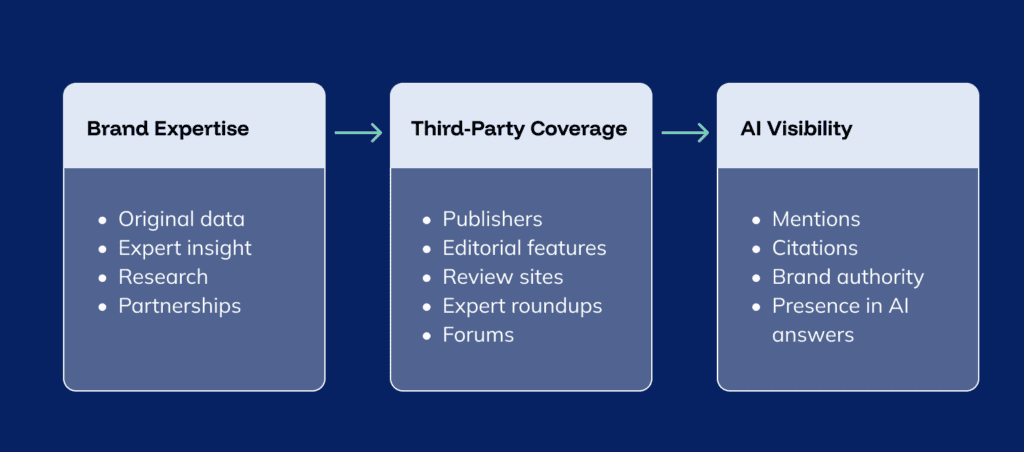
The exact share varies by study and prompt type. Muck Rack and BuzzStream used different methods, but both found that earned sources make up a substantial part of AI citations.[2][5]
The source mix also changes by AI platform and prompt. BuzzStream found that most citations in its 595-prompt study were unique to a single platform. This is why Digital PR can help brands earn coverage across a wider mix of relevant sites instead of relying on one publication to reach every AI platform.[4]
We have seen that variability in our own AI visibility research, too. In a July 2026 study of Go Fish Digital across ChatGPT, Google AI Overviews, and Perplexity, we analyzed 1,554 responses across 73 prompt wordings and found that results shifted substantially depending on both the platform and how the question was framed. We also saw that AI systems can rewrite, shorten, or expand a user’s original question before retrieving information, which means the sources surfaced for one prompt may look very different from those surfaced for another.
People use AI to compare brands
AI is not only used for quick facts. People can ask which brand fits a need, how two companies differ, or which product is a better fit. Google describes AI Mode as useful for complex comparisons.[9]
For questions closer to a buying decision, AI tools often cite third-party content. In BuzzStream’s study, earned content made up nearly all citations for evaluative prompts. A brand’s website can explain what it does. Independent coverage gives AI tools another source to evaluate those claims.[5]
AI tools lean on journalism for industry trends
AI tools use different sources depending on the question. Muck Rack found that industry-trend questions cited journalism at more than twice the rate of how-to questions. [2]
That gives Digital PR a natural role in AI search. Timely research, expert commentary, and data-driven campaigns can earn coverage as a story develops, giving AI tools more credible reporting to draw from when explaining what is changing in a market. [2]
That is why I do not think the AI shift changes the case for Digital PR. It changes the way we explain the value, but the underlying job is still the same: earn outside proof that makes a brand easier to trust.
How a Digital PR Service Supports AI Search Visibility
Digital PR supports the part of GEO that happens beyond a brand’s own website. It creates useful information, earns independent coverage, and helps connect the brand with the topics it wants to be known for.[6][7][10]
1. Digital PR creates original research worth covering
Strong campaigns give journalists something new to work with, such as a survey result, stat, ranking, or trend. The Digital PR team handles the methodology, analysis, writing, visuals, and outreach needed to turn that research into a credible story that earns coverage.[7][10]
Voctos identifies original data as a strong Digital PR asset for GEO. In a BuzzStream interview, Kevin Indig said proprietary research can win citations, but stressed that distribution is critical. The data needs a clear story and a plan to reach the right publishers.[7][10]
The campaigns that tend to perform best are rarely the ones that stay closest to the brand. More often, it is the tangential ideas, the ones just outside the core product or service, that create the strongest coverage opportunities. They feel timely, they have a better shot at fitting the news cycle, and they do not come across like an ad for the company.
At the end of the day, earned media only works when we stop asking, ‘Do we like this idea?’ and start asking, ‘Would a journalist actually care about this?
2. Digital PR earns independent coverage around the right topics
A brand can explain its expertise on its own website. Digital PR adds outside context by earning coverage from publishers that readers and AI systems may already use.[2][3][7]
A strong campaign relates to the brand’s industry without reading like an ad. When relevant publications cover the research, the brand appears alongside the topic it wants to be known for. That can give AI systems more third-party context about the brand.[6][7][8]
3. Digital PR builds a broader, more relevant source mix
Not every AI platform cites the same pages, and the biggest outlet is not always the most useful one. Muck Rack found journalism citations across more than 20,000 outlets and notes that niche trade publications can be especially useful for B2B questions.[2][3]
A Digital PR service builds the media list around the audience, topic, and campaign. The goal is relevant coverage across a mix of trusted sources, not a single popular news site.[3][4]
4. Digital PR connects PR, SEO, and GEO
One piece of coverage can earn a backlink, mention the brand in a relevant context, and later appear as an AI source. [6][8]
Google says the same SEO fundamentals still apply to AI Overviews and AI Mode. BuzzStream’s topical authority interview also emphasizes the need for content, internal links, backlinks, and brand mentions to reinforce the same topics. That connection also shows up in the execution of Digital PR. In our own pitch testing, we have seen how choices like anchor text can influence journalist engagement while also shaping SEO and how a story may be interpreted in AI summaries. Digital PR is most useful when it reinforces what a brand is already building through SEO and owned content. Digital PR is most useful when it reinforces what a brand is already building through SEO and owned content.[9][11]
Digital PR cannot guarantee inclusion in an AI answer. It can build a stronger third-party footprint that gives a brand more chances to be discovered, mentioned, or cited.[2][4][5]
FAQs About Digital PR Services and AI Search
What does a Digital PR service do?
A Digital PR service develops campaign ideas, creates the research and content behind them, pitches relevant journalists, and reports on the coverage the work earns, including backlinks and brand mentions.
Can Digital PR help a brand appear in AI search?
Yes. It can support AI visibility by earning credible coverage, links, and mentions across sources AI tools may use. Results vary by platform, question, industry, timing, and access, so no service can guarantee an AI citation.
Do backlinks still matter in an AI search world?
Yes. Backlinks still support SEO and can send referral traffic. For GEO, they should be considered alongside brand mentions and AI citations.
Is Digital PR the same as GEO?
No. GEO is the broader work of improving how a brand appears in AI-generated answers. Digital PR supports that work by earning third-party coverage, links, and mentions outside the brand’s website. Owned content, technical SEO, and site accessibility still matter.
Do I still need Digital PR for AI search visibility?
Yes. AI search has changed where people get their answers, but it has not changed the value of credible third-party coverage. Digital PR helps brands earn that coverage through original research, timely stories, and relevant publications. That gives people and AI tools more independent proof to work with.
Do I need both GEO and Digital PR?
Usually, yes. GEO helps a brand show up well in AI-generated answers, while Digital PR helps create the outside proof that supports that visibility. GEO is the broader strategy. Digital PR is one of the strongest ways to support it because it earns mentions, links, and coverage from other sites.
Build the Third-Party Proof That Supports AI Search Visibility
AI search has not replaced the need for good website content or strong SEO. It has added another layer: what the wider web says about your brand.
Digital PR helps build that layer through original research and earned coverage. The result is not a guaranteed AI citation. It is a stronger, more credible presence across the sources people and AI systems use to understand a category. Learn how Go Fish Digital’s Digital PR services can help build that earned media footprint.
Sources
[1] Atomic AGI. “Digital PR for AI Search: The Complete Strategy Guide for 2026” April 2, 2026.
[2] Muck Rack. “Earned Media Still Drives 84% of AI Citations. Here’s What That Means for PR.” May 7, 2026.
[3] Muck Rack. “What Are AI Citations? How PR Teams Can Track and Earn Them” July 21, 2026.
[4] BuzzStream. “50 AI Statistics Digital PR and SEO Should Know (2026)” June 30, 2026.
[5] BuzzStream. “What Kind of Content Does AI Cite (Based on Prompt Type)?” April 9, 2026.
[6] BuzzStream. “How AI Mentions and Cites Your Brand (New Study)” July 14, 2026.
[7] Voctos. “Digital PR for GEO: How Brand Mentions Earn AI Citations” July 21, 2026.
[8] Ahrefs. “Top Brand Visibility Factors in ChatGPT, AI Mode, and AI Overviews (75k Brands Studied)” December 12, 2025.
[9] Google Search Central. “AI Features and Your Website” updated December 10, 2025.
[10] BuzzStream. “Kevin Indig on Citations vs Mentions and Proprietary Research” July 22, 2026.
[11] BuzzStream. “Building Your Website’s Topical Authority with Kevin Indig” October 27, 2025.
About Lanie Martin
Lanie Martin is a Digital PR Manager specializing in strategy, planning, and execution of high-impact campaigns. She’s produced 100+ campaigns for 30+ clients across industries and leads Go Fish Digital’s internship program, mentoring the next generation of PR professionals.