


Why You Rank in Google but Don’t Appear in AI Answers

Published: October 16, 2026
Share on LinkedIn Share on Twitter Share on Facebook Click to print Click to copy url
Summarize with ChatGPT

Many brands hold strong organic rankings yet remain invisible inside AI answers from Google AI Overviews, ChatGPT, Perplexity, and Claude. This article explains why that ranking–citation gap occurs, how to audit your AI visibility in five minutes, and what to fix—content clarity, supporting evidence, third‑party coverage, or technical barriers—to start earning citations. It also shows how to measure AI visibility separately from rankings and how to build a Generative Engine Optimization (GEO) playbook alongside SEO.
Why You Rank in Google but Don’t Appear in AI Answers
It’s becoming common for marketers to see top organic rankings in Search Console while brand visibility inside AI answers vanishes. You might hold positions 1–3 for core terms, yet Google AI Overviews, ChatGPT, and Perplexity summarize the answer without citing your site—or worse, highlight a competitor’s page. That visibility loss doesn’t show up in a ranking report, but it absolutely shows up in pipeline.
AI answers and generative search experiences are systems that synthesize direct, conversational responses from multiple sources. Instead of ten blue links, users see a concise explanation, recommended options, and citations. Google’s AI Overviews do this on the SERP; tools like ChatGPT, Perplexity, and Claude do it in chat-style interfaces. These systems select sources not only by relevance, but also by clarity, freshness, corroborated facts, and perceived safety of recommending a brand.
This creates a ranking–citation gap: your page can rank for the keyword but fail to provide the extractable evidence needed to answer the buyer’s specific question (for example, comparisons, use cases, specs, pricing context, and limitations). When that happens, AI engines cite other sources—often third‑party lists or reviews—stealing attention you once earned via clicks. The impact lands on branded demand, inbound inquiries, and revenue quality.
Fixing AI visibility isn’t a single “rank higher” play. It requires content that answers buyer questions upfront, stronger entity signals, third‑party corroboration, and clean technical access for AI crawlers. Our Go Fish Digital point of view is practical and experiment-driven: examine the answers where competitors appear, follow the cited sources, and identify exactly what those sources provide that your content doesn’t. Two quick scenarios we see: your thorough SEO guide ranks #1 but gets skipped because a concise comparison table on a smaller blog is easier to quote; or an industry review page gets the nod in AI Overviews while your page is buried behind a lead form or heavy JavaScript.
Key Takeaways
- Generative engines select citations using clarity, freshness, and corroborated entity signals—and often favor third‑party lists and reviews over top blue links—so you need Generative Engine Optimization alongside SEO to appear.
- Open fresh prompts in ChatGPT or Perplexity that mirror buyer questions, ask which sources or URLs the AI used, log recurring directories, blogs, and review sites across prompts, and compare those citations to your Google rankings to reveal gaps.
- Prioritize answer‑first content and comparisons, strengthen supporting evidence and pricing or limitations, secure third‑party coverage and reviews, and remove technical blockers like disallowed GPTBot/ClaudeBot/PerplexityBot or JS rendering issues, sequencing quick wins first.
Ranking vs. AI answers: understanding the ranking–citation gap
Classic SEO is designed to win clicks from a ranked list. You optimize for query–document relevance, on-page signals, and backlinks so your page earns a top position. AI engines work differently: they retrieve, verify, and synthesize specific facts and comparisons, then present a direct answer with citations. The objective isn’t to send traffic; it’s to resolve the question safely and confidently.
Because of that, AI answers often cite pages that don’t appear in the top organic results. A concise how‑to on a niche forum, a third‑party review site, or a recent case study can be chosen over your evergreen guide—especially if those sources deliver clearer snippets, fresher data, or corroborated claims tied to recognized entities.
We call the disconnect a ranking–citation gap. As AI Overviews and chat answers occupy more screen space, this gap grows—even when your rankings are stable. That’s why marketers see solid positions but a drop in assisted conversions and inbound interest: visibility is shifting to the answer module and its citations.
Generative Engine Optimization (GEO) closes that gap. You don’t abandon SEO; you extend it with optimization that targets answer extraction, entity corroboration, and third‑party validation. GEO and SEO are complementary: the first earns citations inside generative experiences; the second preserves discoverability and depth for users who still click through.
- SEO prioritizes ranking documents for clicks; GEO prioritizes being cited as a trustworthy, extractable source in an answer.
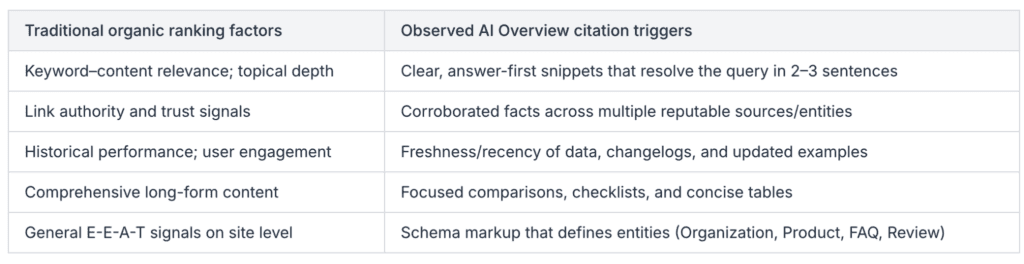
- SEO rewards comprehensive topical coverage; GEO rewards clear, scannable, answer‑first sections with verifiable data.
- SEO leans on link authority; GEO adds corroboration across entities (schema, reviews, directories) and content freshness.
- SEO measures positions and traffic; GEO measures citations, impressions within answers, and assisted conversions.
Technical reasons AI engines may be skipping your site
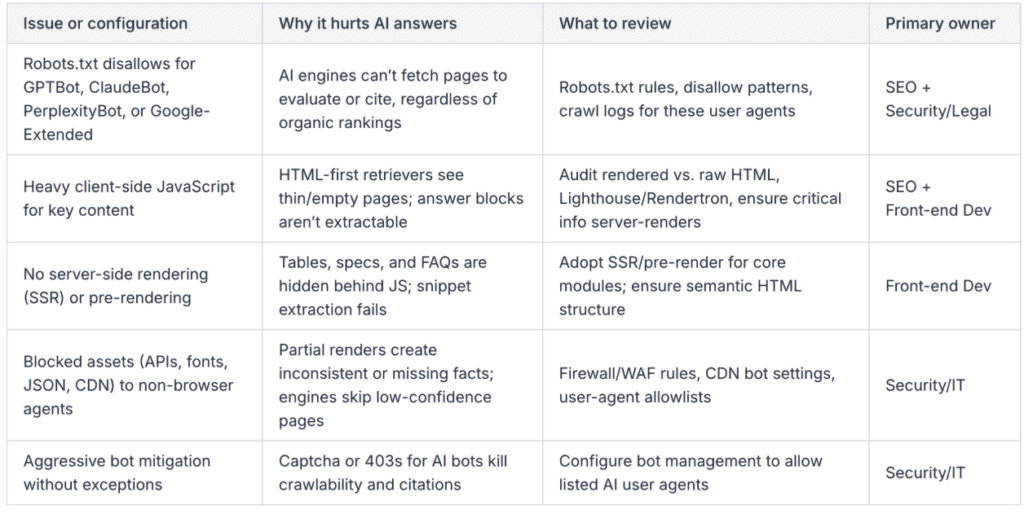
Before rewriting content, confirm AI crawlers can actually fetch and render your pages. Robots.txt rules and security controls introduced to limit AI training often have an unintended side effect: they block the very bots that power AI answers. If GPTBot, ClaudeBot, PerplexityBot, or Google-Extended can’t reach your site, you will not be cited—even if Google Search can still rank you.
Many AI engines rely on fast, HTML‑first scraping. If your critical information (pricing, specs, comparisons, FAQs) is injected client‑side with heavy JavaScript, an AI retriever may see an “empty” page and skip it. Traditional Google crawling can sometimes execute JS well enough to rank the content, which hides the problem from SEO dashboards.
Server‑side rendering (SSR) or pre‑rendering core answer blocks (like a comparison table or FAQ) makes your content extractable to both search crawlers and AI retrievers. When answers are available in semantic HTML with clear headings and schema, your probability of being cited increases.
It’s also common to block required assets (APIs, JSON endpoints, or CDNs) to non‑browser user agents. If AI bots can fetch the HTML but key resources return 403/404, your content may render incompletely and be ignored by answer engines.
Coordinate any changes with legal and security. You can allow GPTBot, ClaudeBot, PerplexityBot, and Google-Extended while still limiting training via other controls. The goal is to enable access for answer generation without opening high‑risk vectors.
Content and information gaps: when your page doesn’t actually answer the question
A page can rank for a keyword yet fail to earn a citation because it doesn’t deliver an answer‑first experience. AI models favor content that leads with a crisp, 2–3 sentence answer, then supports it with concise sections, tables, and evidence. Long preambles and thought‑leadership intros bury the lede and reduce extractability.
The most common missing pieces are the exact elements buyers ask for: side‑by‑side comparisons, concrete use cases by industry or role, pricing context, and honest limitations. When those are absent, engines turn to third‑party lists, Reddit threads, or LinkedIn posts that speak plainly to trade‑offs and fit.
Vague headings like “What to consider” or generic copy like “our solution is flexible” make it hard for AI to identify a self‑contained snippet that answers a specific question. Prefer precise headings (“Pricing tiers and overages,” “Works best for,” “Not a fit if…”) followed by short, declarative bullets.
Here’s a simple rewrite pattern that outperforms in Google AI Overviews and chat engines. Before: “Our platform helps teams collaborate on content with enterprise security.” After: “Is this platform a fit for regulated teams? Yes—SAML SSO, SOC 2 Type II, and field‑level permissions support HIPAA‑adjacent workflows. It’s best for 50–500 seat teams; not a fit if you require on‑prem hosting.” Then add a table of features, use cases by role, and links to audit reports.
Map the questions you see inside AI answers directly to sections on your page. Instead of optimizing just for keywords, create answer blocks aligned to buyer intent. That gives generative systems the extractable segments they need and gives humans the clarity they expect.
- Lead with a 2–3 sentence, answer‑first summary before the exposition.
- Include comparison tables against named alternatives (features, pricing, limitations).
- Add use cases by industry/role; speak plainly about “best for” and “not a fit if…”.
- Publish pricing context (ranges, tiers, overages) or explain how pricing is calculated.
- Acknowledge limitations and link to mitigations; this builds trust and reduces hallucination risk.
Entity, trust, and third-party coverage: why AI still doesn’t “know” your brand
Generative systems build a cautious understanding of brands as entities. They cross‑check your website against sources like Google Business Profile, LinkedIn, Yelp, and sector directories to confirm who you are, where you operate, and what you sell. If the data doesn’t align, recommending you in an AI answer feels risky.
Inconsistent NAP (name, address, phone), mismatched categories, and thin profiles weaken brand recognition. Cleaning these basics—plus maintaining consistent descriptions, services, and locations—reduces friction for engines trying to corroborate your entity.
On‑page, use Organization, Product, FAQ, and Review schema to define your brand, offerings, and proofs. Combine that with transparent case studies, named customer logos, and independently verifiable claims. Agencies such as Wpromote and WebFX often showcase robust reviews and case studies—signals that make a brand safer to cite.
Third‑party coverage matters because it spreads your entity across the web: industry listicles, comparison sites, local directories, analyst notes, and credible blogs. PR and digital PR teams can secure this coverage, while SEO ensures technical and on‑page corroboration. Treat entity‑building as a shared responsibility across SEO, PR, and brand.
Generative engines are risk‑averse recommenders: they prefer brands they can corroborate across your site, structured data, and reputable third‑party sources.
Ranking but not showing in Google AI Overviews (SGE)
Google’s AI Overviews (formerly part of the Search Generative Experience) assemble answers from a pool of sources that extends beyond the top organic results. The system looks for clear, corroborated snippets that directly resolve the query—often preferring third‑party lists, recent reviews, or highly specific guides over general evergreen content.
Freshness, clarity, and corroborated facts frequently outweigh traditional ranking signals for citations. If your evergreen post ranks #1 but the answer module cites a newer comparison or a directory entry, it’s because those sources provided clearer, more verifiable statements.
Certain query types lean heavily on third‑party lists and reviews: “best of” roundups, solution comparisons, and local services. A query like “heavy equipment service near me” may cite local directories or dealer pages. If you’re Thompson Tractor or a similar dealer, AI Overviews might favor directory entries and recent reviews unless your site provides a succinct service summary, coverage map, and review snippets.
Run side‑by‑side checks of your organic rankings against AI Overview appearances for target terms. If you’re ranking but not showing in AI overviews SGE, examine the cited sources, compare their answer clarity and corroboration to yours, and update your page with answer‑first sections, fresh data, and schema.
Treat AI Overviews as a related but separate battleground. Keep winning the blue links, but also optimize for the extractable, verifiable statements that trigger citations inside the generative module.
A 5-minute AI visibility audit: see exactly which sources AI trusts today
You don’t need new tools to diagnose your AI visibility. In five minutes, you can see which sources feed answers in your space using ChatGPT and Perplexity. Use buyer‑style prompts that mirror real questions, not just keywords.
Open a fresh chat each time to avoid prior context. Ask the model to show its sources or URLs, then note the recurring directories, blogs, and review sites it leans on. You’ll often see third‑party roundups, Reddit discussions, Yelp pages, and specific vendor comparisons reappear across prompts.
Compare the recurring citations to your Google rankings. Where you rank but don’t appear in citations, ask: what do those sources provide that we don’t? Clear answer blocks? Pricing context? Independent reviews? That delta becomes your roadmap.
This quick audit—starting with the answers where competitors appear and following the citations—is the Go Fish Digital way to kick off a GEO plan without waiting on dev access or new platforms.
1. List 5–10 buyer questions (comparisons, pricing, use cases, local qualifiers).
2. In ChatGPT or Perplexity, open a new session for each and ask the question plainly.
3. Prompt: “Please cite your sources and list the URLs you used.”
4. Log all citations; star any that recur across multiple prompts (directories, review sites, blogs).
5. Run the same queries in Google; note where you rank vs. which sites AI cites.
6. Highlight gaps (content clarity, evidence, coverage) and convert them into specific fixes.
Prioritizing fixes: clearer content, stronger evidence, more coverage, or a technical cleanup?
Your audit results typically cluster into four buckets: content clarity, supporting evidence, third‑party coverage, and technical barriers. Prioritization is about sequencing high‑impact, low‑effort fixes first while setting up longer‑lead plays in parallel.
If your page ranks but AI answers cite a competitor’s concise comparison or FAQ, the issue is likely content structure. Start with answer‑first rewrites, precise headings, and a compact comparison table.
If AI answers lean on review sites and case‑study heavy competitors, you may need stronger supporting evidence: add pricing context, proof points, customer logos, and transparent limitations. Pair that with schema to make it machine‑readable.
If directories, listicles, and local profiles dominate the citations, focus on third‑party coverage. Secure mentions in credible lists, refresh Google Business Profile, and encourage reviews where buyers research.
If none of the above fixes move citations and your content is strong, investigate technical barriers: check robots.txt for GPTBot/ClaudeBot/PerplexityBot/Google-Extended, look for JS‑dependent content, and ensure SSR for core modules. Sequence quick wins first, then invest in the deeper work that compounds over time.
- Content clarity: Answer‑first sections, precise headings, scannable comparisons, and explicit “best for/not for.”
- Supporting evidence: Pricing context, quantified outcomes, case studies, security/compliance proofs, and Review/FAQ schema.
- Third‑party coverage: Industry listicles, local directories, analyst notes, and authentic reviews to corroborate your claims.
- Technical cleanup: Allowlisted AI bots, SSR or pre‑rendered key content, and accessible assets for non‑browser agents.
Measuring AI visibility separately from rankings
To manage what matters, track AI visibility as its own layer. Core metrics include the number of citations you earn for priority queries, impressions within AI answers (where available), and traffic or leads arriving from AI‑powered experiences like Google AI Overviews.
You can begin with manual spot checks: repeat your 5–10 priority queries monthly across ChatGPT and Perplexity, capture screenshots of answers and citations, and log changes. For Google AI Overviews, document whether you’re cited and which snippet is surfaced. Over time, this becomes a trend line separate from rankings.
Some analytics stacks and platforms can attribute traffic influenced by AI answers. For example, tools like RevenueCloudFX can connect assisted touches—including AI mentions and Overviews clicks—to opportunities and revenue, so you can quantify the impact without turning your report into a product pitch.
Separating AI visibility from rankings clarifies both risk and opportunity. You’ll see where you’re over‑reliant on blue links and where a small content or entity tweak could unlock consistent citations.
When reporting to leadership, translate AI visibility into pipeline terms: citations on decision‑stage queries, influenced demo requests, and revenue assisted by AI mentions. That keeps focus on business outcomes, not just “mentions.”
Building a GEO playbook alongside your SEO program
Integrate Generative Engine Optimization into your existing SEO and content workflows. Fold answer‑block planning into keyword research, add comparison and use‑case modules to briefs, and coordinate digital PR to secure corroborating coverage that feeds AI answers.
Start with focused tests on a handful of high‑value queries. Ship answer‑first rewrites, add schema, and pursue one or two high‑signal third‑party mentions. Measure citations monthly to validate impact before scaling across your catalog.
Sustained gains require cross‑team ownership: content for clarity and comparisons, SEO for structure and schema, PR for third‑party coverage, analytics for measurement, and dev for SSR and crawl access. Treat GEO as a durable capability, not a one‑off project.
Refresh content and entity signals regularly as models update. Data‑driven, full‑funnel frameworks—such as Polaris IQ or The Care Index—can incorporate GEO learnings, while revenue attribution tools like RevenueCloudFX keep the program anchored to growth. Brands that align SEO and GEO will capture more visibility as AI search expands.
Frequently Asked Questions
Why am I ranking but not showing in AI Overviews (SGE) and other AI answers?
AI engines select citations for clarity, freshness, corroborated entity signals, and perceived safety—not just keyword relevance. They often favor third‑party lists, reviews, and recent comparisons over top blue links. If your content isn’t answer‑first, your entity signals are weak, or AI bots can’t access your pages, you can rank yet never be cited.
How do I run a 5‑minute AI visibility audit to see which sources AI trusts today?
Open fresh prompts in ChatGPT or Perplexity using buyer‑style questions. Ask which sources or URLs the AI used, then log recurring directories, blogs, and review sites. Compare those citations to your Google rankings to reveal where you rank but aren’t cited, and convert those gaps into specific GEO fixes.
Which fixes should I prioritize to close the ranking–citation gap?
Sequence quick wins first: publish answer‑first sections and comparisons, add pricing context and limitations, and implement Organization/Product/FAQ/Review schema. In parallel, secure third‑party coverage and reviews, and remove technical blockers such as disallowed GPTBot/ClaudeBot/PerplexityBot or JS‑only rendering for key content.
