


Why Traditional SEO KPIs Are Declining in 2026

Published: February 10, 2026
Share on LinkedIn Share on Twitter Share on Facebook Click to print Click to copy url
Search behavior is changing fast as AI-generated answers are being featured over the traditional “10 blue links” in search results. As AI-generated answers become the primary way users receive information, systems like Google’s AI Overviews and AI Mode, Microsoft Copilot Search, ChatGPT’s web search, Perplexity, and other retrieval-augmented assistants now resolve questions directly on the results surface.
This shift doesn’t eliminate SEO, but it changes what SEO measures, which metrics still matter, and how brands capture visibility when users increasingly receive answers before they ever click.
Key Takeaways:
- How AI Overviews Reduce Clicks and Suppress Legacy Metrics: AI Overviews and chatbot-style results fulfill informational intent directly in the interface, suppressing traditional CTR and decoupling rank from revenue.
- New AI Visibility Metrics That Replace Traditional SEO KPIs: Inclusion, citations, share of answer, entity coverage, and assisted conversions now provide a clearer view of impact than keyword position.
- Why Optimization Must Focus on Extraction, Verifiability & Reasoning Layers: Content must be structured so LLMs can retrieve, chunk, evaluate, and cite it with confidence.
Why Traditional SEO Metrics Are Losing Predictive Power
Because AI-generated answers reduce organic clicks, fragment visibility across surfaces, and obscure attribution. Ranking, CTR, and sessions still exist, but they are weaker indicators of business outcomes when user journeys are completed or redirected inside AI summaries.

How Search Became an AI Answer Layer
Google’s Expansion of AI-First Search Experiences
Google now positions AI Overviews and AI Mode not as add-ons to search, but as core interfaces, systems that reorganize how information is surfaced rather than simply appending new answer types. Their adoption numbers make this unmistakable:
- AI Overviews reach 2 billion users each month.(Source Google, 2025)
- AI Mode already has 100 million active users across the U.S. and India. (Source Google, 2025)
- AI Overviews appear in -47% of all Google searches, making them a dominant entry point into the SERP. (source 2024 Botify Study)
Together, these figures show a fundamental shift: AI-generated answers are no longer peripheral; they now shape the first interaction most users have with information. Search is becoming an AI-mediated reasoning layer, not a list of links.
How AI Assistants Absorb Search Intent Across Platforms
LLM-powered systems, such as ChatGPT, Copilot, Perplexity, and other assistant-style interfaces, now integrate real-time web retrieval, enabling responses that merge citations, summaries, and multi-source synthesis into a single actionable answer. As a result, users are performing more informational and task-oriented searches inside assistants rather than traditional search engines.
Key adoption signals:
- ChatGPT → weekly active users: 700 million
- AI search platforms → year-over-year growth: 527%
Taken together, these trends show that assistants are becoming the first stop for search-like behavior, shifting intent from engines to AI-native environments.
Fragmented Search Behavior in the AI Era
Generative AI tools are reshaping how users discover information, pulling traffic away from traditional SERPs and directly answering queries, especially long-tail informational ones, within AI-generated responses rather than websites.
Key indicators of the shift:
- Searches resulting in zero clicks → 60% share (Source: Bain & Company, 2025).
- AI Overviews triggered by informational intent → 88% (Source: Semrush, 2025).
Collectively, these numbers show that informational discovery is migrating from link-based results to AI-first answer systems, fragmenting market behavior and diminishing the role of classic organic search.
Why Traditional SEO Metrics Are Declining in 2026
Why Rankings Are Becoming Less Stable and Less Comparable
AI-driven surfaces increasingly intercept user attention before ranked links appear, meaning the visible SERP is no longer the primary interface for many queries. Users now interact with AI answers and iterative follow-up prompts, a dialog-based flow that bypasses classic ranking order altogether.
Traditional rank tracking also breaks down because models retrieve, re-rank, and cite content at the passage level, not the URL level. As a result, rankings offer limited predictive power:
- Correlation between rankings and traffic has fallen sharply, driven by CTR compression and rising zero-click behavior.
Together, these shifts mean that rankings no longer represent the experience users actually have, and therefore no longer map cleanly to outcomes.
How AI Summaries Reduce CTR Across the SERP
When an AI summary appears, user interaction patterns change dramatically. The answer layer absorbs a large share of intent before users consider clicking through:
- CTR when an AI summary is present: 8%
- CTR without an AI summary: 15%
- Searches ending with no click when an AI summary is shown: 26% (Source: Pew Research, 2025)
This shows that AI summaries fulfill much of the informational need upfront, systematically reducing downstream engagement with organic listings.
Why AI Introduces Attribution Gaps in Analytics
Google Search Console currently does not separate AI Overview impressions or AI-driven clicks, making traditional rank → CTR → session forecasting increasingly unreliable. Because AI systems extract, summarize, and synthesize passages, content can influence user decisions, brand lift, trust, or downstream conversions, without ever generating a measurable session in analytics platforms.
The result is a widening gap between actual impact and observable traffic metrics.
Why Sessions Are Declining While Conversion Quality Rises
While total organic click volume contracts, higher-intent users still choose to click through, and their behavior is materially different from general organic traffic:
- AI-referred visitors deliver 4.4× higher conversion value (Source: Semrush, 2025)
- AI-referred visitors show a 27% lower bounce rate (Source: Adobe, 2025)
This indicates a structural shift: fewer visits, but significantly more valuable ones, as AI surfaces filter casual browsers and pass through only task-ready, decision-oriented users.
The 2026 KPI Shift: From SEO Metrics to AI Visibility & Business Outcomes
A Practical Framework for Measuring AI Visibility
To replace declining SEO reliability, organizations need a dual-layer KPI system:
- Leading indicators that measure visibility and retrieval across AI surfaces.
- Lagging indicators that measure downstream business performance.
Leading AI Visibility & Retrieval Indicators
Answer Inclusion Rate
How often your brand or content is cited, referenced, or implied within responses across major AI platforms.
Citation Share (Share of Answer)
The proportion of total citations your content receives relative to all sources within a topic or intent cluster.
Entity Coverage
Whether your brand, products, and terminology are recognized as structured entities with accurate attributes, enabling consistent retrieval during fan-out and reasoning steps.
Supporting signals:
- ChatGPT citations: -50% originate from business and service websites.
- AI Overviews citations: associated with CTR improvements from 0.6% to 1.08% when a site is cited.
These indicators measure how well your content “qualifies” as an authoritative building block for AI-generated answers.
Lagging Indicators That Measure AI-Driven Business Impact
Assisted Conversions
Conversions that are initiated or meaningfully influenced by AI exposure, even when no click is recorded.
Conversion Quality
Revenue per visit, pipeline generation, retention uplift, or other post-click value generated from AI-driven traffic, which tends to be higher-intent.
Brand Demand Lift
Growth in branded queries and branded prompts triggered after repeated exposure within AI answers.
Together, these lagging metrics quantify what traditional SEO can no longer capture: AI visibility that translates into measurable business performance.
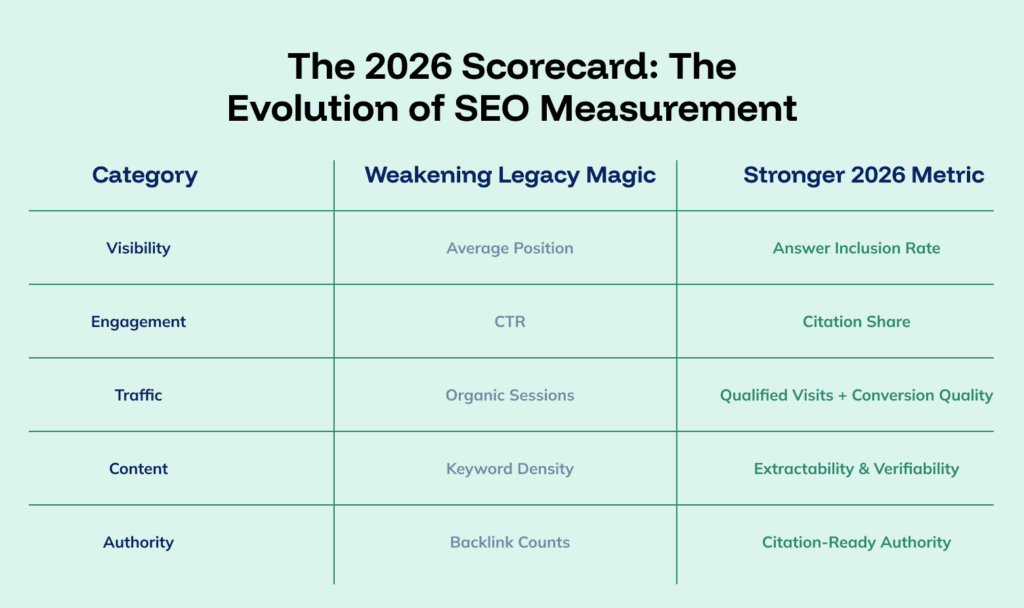
Legacy SEO KPIs vs. 2026 AI-Era Growth KPIs
| Category | Weakening Legacy Metric | Why It Declines | Stronger 2026 Metric | How to Measure |
| Visibility | Average Position | AI answers redefine “position” | Answer Inclusion Rate | Track panels across AI surfaces |
| Engagement | CTR | AI summaries reduce clicks | Citation Share + Assisted Clicks | Monitor citations and downstream conversions |
| Traffic | Organic Sessions | Zero-click behavior rises | Qualified Visits + Conversion Quality | Attribute revenue per AI-informed visit |
| Content | Keyword density | LLMs reward clarity & verifiability | Extractability + Claim Verifiability | Add definitions, tables, citations |
| Authority | Backlink counts | Quantity < credibility | Citation-Ready Authority | PR, expert sources, structured claims |
| Reporting | SERP dashboards | AI reporting is aggregated | Multi-surface visibility | Combine GSC, logs, AI monitoring |
What Still Works: Core Content Qualities AI Systems Reward
AI-mode behavior, driven by dense retrieval, reasoning layers, and pairwise passage ranking, consistently prioritizes content that meets these foundational criteria:
- Technically accessible: Fast, crawlable, indexable pages with clean structure and machine-readable elements (schema, headings, modular sections). These ensure content can be retrieved and chunked efficiently during passage-level evaluation.
- Topically deep: Comprehensive, task-resolving coverage that answers subqueries in isolation. Depth improves passage utility, making your content more competitive in pairwise ranking and synthesis steps.
- E-E-A-T strong: Clear expertise, transparent authorship, credentials, firsthand experience, and consistent sourcing, all of which increase trust signals evaluated during model reasoning and citation selection.
High-quality, factual, and easily verifiable content increases the probability of LLM citation, a pattern consistently supported by observed AI citation behavior across platforms.
How to Optimize Content for AI Retrieval, Extraction & Citation
Retrieval: How to Help AI Models Find the Right Passage
AI retrieval systems surface content at the passage level, not the page level. To increase discoverability:
- Map topic clusters directly to real decision journeys and user intents.
- Use descriptive, intent-aligned headings that mirror likely subqueries generated during fan-out expansion.
- Structure each section so it can stand alone when retrieved out of context.
Extraction: Write Content in Formats AI Can Reliably Reuse
Models prefer content that is cleanly modular and easy to recombine in synthesis. Improve extractability by:
- Providing definition blocks for key terms that answer “what is X?” subqueries.
- Using comparison tables, pros/cons lists, and step-by-step frameworks increases the chance of being selected during pairwise passage ranking.
- Keeping passages semantically complete and non-redundant.
Grounding: How to Increase Your AI Citation Probability
Citation selection favors passages that include:
- Verifiable facts, quantitative claims, and named sources.
- Clear semantic triples (e.g., X provides Y because Z) that improve confidence in attribution.
Supporting signals from observed AI behavior:
- AI Overview queries with <100 searches/month appear in 68% of triggers, showing that citation does not correlate with keyword volume.
- Low-CPC keywords dominate AI Overviews at a 95% share, indicating that grounding strength, not commercial value, drives inclusion.
Recency: Keep Information Fresh to Maintain AI Relevance
Models deprioritize outdated content. Refresh:
- Pricing, feature sets, and availability.
- Requirements, regulations, and evolving standards.
- Any factual attributes that impact entity correctness or decision-making.
Frequent updates improve both retrieval relevance and citation reliability.
Building a Modern 2026 AI-Search Analytics Stack
How to Build an AI Query Visibility Panel
Create a recurring intelligence layer that tracks how AI systems describe, retrieve, and position your brand. Monitor high-value prompts across key intent types:
- Informational
- Comparison/alternatives
- How-to and procedural
- Troubleshooting
- Brand queries and branded prompts
Each week, log:
- Inclusions and citations across major AI surfaces.
- AI-generated descriptions of your brand or products.
- Competitor presence and share of answer.
- Follow-up questions the AI generates (revealing hidden intents and subqueries).
This forms your core visibility signal, what the AI believes your brand is, and where it positions you.
How to Connect AI Visibility to Business Outcomes
Tie AI exposure to business impact by integrating search intelligence with your CRM. Track:
- Assisted conversions influenced by AI-cited or AI-summarized content
- AI-touch revenue, including pipeline or retention tied to AI-driven sessions
- Brand demand trends, reflected in branded queries and prompt volume over time
This transforms AI visibility from a diagnostic metric into a measurable revenue driver.
How to Reframe Search Console Data in the AI Era
Google Search Console remains an essential diagnostic tool, but its traditional metrics now require reinterpretation:
- CTR and average position should be treated as directional, not definitive
- Neither metric captures AI Overview impressions, AI interactions, passage-level retrieval, or non-click influence
GSC becomes one component of a broader analytics stack, not the source of truth for performance.
Why Trust & Accuracy Are Now Core to AI Visibility
AI systems can misinterpret, distort, or hallucinate brand attributes, creating reputational and conversion risk if those inaccuracies spread across AI surfaces.
To protect brand accuracy:
- Maintain canonical truth pages: Publish definitive, up-to-date sources of record for product facts, policies, pricing, and brand positioning. These serve as grounding anchors for AI systems.
- Monitor inaccuracies systematically: Track how your brand is described across AI Overviews, AI assistants, and third-party AI platforms. Prioritize corrections for claims tied to safety, compliance, or revenue impact.
- Issue corrections when needed: Use publisher feedback channels, schema reinforcement, and authoritative updates to reduce hallucination risk and re-align AI outputs with verified information.
Trust is now a measurable component of performance because AI visibility without accuracy can erode credibility, conversions, and long-term brand equity.
Final Thoughts: Preparing for the AI-First Search Landscape
Traditional SEO isn’t disappearing; it’s evolving into a broader discipline of search presence and answer-layer authority.
In a landscape where AI-generated answers serve as the first touchpoint for billions of searches each month, the metrics that matter most are those that measure visibility and trust inside the AI answer layer, not just performance below it.
Brands that invest in:
- AI visibility
- Extractable, verifiable content
- Entity-level authority and accuracy
- High-quality, conversion-ready pathways
will outperform competitors who continue relying solely on rank tracking and organic session volume.
The future of SEO belongs to teams that understand search happens everywhere, not only in search engines, but across AI assistants, answer surfaces, multimodal interfaces, and reasoning-driven retrieval systems.
SEO & AI Visibility FAQs
Common questions and answers from our experts:
How do I measure AI visibility across Google, Copilot, and ChatGPT?
Develop a fixed prompt panel and track it weekly. Monitor:
- When your brand is included or cited
- How each AI system summarizes or describes your brand
- Competitor visibility and share of answer
Platforms like Profound, aHrefs, or Semrush can automate portions of this tracking and provide trend-level insight across multiple AI surfaces.
What content formats are most likely to be cited in AI answers?
AI systems most reliably extract and reuse formats that are modular, unambiguous, and fact-rich, including:
- Definitions
- Tables and structured comparisons
- Step-by-step guides
- Comparison frameworks
- Expert explanations
- Claims backed by data or named sources
These formats align closely with how LLMs rank, evaluate, and assemble passages during synthesis.
Does ranking still matter?
Yes, but far less than before. Rankings describe what appears below the answer layer, while citations and inclusions shape what users see first. In many queries, being cited in the AI-generated answer matters more than where you rank in the traditional SERP.
How should we forecast traffic for 2026?
Use forecasting models built around AI-era behavior, including:
- CTR compression curves
- Higher-intent click share
- Assisted conversion attribution
- AI-driven demand trends
Avoid traditional rank → CTR → session models, they no longer reflect how users interact with AI-first results.
What is “entity optimization” in practical terms?
It means ensuring your brand, people, products, and claims are consistently represented as structured entities with accurate attributes across:
- Your website
- Authoritative third-party databases
- Marketplaces, profiles, and knowledge sources
This strengthens search engine understanding and improves the accuracy of AI-generated summaries, comparisons, and citations.
