



SEO vs GEO vs AEO: What They Are, Differences & How To Use Them

Published: July 07, 2026
Share on LinkedIn Share on Twitter Share on Facebook Click to print Click to copy url
Summarize with ChatGPT

Search is changing, and so is the way brands earn visibility. While traditional SEO is still essential, AI-powered platforms like ChatGPT, Google Gemini, Perplexity, and Google’s AI Overviews are creating new opportunities for users to discover content.
That’s why understanding SEO vs GEO vs AEO has become increasingly important for marketers.
In this guide, we’ll explain what each strategy is, how they differ, how they work together, and how you can use all three to build a search strategy that drives visibility across both traditional search engines and AI-powered search experiences.
Why SEO, GEO, and AEO All Matter
People aren’t just searching differently, they’re finding information differently. Traditional search engines like Google and Bing still play a central role, but they’re no longer the only place users go for answers. AI-powered experiences like Google AI Overviews, ChatGPT, Perplexity, and Gemini are becoming a regular part of the customer journey, delivering direct answers instead of a list of links.
This shift has changed what it means to be visible online.
According to SparkToro, nearly 60% of Google searches now end without a click, underscoring how users are increasingly finding answers directly within search experiences rather than visiting websites.
Ranking well in search results is still important, but today’s brands also need to earn placement within AI-generated responses and answer-focused search experiences. That means marketers need to think beyond traditional SEO and consider how their content performs across multiple discovery channels.
What Is SEO? (Search Engine Optimization)
Search Engine Optimization (SEO) is the practice of improving your website so search engines can easily crawl, understand, and rank your content for relevant searches. The goal is simple: increase qualified organic traffic by helping your pages appear when potential customers are looking for information, products, or services.
Although search has evolved, SEO remains the foundation of digital visibility. Every AI-powered search experience still relies on high-quality, trustworthy content pulled from the web. Without a strong SEO strategy, your content is less likely to be discovered, indexed, or viewed as a reliable source.
Modern SEO typically consists of three core areas:
Technical SEO
Technical SEO ensures your website is accessible to both users and search engines. This includes improving crawlability, fixing indexation issues, optimizing Core Web Vitals, creating a logical site architecture, and delivering a fast, mobile-friendly experience.
On-Page SEO
On-page SEO focuses on creating content that satisfies search intent. This includes optimizing titles, headings, metadata, internal links, images, and page structure while publishing content that thoroughly answers users’ questions.
Off-Page SEO
Off-page SEO builds authority beyond your website. High-quality backlinks, brand mentions, digital PR, reviews, and other trust signals help search engines determine whether your content deserves to rank above competitors.
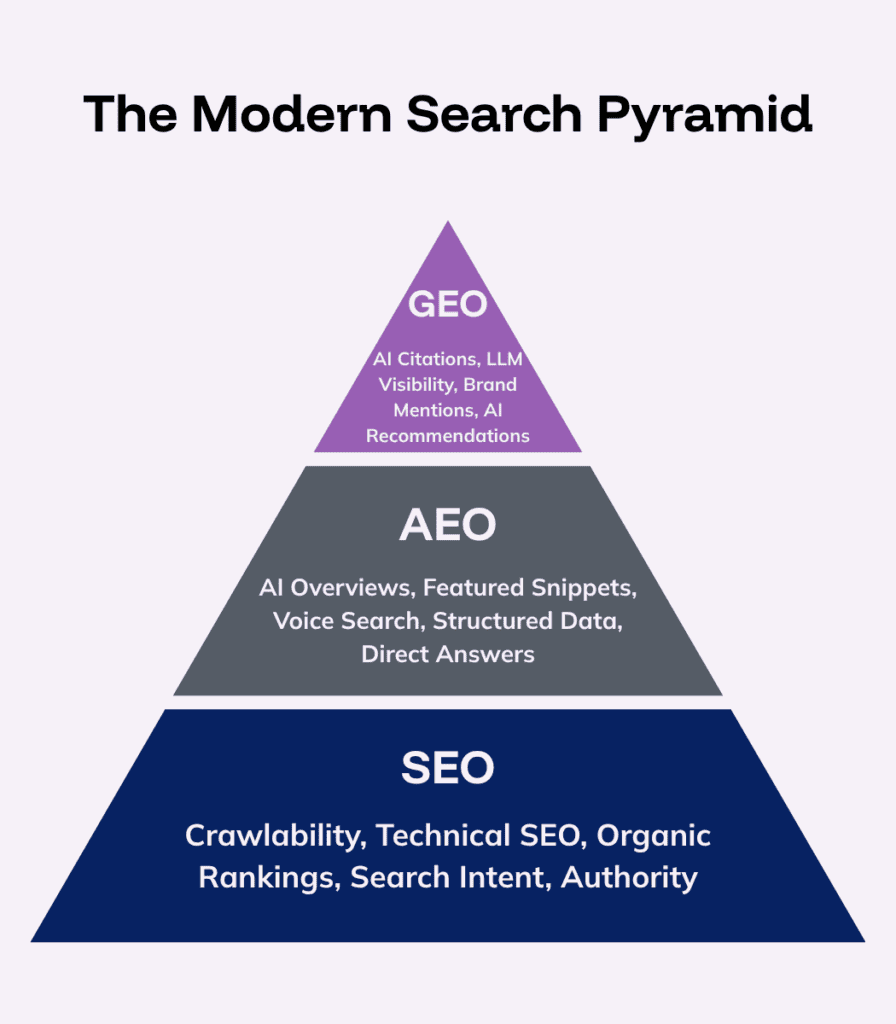
Together, these three pillars establish the authority that fuels every other visibility strategy. Strong SEO doesn’t just improve rankings—it creates the technical and content foundation that makes AEO and GEO possible as AI continues to reshape how people search.
What Is GEO in Marketing? (Generative Engine Optimization)
Generative Engine Optimization (GEO) is the practice of optimizing your content so AI-powered platforms can find, understand, and reference it when generating answers.
Unlike traditional search engines, tools like ChatGPT, Google Gemini, Perplexity, and Google’s AI Overviews don’t simply return a list of webpages. They synthesize information from multiple sources into a single response. The goal of GEO is to increase the likelihood that your brand is one of those trusted sources.
Rather than asking, “How do I rank #1?” GEO asks a different question: How do I become a source AI trusts enough to cite?
That means creating content that’s accurate, well-structured, and backed by authority. While every AI platform evaluates content differently, they generally favor pages that:
- Clearly answer user questions.
- Demonstrate expertise and credibility.
- Are easy to summarize or reference.
- Are supported by authoritative backlinks and brand mentions.
GEO isn’t a replacement for SEO—it’s an extension of it. The stronger your technical SEO, content quality, and brand authority, the more likely AI systems are to recognize your website as a reliable source.
What Is AEO in Digital Marketing? (Answer Engine Optimization)
Answer Engine Optimization (AEO) focuses on helping your content become the answer, not just another search result.
Instead of optimizing only for clicks, AEO helps your content appear in AI Overviews, Featured Snippets, People Also Ask results, and voice search experiences like Siri and Alexa.
Answer engines prioritize content that is clear, direct, and easy to extract. Leading with a concise definition, followed by supporting details, makes it easier for AI systems to surface your content.
Some common AEO best practices include:
- Answering the primary question near the top of the page.
- Using headings that mirror common search queries.
- Adding FAQ sections for related questions.
- Organizing information with lists, tables, and step-by-step instructions.
- Implementing structured data where appropriate.
While AEO can contribute to zero-click searches, it also builds brand authority by positioning your business as the trusted source users see first.
SEO vs GEO vs AEO: Key Differences
Although SEO, GEO, and AEO all aim to increase visibility, they optimize for different outcomes.
Understanding those differences can help you prioritize your efforts and build a strategy that reaches users across traditional search engines and AI-powered platforms.
Think of it this way:
- SEO helps search engines rank your content.
- AEO helps answer engines surface your content.
- GEO helps AI platforms reference your content.
Rather than viewing these as competing strategies, it’s more helpful to think of them as layers of the same search ecosystem. Each one addresses a different way people discover information online.
| Strategy | Primary Goal | Where It Appears | Core Focus | Key Metrics |
| SEO | Increase rankings and organic traffic | Google, Bing, traditional search results | Technical SEO, content quality, authority, backlinks | Rankings, impressions, organic traffic, conversions |
| AEO | Become the direct answer to a question | AI Overviews, Featured Snippets, People Also Ask, voice search | Clear answers, structured content, schema markup | Snippet ownership, AI Overview visibility, voice search appearances |
| GEO | Increase brand mentions and citations in AI-generated responses | ChatGPT, Gemini, Perplexity, Claude, Copilot | Authoritative content, expert insights, digital PR, brand authority | AI citations, brand mentions, share of voice across AI platforms |
A single piece of content can support all three. A comprehensive guide might rank in Google’s search results, earn a Featured Snippet through clear formatting, and later be cited by ChatGPT or Perplexity because it provides trustworthy, original information.
How to Use SEO, GEO, and AEO Together in Your Marketing Strategy
The most successful brands don’t treat SEO, GEO, and AEO as separate initiatives. Instead, they build on a strong SEO foundation and layer in optimizations that improve visibility across AI-powered search experiences.
Gartner predicts that traditional search engine volume will decline by 25% in 2026 as users shift toward AI assistants and other virtual agents.
Here’s how to bring all three together.
1. Build a Strong SEO Foundation
Everything starts with SEO. Before worrying about AI citations or Featured Snippets, make sure your website is technically sound and your content aligns with search intent.
Start by auditing your site’s:
- Crawlability and indexation
- Site speed and Core Web Vitals
- Mobile usability
- Internal linking
- Content quality and topical coverage
Just as importantly, demonstrate expertise. Publish content written by subject matter experts, cite reputable sources, and make it easy for users—and search engines—to understand who is behind your content. These trust signals support both traditional rankings and AI visibility.
2. Optimize Your Content for Answer Engines
Once your SEO foundation is in place, look for opportunities to make your content easier for answer engines to extract.
Simple structural changes can have a meaningful impact. Consider:
- Answering the primary question within the first paragraph.
- Using H2s and H3s that match common search queries.
- Adding FAQ sections that address related questions.
- Breaking up complex information with lists, tables, and comparison charts.
- Implementing relevant structured data where appropriate.
Remember, answer engines prioritize clarity. If someone can understand your answer in under 60 seconds, AI systems are more likely to surface it.
3. Create Content Worth Citing
Ranking is one thing. Being cited is another.
Generative AI platforms are more likely to reference content that adds something new to the conversation rather than repeating what’s already available online.
Instead of publishing another generic “what is SEO” article, look for opportunities to create content that includes:
- Original research or survey data
- Industry benchmarks
- Proprietary frameworks or methodologies
- Expert opinions and commentary
- Case studies with measurable results
The more unique your insights, the more likely AI systems are to recognize your content as a valuable source.
4. Invest in Brand Authority
GEO isn’t just about what’s on your website. It’s also about how your brand is recognized across the web.
Mentions from reputable publications, backlinks from authoritative websites, podcast appearances, conference presentations, and digital PR all help reinforce your credibility. Those external signals can influence how both search engines and AI platforms evaluate your brand.
In other words, authority isn’t built with one great article—it’s built through consistent visibility across your industry.
5. Measure Performance Across Every Search Experience
Each strategy has its own success metrics, so it’s important to look beyond traditional SEO reporting.
Track metrics like:
- SEO: Rankings, organic traffic, impressions, click-through rate, and conversions.
- AEO: Featured Snippets, AI Overview appearances, People Also Ask visibility, and voice search performance.
- GEO: AI citations, brand mentions in ChatGPT, Gemini, and Perplexity, and overall share of voice across AI platforms.
Monitoring these metrics together gives you a more complete picture of your brand’s visibility and helps identify new opportunities as search continues to evolve.
Conclusion
The debate around SEO vs GEO vs AEO isn’t about picking one strategy — it’s about adapting to how people search today. Traditional search engines still matter, but AI-powered platforms are becoming a bigger part of how users discover information and brands.
Not sure where your business stands? Go Fish Digital can help. Whether you need an SEO Audit to improve your organic performance or an AI Search Audit to understand how your brand appears in AI-generated search experiences, our team can identify opportunities and build a strategy that keeps you visible wherever your audience searches.
Frequently Asked Questions
What is the difference between SEO, GEO, and AEO?
SEO focuses on improving your visibility in traditional search engine results. AEO helps your content appear as direct answers in features like Google’s AI Overviews and Featured Snippets. GEO focuses on increasing the likelihood that generative AI platforms, such as ChatGPT, Gemini, and Perplexity, reference or cite your content when generating responses.
Does GEO replace SEO?
No. GEO builds on SEO rather than replacing it. Strong technical SEO, high-quality content, and established authority all make it more likely that AI systems will discover and trust your content.
Is AEO only for AI search?
No. While AEO supports AI-powered search experiences, it also helps your content appear in Featured Snippets, People Also Ask results, and voice search responses. Many of the same optimization techniques improve both traditional and AI-powered search visibility.
Which should I prioritize: SEO, GEO, or AEO?
Start with SEO. Without a strong technical foundation and high-quality content, it’s difficult to succeed with either AEO or GEO. Once your site is performing well in traditional search, incorporate answer-focused formatting and create original, authoritative content that AI platforms are more likely to reference.
