

New Visibility in Search: AI Answers, Citations & Evolving SEO Metrics

Published: May 11, 2026
Share on LinkedIn Share on Twitter Share on Facebook Click to print Click to copy url
Summarize with ChatGPT

Search visibility used to be a relatively simple idea: if your pages ranked well, earned impressions, and drove clicks, you were visible. That model still matters, but it is no longer complete. In 2026, visibility increasingly happens inside an answer layer that sits above or alongside traditional organic results, where Google and other AI-driven interfaces synthesize information, cite sources, and shape brand perception before a user ever visits a website. Google’s own rollout of AI Overviews and AI Mode makes that shift explicit, while Pew Research has found that users are less likely to click external links when AI-generated summaries appear.
That means brands now need to think about more than rank position. They need to ask whether they are being included in AI-generated answers, whether they are being cited, how prominently they appear, and whether they are being described accurately. Visibility is no longer just about winning a blue link. It is about being selected, summarized, and trusted in environments where the answer often arrives before the click.
For SEO teams, this is not the end of traditional search strategy. It is an expansion of it. Rankings, crawlability, site performance, and conversion data still matter. But they now sit beside a new set of signals tied to AI inclusion, entity understanding, and source trust. The brands that adapt fastest will not be the ones chasing every new acronym. They will be the ones that build useful, well-structured, evidence-backed content that both people and machines can confidently rely on.
What “new visibility in search” actually means
At its core, new visibility in search means your brand can influence a search journey even when the user never clicks through to your site. In the legacy model, visibility was measured through impressions, average position, click-through rate, and traffic. In the newer model, visibility also includes whether your content or brand is incorporated into AI-generated answers, whether your site is cited as a source, and whether the summary reflects your expertise accurately. Google now openly describes AI features in Search as experiences that can help users find websites, which is a useful signal that the search interface itself has expanded beyond link lists into synthesized discovery.
This shift is closely tied to zero-click behavior. When an answer is presented directly in the interface, users often complete part of their research without visiting a publisher at all. Pew Research’s analysis of U.S. browsing behavior found that users were less likely to click links when an AI summary appeared in Google results. That does not mean SEO is dead. It means search visibility now includes exposure, influence, and framing that may occur before traffic is earned.
It also means exact-match keyword thinking is less useful on its own. Google’s AI Mode uses a “query fan-out” technique that breaks a question into subtopics and runs multiple related searches behind the scenes. In practice, that means a brand’s visibility may depend on whether it is relevant to a family of connected questions, not only the single term a strategist happens to track in a rank tool.
A useful way to explain this to stakeholders is to separate visibility into two layers. The first is the familiar retrieval layer: rankings, snippets, rich results, and clicks. The second is the answer layer: inclusion in summaries, citations, prominence within the response, and the accuracy of how your brand is framed. Strong search strategy now has to serve both.
Recent Google updates reshaped what visibility looks like
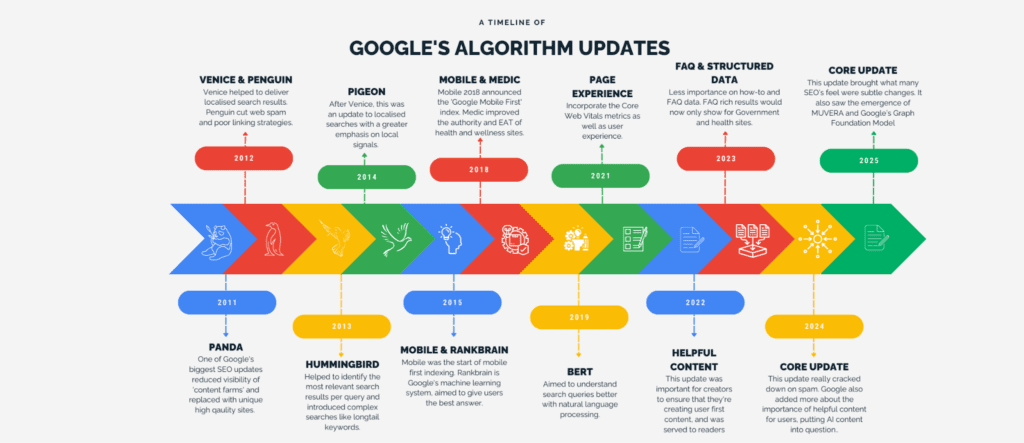
Google’s recent update history helps explain why this shift feels so pronounced. Search Central says core updates are broad changes to Google’s algorithms and systems, rolled out several times a year. In parallel, Google has continued refining spam systems and content quality guidance, pushing site owners toward original, reliable, people-first content rather than content built primarily to manipulate rankings.
The March 2024 core update was especially significant because Google paired it with new spam policy updates and stronger language around reducing low-quality, unoriginal content in Search. Google also now states in its ranking systems guide that the helpful content system is part of its core ranking systems rather than a separate named system. That matters because it reinforces a broader reality: quality, originality, and usefulness are not niche optimization ideas. They are central to how Google evaluates search visibility at scale.
The update cadence has not slowed. Google’s Search Status Dashboard shows core updates in March 2025, June 2025, December 2025, and March 2026, underscoring that the search landscape is still changing in real time. For marketers, the takeaway is not to obsess over every rollout rumor. It is to recognize that visibility is being shaped by an ongoing quality framework, not a static checklist.
This is also where E-E-A-T becomes more useful as a strategic lens. Google’s people-first content guidance says its ranking systems seek helpful, reliable information created to benefit people, and that quality raters are trained to evaluate factors tied to experience, expertise, authoritativeness, and trustworthiness. Google further notes that trust is the most important of those elements. In practical terms, that raises the value of first-hand insight, credible sourcing, clear authorship, and consistency across the web.
From rankings to inclusion: the new metrics of search visibility
If search visibility now exists partly inside answers, the measurement model has to evolve with it. Rankings and organic sessions still belong in reporting, but they no longer tell the whole story. A stronger framework includes at least five additional questions: Were we included in the answer? Were we cited or only mentioned? How prominent was our inclusion? Was our brand or expertise described accurately? And across how many related prompts did we appear? Those are the types of signals that help explain brand exposure in AI-led search journeys.
\This matters because AI interfaces do not all present sources in the same way. Google may synthesize information within Search and link to source cards. ChatGPT search brings web information directly into a conversation and surfaces sources. Claude’s web search feature similarly provides direct citations when it incorporates web information into responses. The mechanics vary, but the strategic implication is the same: inclusion and attribution now deserve measurement alongside position and traffic.
For leadership teams, the cleanest reporting model is not overly technical. A quarterly view can track a set of priority prompts by engine and record selection status, citation status, summary accuracy, and downstream indicators like branded search lift, assisted conversions, or influenced pipeline. That approach keeps the reporting grounded in business outcomes rather than turning AI visibility into a vanity metric. When the interface changes, user behavior changes too, so performance measurement has to adapt.
Where visibility now lives: AI Overviews and answer engines
Google is not the only place where users now encounter synthesized answers, but it remains the most important starting point for most brands. Google’s AI Mode announcement describes a more conversational search experience that supports longer, more nuanced questions and follow-up exploration. That matters because it expands the kinds of queries users are likely to ask inside search itself, particularly for research-oriented journeys that once required multiple searches and site visits.
Outside Google, answer engines and assistants are reinforcing the same trend. OpenAI says ChatGPT search connects people with original, high-quality content from the web and incorporates it directly into conversation. Anthropic says Claude can search the web and provide direct citations so users can fact-check sources. In other words, visibility is no longer confined to the SERP. It now spans a broader ecosystem of interfaces where source trust, extractable answers, and brand clarity affect whether your content is surfaced at all.
The practical implication is that brands should stop optimizing for a single results page and start thinking in terms of answer environments. The question is no longer just “Do we rank?” It is also “Are we a source these systems can confidently retrieve, interpret, and cite?” That is a more demanding standard, but it also rewards stronger fundamentals. (Google for Developers)
Suggested visual: A comparison table showing Google AI Overviews / AI Mode, ChatGPT search, and Claude web search across source display, follow-up behavior, and citation visibility.
Entities, semantics, and why the answer layer favors clarity
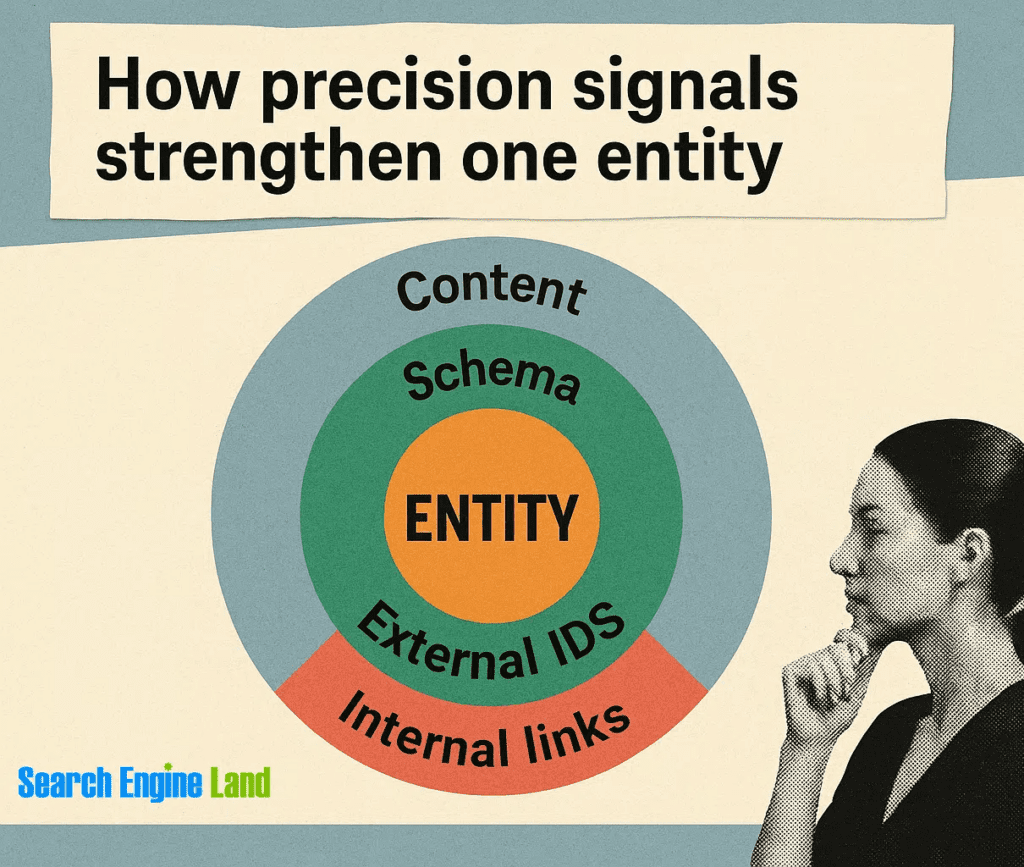
One reason the new visibility model feels different is that search engines and AI systems are increasingly trying to understand things, not just strings. Brands, products, people, locations, and concepts all function as entities that can be connected to topics and attributes across the web. That makes consistency more important. If your site, structured data, author pages, and third-party references all describe the same organization clearly, it becomes easier for search systems to interpret what you are authoritative about.
Google’s structured data documentation does not promise AI citations, but it does say structured data helps Google understand content and that Organization markup can help disambiguate your organization in search results. That is a meaningful distinction. Technical clarity alone is not enough, but it supports the broader trust and interpretation layer that determines how confidently a system can connect your brand to a topic.
This is also where E-E-A-T becomes more than a buzzword. Google’s documentation says trust is the most important element, and that some content is helpful because of the experience it demonstrates while other content is helpful because of the expertise it shares. For brands, that argues for stronger author bios, first-hand examples, transparent sourcing, original research, and consistent naming conventions across owned and earned media. The more corroborated and coherent your entity signals are, the easier it is for search systems to treat your content as dependable.
Measuring AI visibility alongside traditional SEO KPIs
A practical AI visibility program does not need to be overly complex. Start with a curated set of priority prompts tied to your highest-value products, services, and informational themes. Evaluate those prompts across the environments that matter most to your audience. Then establish a baseline: where are you included, where are you cited, and where are you absent? Because Google’s AI experiences use related-query expansion, it is smart to group prompts into clusters rather than treat every query as an isolated unit.
From there, create a recurring review cycle. Monthly or quarterly, revisit the prompt set and assess changes in inclusion, source prominence, and description quality. Pair that view with your traditional SEO reporting in Search Console and analytics so stakeholders can see how answer-layer visibility relates to rankings, traffic, branded demand, and conversions. Google’s Search Essentials remain the baseline for eligibility and performance in Search, while AI-layer tracking adds a newer dimension of interpretation and brand influence.
The goal is not to replace SEO KPIs. It is to stop pretending they are sufficient on their own. In a search environment where users can get useful summaries before they ever click, marketing teams need a way to measure influence before the visit as well as performance after it.
Optimizing content for the new visibility landscape
The strongest content for this environment tends to share a few traits. It answers questions clearly, provides evidence, demonstrates first-hand knowledge or expertise, and is easy for search engines to crawl and interpret. Google’s people-first content guidance and Search Essentials both point in that direction: create content that benefits people, avoid content built primarily for ranking manipulation, and make sure your pages are eligible to appear in Search at all.
That makes answer-first structure more valuable. Clear headings, concise definitions, direct responses near the top of a section, and supporting detail beneath them all improve readability for people while making the content easier for retrieval and summarization systems to parse. Original examples, proprietary data, and expert commentary strengthen the page further because they differentiate it from generic summaries that say the same thing as everyone else. Google’s guidance on using generative AI content is relevant here too: AI can be useful in content workflows, but scaling pages without adding value may violate spam policies.
Technical hygiene still matters. Google says Search Essentials are the core parts of what makes content eligible to appear and perform well in Search, and Core Web Vitals remain part of Google’s view of real-world page experience. Structured data can further help Google understand article and organization details. None of those elements guarantees AI inclusion, but together they reduce friction and improve the odds that your content can be discovered, understood, and trusted.
The broader opportunity is organizational. The brands best positioned for this shift are not treating AI visibility as an SEO side quest. They are aligning content, SEO, analytics, PR, and subject-matter expertise so that the market sees one coherent, evidence-backed brand across owned pages and the wider web.
| Before At Go Fish Digital, content strategy is a thinking partnership rooted in sharp intuition, proprietary intelligence, and a shared source of truth. | After We build content strategies that show your team what to create, why it matters, and how it drives growth. Our approach identifies content gaps, aligns topics to what your audience is searching for, and turns that insight into a clear plan tied to SEO, AI visibility, and conversions. |
SEO in 2026: visibility is now a selection problem
The biggest strategic change is this: SEO is no longer only about ranking well enough to be chosen by a user. Increasingly, it is also about being trustworthy and useful enough to be chosen by the system before the user ever decides where to click. Google’s AI search experiences, ongoing core updates, and people-first content guidance all point toward that direction of travel, while research on AI summaries suggests user behavior is already adapting around it.
For brands, that raises the bar, but it also clarifies the path forward. Build content that deserves to be cited. Strengthen the signals that make your expertise easy to verify. Measure not just where you rank, but where you are included and how you are framed. And treat visibility as something that happens across search interfaces, not only inside the classic SERP.
The brands that win this next phase of search will not necessarily be the ones publishing the most content. They will be the ones creating the most useful, most trustworthy, and most extractable content in their space — the kind that earns both rankings and selection.

About Katie Rupe
Katie Rupe is an SEO Strategist focused on organic visibility, content strategy, and measurement. She helps brands adapt to changes in search behavior by connecting technical SEO, content quality, and performance reporting.