


Agentic AI for Search: What Makes Barracuda Different

Published: December 05, 2025
Share on LinkedIn Share on Twitter Share on Facebook Click to print Click to copy url

Most AI tools help teams generate more tasks. Barracuda was built for something different.
As the intelligence engine behind E.C.H.O., Barracuda analyzes semantic structure, identifies gaps that limit authority, and highlights the topics users actively search for within their non-linear paths. That includes where user interest forms, which queries shape demand, and where prospects expect to find answers as they move between channels.
Instead of adding another dashboard to manage, it standardizes how ranking signals, coverage depth, and internal linking are evaluated. Because the model reflects how Google, TikTok, and Meta organize and distribute information, the recommendations align with what actually influences visibility and discovery.
This article breaks down how Barracuda works, how it differs from general agentic AI tools, and the measurable outcomes it has delivered for our own site and for clients.
Why E.C.H.O. Needed an Engine
Strategic guidance only works when it’s consistent, accurate, and repeatable across every account. Most teams rely on senior leaders to diagnose issues, interpret ranking signals, and decide what to fix first.
That creates bottlenecks: strategy moves at the pace of the people with the deepest expertise.
E.C.H.O. needed an engine that could standardize this work and remove bottlenecks altogether. Barracuda fills that gap by handling strategy components that are difficult to scale, including:
- Mapping entity relationships across pages and clusters.
- Measuring coverage completeness to show where topics are thin or overlapping.
- Clustering related queries to reveal how platforms interpret a subject.
- Identifying which signals matter most for visibility across search and AI systems.
Barracuda turns E.C.H.O. from a guidance layer into a repeatable system.
Every account manager gets access to the same level of insight, and recommendations are grounded in a shared model that reflects how platforms evaluate and surface content. Strategy becomes scalable because the intelligence behind it is no longer limited to individual expertise.
But, What Does Barracuda Really Do?
Barracuda isn’t only built to generate content or automate surface-level tasks. It also helps teams understand how platforms read, rank, and interpret information, and then turn that into guidance E.C.H.O. can activate every week.
Here’s what it handles behind the scenes:
- Platform-modeled scoring
Aligns recommendations with the signals Google, TikTok, and Meta reward, rather than generic AI assumptions.
- Semantic clustering and topic mapping
Groups related queries, exposes thin or overlapping areas, and shows where topical strength needs reinforcement.
- Entity and relationship detection
Identifies missing or inconsistent entities, weak connections between concepts, and pages competing with one another.
- Internal linking and architecture checks
Surfaces broken link paths, flat structures, and missing hubs that limit crawl clarity and authority transfer.
- Coverage completeness scoring
Measures whether a topic is built out enough to deserve visibility and lists the assets, schema, or expansions still required.
- Client-specific adaptability
Supports custom scoring models, dashboards, and tools when a client need falls outside standard workflows.
- Cross-channel alignment checks
Evaluates how content, clusters, and authority signals interact across SEO, GEO, and paid distribution so channels strengthen one another instead of diluting impact. Highlights where coverage or positioning creates overlap, where traffic handoff breaks down, and where integrated efforts can amplify visibility.
In short: Barracuda pinpoints where authority is earned or weakened, clarifies the steps that strengthen visibility, and ensures those gains support SEO, GEO, and paid channels without working against one another.
What Is Agentic AI and How Barracuda’s Approach Differs From General Tools
To expand on what we covered in our blog Why E.C.H.O. Is the Foundation for Modern Marketing, agentic AI describes systems that can plan, decide, and execute toward a goal with minimal manual input. These systems use reasoning and context to complete multi-step tasks instead of automating one-off actions.
Barracuda takes a different approach.
Its reasoning is modeled around how platforms interpret intent, relationships, and topical coverage. It evaluates clusters, entities, and linking patterns in the same structural terms Google, Meta, and other systems rely on when deciding what to surface.
This gives each E.C.H.O. agent the context needed to act without producing steps that weaken visibility or add unnecessary work. Instead of following generic agent chains, Barracuda keeps all actions inside a defined model based on platform behavior. The result is consistent guidance that strengthens coverage depth, internal linking, and semantic clarity across every account.

Feature and Capability Snapshot: Go Fish Digital’s Barracuda vs. Other Proprietary Marketing Platforms
Many proprietary platforms optimize around campaign performance, predictive signals, and channel efficiency. Barracuda focuses on something different: structural clarity, cluster completeness, and the signals search engines and AI systems use to decide which brands surface.
This makes Barracuda a separate class of intelligence engine. Rather than modeling audience behavior or media trends, it models how platforms interpret meaning, relationships, and topical strength.
The distinctions below outline how that difference shows up in practice:
| Dimension | Barracuda | Other Proprietary Platforms |
| Optimization Focus | Visibility signals, semantic coverage, entity consistency, and AI-readability. | Media efficiency, creative performance, forecasting accuracy, or multi-channel lift. |
| Modeling Source | Modeled on how search engines and AI systems interpret relationships and content structure. | Modeled on audience behavior, ad delivery patterns, or cross-channel performance data. |
| Output Type | Structural recommendations, cluster corrections, linking paths, and coverage requirements. | Forecasts, budget plans, creative insights, or channel-level performance guidance. |
| Primary Use Case | Strengthening topical depth and improving how content is understood, cited, and surfaced. | Improving media results, creative testing cycles, audience reach, or attribution. |
| Data Requirements | Uses page structure, clusters, entities, link maps, and platform response patterns. | Uses historical campaign data, audience segments, spend levels, and performance logs. |
| How It Scales | Through automated analysis and weekly guidance delivered via E.C.H.O. | Through predictive models, dashboards, and media or creative optimization workflows. |
| Role in the Stack | Intelligence layer for search and AI discovery. | Activation or performance layer for media, creative, or analytics. |
Barracuda isn’t competing with media, creative, or predictive tools. It fills the structural gap they don’t address; the underlying clarity and consistency that determines whether content earns visibility across search engines, AI answers, and platform-generated summaries.
Those tools optimize after something is visible.
Barracuda focuses on whether it becomes visible in the first place.
How We Used Barracuda on Our Own Site: GEO Cornerstone Rebuild Case
When we applied Barracuda to our own site, the goal was simple:
Quote: We wanted to see where our GEO content was falling short and how platforms were interpreting the structure, entities, and relationships across those pages.
The analysis surfaced several issues that were holding back visibility, including thin clusters, inconsistent entity coverage, missing grounding signals, and internal links that did not reinforce topic depth.
Barracuda produced a structured readout of what needed to change. It identified which pages should become cornerstones, where consolidation was required, and which relationships needed strengthening to match how platforms understand the topic. It also mapped the prompt expansions AI systems generate around GEO, which shaped the supporting content we built next.
After restructuring these pages and aligning them to the signals Barracuda surfaced, performance shifted in measurable ways:
- +43 percent lift in AI-driven referral traffic.
- +83 percent lift in conversions from AI referrals.
- 25X higher conversion rate compared to traditional search for those same sessions.
These improvements did not come from increasing content volume. They came from correcting structure, coverage, and linking in a way that matches how search engines and AI systems process information. Barracuda showed us exactly what needed attention, and E.C.H.O. turned those insights into weekly actions until the full rebuild was complete.
How Barracuda Works for Clients: MoneyGeek
MoneyGeek’s site contained thousands of insurance guides, each written with strong expertise but without a structure that clearly communicated topical focus to search engines or AI systems. Barracuda encoded more than 4,000 pages to map how closely each piece of content related to its surrounding topics.
The analysis showed where articles overlapped, where clusters were weak, and where entity relationships needed reinforcement.
This produced a clear roadmap. Barracuda identified which pages should be consolidated, which needed redirected, and which topics required expansion to create a stronger and more interpretable cluster. It also surfaced the internal link paths that needed to be rebuilt so high-value content could transfer authority more effectively.an
After implementing these changes, MoneyGeek saw measurable lifts in search visibility:
- +74.8 percent increase in clicks.
- +50.6 percent increase in impressions.
- Stronger authority across core insurance categories.
The work did not rely on publishing more content. It came from improving the structure and relationships between the content that already existed. Barracuda supplied the intelligence behind those decisions, and the results validated how much impact a cluster-first, entity-aware approach can create for large content libraries.
In-Use Example: “Agentic AI Tools” and What It Reveals
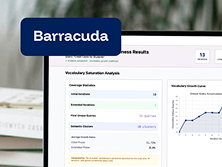
To understand how platforms expand a topic, Barracuda runs iterative fan-out tests that map the related questions an AI system is likely to generate. For the query “agentic AI tools,” Barracuda completed fourteen iterations and identified thirteen unique queries grouped into six semantic clusters.
These patterns showed how compact this topic really is and where coverage gaps exist.

Here is what the analysis surfaced:
- The topic stopped expanding after fourteen iterations, which shows the query set is limited and predictable.
- Those queries fell into six clear clusters: definitions, examples, benefits, automation, platforms, and frameworks.
- The definition and example clusters were the largest, confirming where most search and AI demand sits.
- Only one cluster focused on benefits, which is a gap most competitors are not addressing.
- Because the topic saturates quickly, you only need a small set of focused pages to build complete coverage.
- Competitor content mostly matches the definition cluster but rarely expands into benefits, outcomes, or business impact.
This type of analysis helps E.C.H.O. determine how many assets a cluster needs, what each page must address, and how to connect them in a way that reflects how search engines and AI systems interpret the topic. The result is a complete and predictable cluster that can actually earn visibility.
Conclusion
Barracuda gives teams a clearer view of how platforms interpret structure, relationships, and topical depth. It highlights where coverage is strong, where authority breaks down, and where signals need reinforcement so content can earn visibility across both search and AI systems. Instead of reacting to surface-level metrics, teams get a defined model that shows what actually shapes discovery.
This is what sets Barracuda apart.
By mirroring the logic search engines and AI systems use to understand information, E.C.H.O. can deliver guidance that stays aligned with platform behavior and remains consistent across accounts. Clusters tighten, architecture becomes clearer, and strategic decisions move faster because the underlying rules are no longer ambiguous.
A stronger structure benefits more than organic channels. When coverage, entities, and linking are consistent, paid, social, and content programs stop stepping on each other and start reinforcing the same themes. That alignment creates more coherent pathways for users and reduces the fragmentation that holds back integrated marketing efforts.
Barracuda and E.C.H.O. already support measurable gains for our own site, for MoneyGeek, and for other brands building visibility in AI-shaped environments. If you want a walkthrough of how the system can support your goals, our team can show what the model uncovers.
