

Business Events Marketing That Works for Small Destinations

Published: October 15, 2025
Share on LinkedIn Share on Twitter Share on Facebook Click to print Click to copy url

Small DMOs don’t have the luxury of wasted motion. You’re juggling the same pressure as the big destinations—often with a fraction of the staff, budget, and time.
The good news: You don’t need a bigger budget to run smarter business events marketing. You need a tighter plan, clearer priorities, and targeting that stops chasing “any group” and starts winning the right groups.
Below are practical moves that work for smaller destinations—built for results you can defend.
Do These First: The Highest-Return Moves for Small DMOs
If you only do a few things this quarter, do these in this order.
1. Define your “best-fit” meeting.
Pick your top 2-3 sweet spots (industry, meeting size, season, weekday pattern, drive market vs. fly market). If you can’t describe the perfect piece of business, you’ll waste money targeting everyone.
2. Build one clear message that matches that sweet spot.
Not a list of features—an answer to the planner’s question: “Why here, and why now?” Tie it to outcomes (ease, value, walkability, flexibility, service culture, etc.).
3. Fix the “request” path on your meetings site.
Make it obvious what to do next: submit an RFP, request a sample itinerary, talk to sales, download specs. Remove friction and dead ends.
4. Use your first-party data to expand your reach (without spamming anyone).
Your CRM and email lists are fuel for smarter targeting. Use them to model lookalike audiences and retarget site visitors, not to blast more emails at the same contacts.
5. Put paid media where planners actually behave, not just where the industry “always” shows up.
You don’t need more impressions. You need the right planners seeing the right message repeatedly across the channels they use daily.
Once these are in place, everything else performs better: content, email, trade, paid, and sales outreach.
Provide a Strategic Approach With Limited Dollars
Alignment starts with strategy—and a clear definition of what you’re trying to win.
The fastest way to waste budget is to market broadly and hope the right planners find you. The better move is to focus on planners organizing events that align with your destination’s product, especially in need periods and shoulder seasons, when group business matters most.
When you work with Go Fish Tourism + Business Events, you gain a team that helps you prioritize, build a practical strategy, and support your sales efforts with insights and direction. For more than a decade, we’ve worked inside meetings and sports planning ecosystems, and we know how to engage planners across the full planning cycle.
More Efficient Meetings Media
Meeting planners don’t live only inside trade media. You need to reach them where they spend time online, with tight targeting and creative that earns attention.
A smart digital media approach blends message discipline with performance execution. Powered by the integrated capabilities of Go Fish Digital, including performance-driven media and cross-industry expertise, we build targeted media strategies designed to reach planners based on real behavior signals and decision-stage intent so your dollars go toward meaningful exposure, not vanity reach.
Going beyond conventional methods, we build integrated, cross-device campaigns that use your first-party data opportunities, retargeting, and channel mix (display, social, paid search, and selective trade placements) to keep your destination present throughout the research-to-RFP window.
Leverage Your Planner & First-Party Databases
First-party data is one of the few advantages smaller DMOs can control—and most underuse.
Over the past decade-plus, we’ve fine-tuned audience modeling using first-party data collected through research, relationships, and opt-ins.
We help you use your own first-party data to build larger, qualified audiences in programmatic tools. We don’t share your database or solicit your contacts. We use your data to improve targeting, expand reach to similar planners, and reduce wasted spend.
We can also strengthen performance inside your existing CRM by improving list structure and tagging so meetings marketing emails and sales outreach are cleaner, more relevant, and more likely to convert.
Make Your Meetings Site More Appealing
Your meetings website should function like a sales tool—not a brochure.
We help you prioritize what content your site needs to move planners from curiosity to action: clear positioning, proof points that match your best-fit groups, strong visuals, and direct calls to action (CTAs).
On the creative side, we ensure your business events site looks and feels like a destination that can execute, while staying true to your brand. The goal is simple: reduce friction, increase confidence, and move planners toward an RFP.
Tell Your Story to Drive Interest
Awareness doesn’t happen overnight, and perception doesn’t change on a single campaign. But with consistent messaging and smart targeting, smaller destinations can shape what planners believe about them and win business because of it.
For example, VisitColumbusGA needed to distinguish itself from Columbus, OH, and tell planners a clearer story about Georgia’s second-largest city, its hotel growth, and its convention package. Through our partnership with the destination organization, we helped raise awareness, increase RFP activity, and shift perception of Columbus, GA, as a meetings destination.
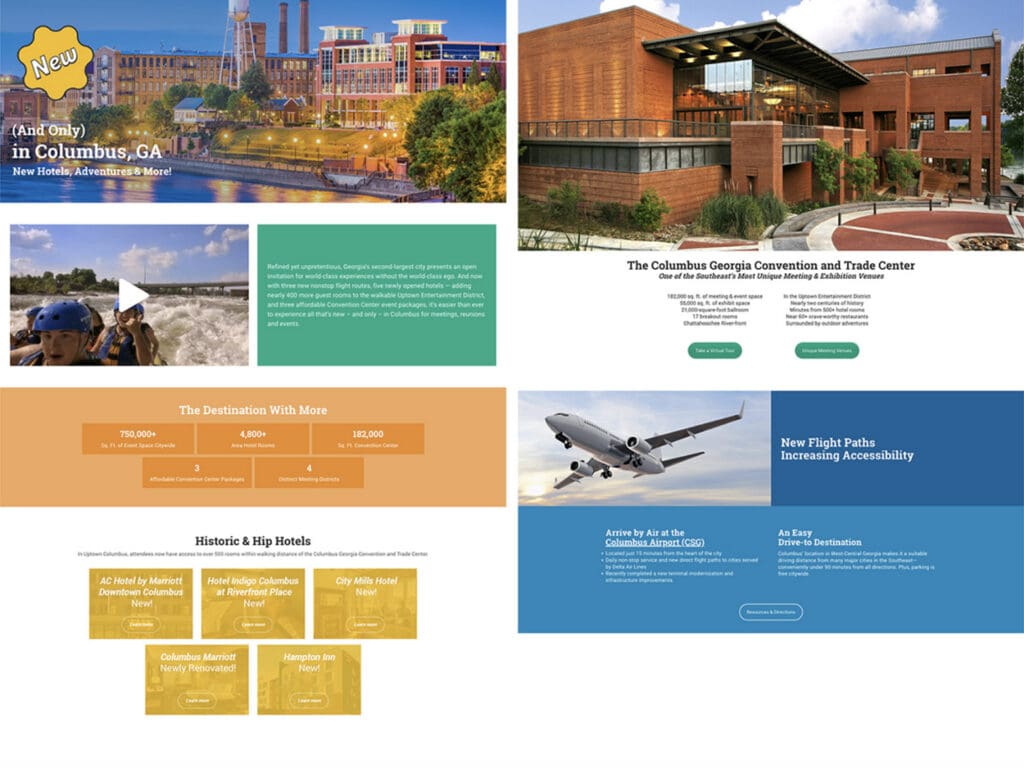
We build stories that speak directly to planners, grounded in what they need to know, delivered with a point of view, and reinforced across channels so it compounds over time.
Identify Your USP
A business events marketing strategy should make your unique selling proposition (USP) unavoidable.
Your USP is what makes your destination stand out. It should be specific enough to guide decisions and strong enough to earn attention. It’s also the backbone of your content because content without a clear differentiator turns into generic copy that no planner remembers.
We use your USP to guide content planning and writing and show planners how your destination supports an exceptional meeting or event.
Support Sales With Marketing
Smaller teams can’t afford the usual sales-versus-marketing disconnect. Your marketing should directly support what sales needs to book business.
Go Fish Tourism + Business Events bridges that gap by aligning strategy, messaging, and campaigns with real sales priorities so the group sales team gets usable tools and the marketing team gets time back.
We can also build integrated support around key industry events where you’re already investing (before, during, and after the show) to increase visibility and drive follow-up that converts. That shrinks the to-do list for sales teams on the road and keeps relationships moving.
For example, Visit Rapid City’s regional meetings campaign focused on growing group business by targeting planners in South Dakota and nearby states. We used a layered approach, including email marketing around Connect Marketplace in nearby Minneapolis, MN, and geofencing to reach planners while they were onsite.

Another effective way to convert prospects is to show them your destination firsthand. Familiarization (FAM) tours help your sales team get booked business. Our Destination Experiential (FAM) program is designed to be a win-win—even if not every attending planner chooses your destination. The program also gives your team insight into planner perceptions before and after the experience, plus assets you can use in future meetings marketing.
Need Help With Your Destination’s Business Events Marketing?
If you don’t have the bandwidth to meet business events sales and marketing demands and still win booked business, reach out to see how we can help.