


Why AI Makes Product Feed Optimization Critical for Google Shopping

Published: October 16, 2025
Share on LinkedIn Share on Twitter Share on Facebook Click to print Click to copy url

What You’ll Learn
AI is changing how shoppers search and how products surface on Google. Optimized product feeds now play a bigger role than ever, influencing whether your products get shown across Shopping, Maps, Images, and AI results.
Titles, descriptions, structured data, and supporting signals like reviews and lifestyle images directly impact visibility. Pairing an optimized feed with a strong ads strategy is the fastest way to increase conversions and revenue.
The Evolution of Google Shopping
In 2012, Google transformed Shopping from free Froogle listings into a paid auction system. That “pay to play” change sparked an eCommerce boom. But the merchants who scaled fastest were not just bidding higher, they paired smart ad campaigns with optimized product feeds.
Now, AI is driving another major shift. Shoppers are searching in new ways, products are surfacing across more placements, and competition is sharper than ever. Optimized product feeds are no longer optional, they are essential for visibility and growth.
Why Optimized Feeds Matter in the Age of AI
Search Behavior Is More Complex
Shoppers no longer type short queries like “women’s running shoes.” Instead, they ask: “best women’s trail running shoes for high arches.”
AI can parse intent, but your feed has to send the right signals to match these nuanced searches. A well-optimized feed also improves impressions, click-through rates (CTR), and return on ad spend (ROAS)
Products Show Up in More Places
Optimized feeds unlock visibility across:
- Paid Shopping Ads
- Organic Shopping results
- Maps
- Image search
- AI Mode
The more structured data you add to your feed, the greater your opportunity to capture clicks and sales.
If your feed is not optimized, AI search may never surface your products. That means fewer impressions, fewer clicks, and lost revenue to competitors who are giving Google stronger signals. Every product you sell should be audit-ready for AI-driven results.
Only the Best Products Are Visible
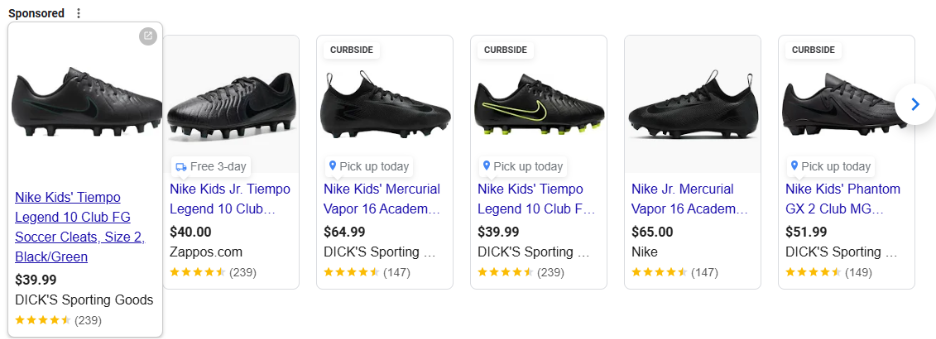
AI-driven results focus on quality over quantity. Instead of surfacing dozens of results, only a handful make the cut. That makes feed optimization the deciding factor between being seen or being invisible.
How to Optimize Product Feeds for AI
1. Strengthen Product Titles
Titles remain the clearest signal of product relevance. Strong titles should include brand, category, and key attributes like size, color, and material.
Case Study: A B2B seller struggled with low CTR on product listings. After our Feeds Team restructured titles, they saw a 12% lift in conversion rate and 13% more revenue in just 45 days.
2. Write Descriptions for AI Search
AI thrives on context. Strong descriptions do not just list specs, they describe use cases and benefits in natural language. For example:
- “Engineered for long-distance runners who need responsive comfort mile after mile.”
- “Eco-friendly running shoes designed for everyday wear.”
These conversational phrases give AI more reasons to match your product to high-value queries.
3. Add Supporting Signals
AI considers a variety of signals beyond titles and descriptions:
- Shipping speed and cost
- Return policy
- Product condition and sustainability certifications
- Ratings and reviews (social proof)
- Lifestyle images with keyword-rich alt text
According to the University of Virginia’s Darden Report, nearly 60% of consumers say they’ve used AI to help them shop. This shift signals just how fast AI-driven decision-making is becoming standard, including in product discovery and shopping.
Do Not Forget Your Ads Strategy
An optimized feed alone will not deliver maximum performance. To unlock growth, your feeds and campaigns need to work in sync:
- Labels enable smarter campaign structures.
- The right campaign types maximize efficiency and ROAS.
- Strong execution scales growth.
When feeds and ads align, visibility expands and revenue grows. When they do not, performance suffers.
The Bottom Line
Google’s move to “pay to play” Shopping in 2012 redefined eCommerce. Today, AI search is reshaping it again. Merchants who invest in product feed optimization, backed by smart ad strategies, will be the ones who win visibility, conversions, and growth.
Request your free ads audit today!
FAQs on Product Feed Optimization and AI
What is a product feed in Google Shopping?
A product feed is a structured file that contains all the details about your products, including titles, descriptions, pricing, availability, and images. It is how Google knows what you sell and when to display your products.
Why is AI changing product feed optimization?
AI-driven search looks at intent and context, not just keywords. This means your feed must be optimized with richer titles, descriptive copy, and supporting signals so your products surface for long, conversational queries.
How often should I update my product feed?
At minimum, update your feed whenever pricing, availability, or product details change. Daily updates are generally best practice. Regular audits, monthly or quarterly, help ensure your feed keeps pace with AI-driven search requirements.
Do reviews and ratings impact product visibility?
Yes. Google and AI systems highlight products with strong social proof. Incorporating reviews, ratings, and even sustainability signals can improve your chance of being featured.
Can I optimize my feed without changing my ad strategy?
You can, but results will be limited. Product feed optimization works best when paired with campaign structures and bidding strategies that amplify your optimized signals.
Want to know if your feed is AI-ready?
Go Fish’s Feeds Team can audit your product listings for missed opportunities, while our Paid Search experts ensure campaigns and feeds are working together to maximize growth.
See what your feed is missing. Request a free Product Feed Audit today.
About Logan Durant
I’ve had the pleasure of managing high-performing paid advertising teams for nearly 15 years. During that time, “growth” has become my driving force. I love creating strategies that help our clients grow as much as I love developing new leaders on our team. Fostering the next generation of AI-driven advertising is my current focus and passion.