


Why a DMO Remains Invaluable to Meeting Planners, Even With the AI Revolution

Published: October 24, 2025
Share on LinkedIn Share on Twitter Share on Facebook Click to print Click to copy url

As artificial intelligence continues to evolve, it’s raised the question of its capabilities and what it can truly replace.
AI Tools for Planners & Destination Organizations
First things first, let’s look at some AI tools available to business event strategists and DMOs.
Chatbots
Chatbots are an AI tool being used in the meetings industry to save planners and DMO sales teams time by answering an influx of questions on websites and apps. Skift Meeting’s “Event App Bible” explains how the chatbot’s AI can analyze users’ searches to get an understanding of what they want to know and make predictions to provide more relevant results, improving user experience. Visit Indy is a use case for this technology. Drift powers the organization’s “Indy Concierge” chatbot and provides an additional touchpoint for planners on their site.
Wordly
This translation platform is, at its core, an inclusivity tool. Wordly has been shown to be advantageous for business event strategists planning for diverse, international, and cross-cultural groups, where attendees have varied backgrounds and come together from different parts of the world. Everything from sign language translation to live translation is available from this technology.
Project SPARK
PCMA collaborated with event technology provider Gevme to create Project SPARK. For planners, the functionality of SPARK is promising: “Your personal AI event concierge for content creation and brainstorming.” So, how is this technology an outlier among large language models (LLMs)? It was designed to leverage multiple LLMs but be “fine-tuned” for the events industry. Routine tasks like content generation, repurposing, brainstorming, analyzing legal documents, and event analysis across multiple formats can be accomplished through a centralized platform. In contrast to the general-purpose LLMs, SPARK boasts that it is tailored to the particular needs of event planners.
DMO Benefits
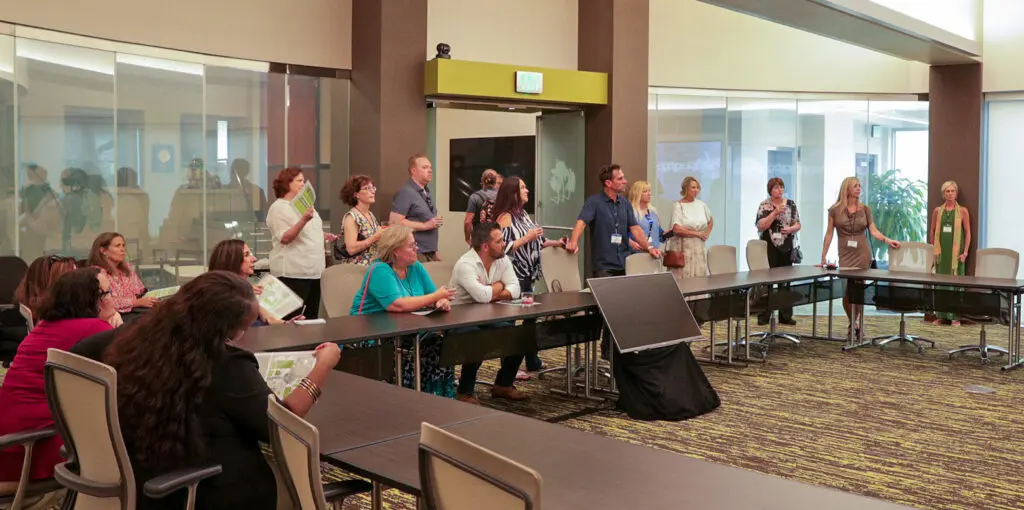
The good news: More than half of business event strategists consider destination organizations very important to the meetings industry and see them as becoming even more vital to the industry in the future, according to research conducted by Future Partners and Destinations International.
Human Touch
DMOs know it best: “[We offer] personalized attention to things that can’t be communicated in a check box. Tools can be very restricting. Unmeasurable variables are not necessarily taken into consideration,” writes Québec City Business Destination for Skift Meetings.
It’s crucial to remind planners that DMOs, in the words of Destinations International, are the “truest of destination influencers.” Your destination organization can provide guided expertise from where to book to what to do. (Just try asking AI the same question asked to a DMO sales team member!) You have a list of connections that can help planners incorporate your destination’s spirit into their events, create a sense of place through local thought leaders, and shape a space that provides a sense of belonging for all. For example, Choose Chicago’s Connecting to Chicago program directly connects planners with the city’s intellectual capital—from its civic and corporate communities to leaders from nationally-ranked institutions and Fortune 500 companies—to extend the destination’s value to attendees.
Bottom line: You can’t build a relationship with a chatbot. But you can with a person.
Specialized DMO Services
Some planners may be comparing AI tools to DMO services, looking for the benefits and distinctions between the two. One critical thing to remind clients and potential clients is that your destination organization not only offers comprehensive services but attendee promotion services for free or at a minimal charge. Planners can do a lot more attendee marketing than they’d ever be able to do on their own or with an AI tool.
DMO Websites & AI: A Strategy, Not a Replacement
One of the things we learned from Destinations International is that organizations need to embrace AI; these tools can make us better. It can be used to jumpstart an RFP. But it can be unreliable and provide misinformation.
By going straight to your DMO’s website, business event strategists will be sure to get the latest updated and factually correct meeting facility and accommodation specs for the destination—like the number of hotel rooms available to be blocked for an event.
Planners can also discover a destination’s hidden gems on your destination organization’s website. For example, the Daytona Beach Area CVB team provides a local’s perspective, sharing the top group experiences and activities that planners can draw inspiration from. As a cyberspace resident, AI wouldn’t be able to give the same insights.
Planners also tell us that the virtual tools on DMO websites—like an online walking tour of a venue—can be a great reference point when planning.
Knowing what tools are out there and how planners use them can fuel your website strategies. Use this knowledge of technology and planning behaviors to reveal how your site stacks up. Ask things like:
- Does our site provide information in an engaging way?
- Are you relaying that your services are irreplaceable?
- Are there trust indicators throughout? Proof of life? Testimonials?
- Does your website remove barriers and make it easy to plan?
- Your brand is something that belongs to you. Is it represented? Is the copy worth reading? Is the imagery something they’ll ogle?
The Verdict
Our takeaway: DMOs are visionaries and an irreplaceable resource for meeting planners; they possess an emotional intelligence that AI can’t emulate. AI can be a great tool to supplement your strategies, but they’re not replacements for each other.
Learning about these tools that help with the daunting parts of the B2B process (on the buyer and seller sides) is exciting. And knowing what planners are using AI for can only help destination organization teams provide more customized, innovative, and high-touch solutions.
Interested in some human interaction after reading this? Contact us directly.