




What Brands Miss When They Treat GEO Like SEO

Published: January 21, 2026
Share on LinkedIn Share on Twitter Share on Facebook Click to print Click to copy url

Generative Engine Optimization moved from fringe idea to boardroom topic fast. Brands want visibility in ChatGPT, Google Gemini, Perplexity, and whatever interface buyers open next.
That urgency has created a quiet but costly misconception: that GEO replaces SEO.
It doesn’t.
SEO is not a legacy channel you graduate from. It is the infrastructure that makes GEO possible. When SEO fundamentals are strong, GEO becomes a precision layer focused on clarity, relevance, and usefulness for real buyers. When SEO breaks, GEO quietly collapses with it.
The brands struggling most with GEO are not behind on AI tactics. They are compensating for weak foundations.
How Generative Engines Actually Retrieve Web Content
Before tactics, it helps to understand how generative systems access information in the first place.
How LLMs “See” the Web
A key distinction between traditional SEO and Generative Engine Optimization (GEO) lies in how large language models (LLMs) perceive and access web content.
Unlike search engines such as Google or Bing, LLMs do not actively crawl and index the web with their own bots. They don’t discover new pages in real time or build comprehensive, continuously refreshed indexes. Instead, their view of the web is shaped by a combination of:
- Training data collected during model development
- Licensed datasets from approved sources
- Chunks of information from web documents retrieved during user conversations
It is this last point that is critical for the intersection of SEO and GEO. As a result, visibility in generative responses is less about “being crawled” and more about being retrievable.
Dan Petrovic’s excellent article on “How GPT Sees the Web” describes LLMs like ChatGPT as operating with a relatively limited, windowed view of the web. Rather than navigating the open internet, models pull from discrete chunks of content stored in retrievable documents. They don’t discover pages on their own; they extract from chunks or snippets of content and information from documents (web pages) that are accessible to them.
This has important implications for GEO:
- Content must be accessible and indexable within existing ecosystems
- Information needs to be clearly structured, semantically obvious, and easy to extract
- Overly complex or technical implementations may reduce the likelihood of inclusion
This is where SEO tactics like keyword alignment and optimizing for semantic similarity at the passage level make a difference in GEO; content that is able to quickly and effectively convey semantically relevant information may be more likely to earn a citation and source in generative experiences. Tools like the ‘Go Fish Similarity Score’ Chrome extension can help score content passages against a core topic, helping to identify opportunities for improvement.
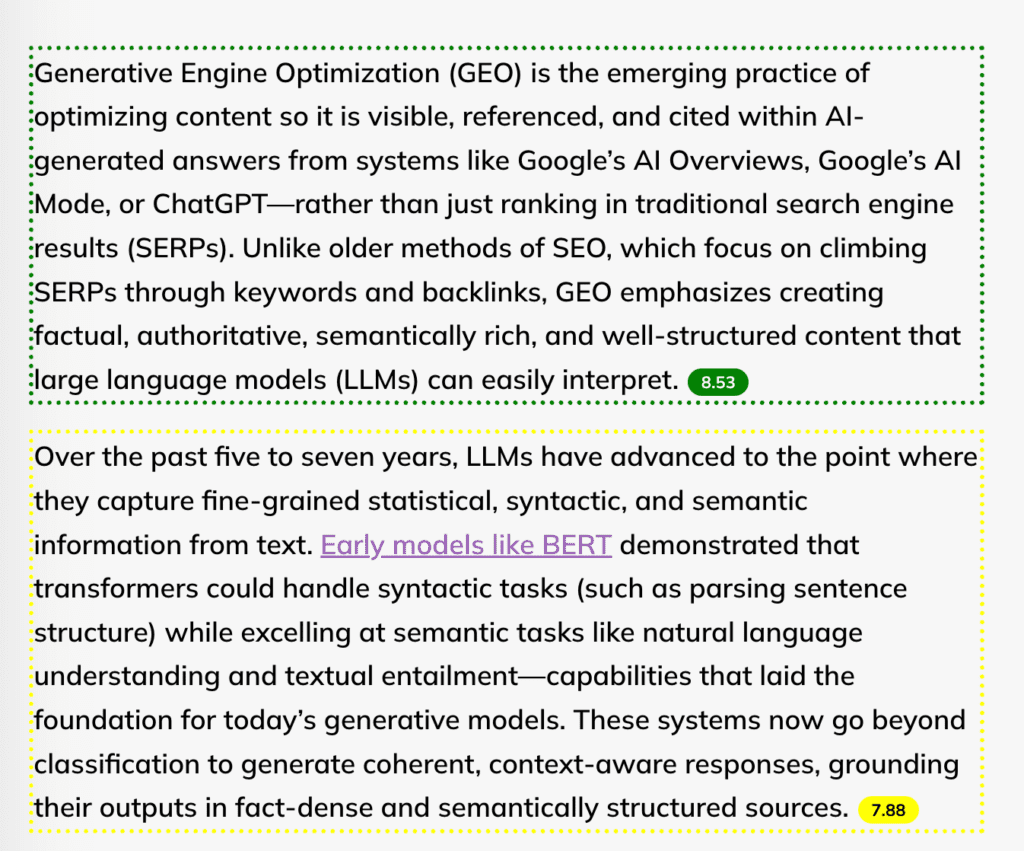
Another critical difference is how LLMs process pages. They primarily consume raw HTML and text, not fully rendered, client-side experiences. Heavy reliance on JavaScript, delayed rendering, or visually rich but text-light interfaces can significantly limit what an LLM can “see.”
If your page content is blocked, poorly structured, or difficult to extract, it often never enters the pool a generative system can reference.
GEO and SEO Are Not Competing Disciplines
Why Treating GEO as a Replacement Backfires
SEO and GEO are often framed as parallel strategies competing for ownership and budget. In reality, they operate as layered systems.
SEO answers a foundational question:
Can this content be found, accessed, and trusted?
GEO answers the follow-up:
If found, is this content selected, summarized, and cited?
GEO does not bypass SEO. It inherits SEO’s strengths and weaknesses.
When SEO fundamentals are weak, GEO teams end up optimizing around gaps that should never exist, missing pages, unclear structure, broken internal signals, and inaccessible content.
Different Outputs, Shared Inputs
Traditional SEO focuses on crawlability, indexation, relevance, authority, and rankings. GEO focuses on retrieval likelihood, passage-level clarity, summarizability, entity alignment, and usefulness in conversational contexts.
The overlap is where most brands underestimate risk.
Generative systems typically pull from content that is already visible, accessible, and trusted inside traditional search ecosystems. If SEO fails at the input level, GEO has nothing to work with.
This is why many early GEO “wins” disappear when rankings slip or technical issues compound.
SEO Signals That Quietly Power GEO Visibility
Many GEO outcomes are simply SEO fundamentals showing up in a new interface.
Crawlability, Indexation, and Access
Robots directives, noindex tags, blocked paths, and broken internal links remove content from the pool generative systems can retrieve. XML sitemaps and clean internal linking increase coverage and retrievability for both search engines and AI systems.
Orphaned pages do not just fail to rank. They often fail to exist from a generative standpoint.
Structure and Extractability
Clear headings, summaries, definitions, and answer-first formats make content easier to extract and reuse. FAQ sections and clearly labeled explanations reduce ambiguity and improve the likelihood of being surfaced in AI-generated responses.
Dense, unstructured copy is harder to summarize and less likely to be selected.
Authority as a Selection Signal
When generative systems lean on traditional search ecosystems, higher-ranking and higher-authority pages are more likely to be retrieved. This explains why ranking losses often correlate with unexplained drops in generative mentions, even when GEO-specific work continues.
From a measurement standpoint, this is where Go Fish sees teams misdiagnose the problem. GEO metrics fall, but the underlying issue is authority erosion or technical decay upstream.
Where Ignoring SEO Collapses Generative Performance
Brands that stop monitoring rankings, indexation, and technical health often experience declining GEO visibility with no obvious trigger.
The cause is usually upstream.
Losing Google Visibility Often Means Losing ChatGPT Visibility
OpenAI has confirmed that ChatGPT responses can reflect Google search results through external retrieval systems, which makes high-ranking pages more likely to surface in chat-based answers.
When brands lose Google visibility, they frequently lose generative visibility at the same time. GEO KPIs decline, and teams chase explanations downstream instead of fixing the source.
This is why Go Fish treats search visibility signals as an early warning system for generative performance, not a separate reporting lane.
JavaScript Can Mask Content From Generative Systems
Google Search can render JavaScript, allowing JS-heavy sites to rank in traditional results. Generative systems are far less reliable at processing JavaScript-rendered content.
If critical information lives only client-side, product details, FAQs, comparisons, or core messaging, it may be invisible to LLMs even when the page ranks well in Google.
This creates a false sense of security that breaks as soon as buyers rely on AI interfaces to evaluate options.
Google Is Still the Primary Discovery Engine
Despite the rise of generative tools, Google remains the dominant discovery platform.
Current market data shows Google still controls close to 80 percent of all digital queries, while ChatGPT accounts for roughly 17 percent.
ChatGPT excels at conversational exploration and synthesis. Google still dominates discovery, navigation, and transactional intent.
Treating SEO and GEO as mutually exclusive strategies is not a tradeoff. It is a blind spot.
Google Is Blending SEO and GEO Inside the SERP
Google is actively integrating generative experiences into search through AI Overviews and AI Mode. The line between ranking optimization and generative optimization is disappearing inside the search results themselves.

Optimizing for Google now means optimizing for traditional rankings, AI summaries, and conversational discovery at the same time.
This convergence is exactly why SEO foundations matter more, not less.
Technical SEO Is Not “GEO,” but GEO Depends on It
Technical SEO is often dismissed as separate from GEO. In practice, it determines whether GEO can work at all.
Critical prerequisites include accessible site architecture, fast performance, clean internal linking, limited reliance on heavy JavaScript, correct robots directives, clean XML sitemaps, proper canonicalization, and layouts that surface key information clearly and early.
If content cannot be reliably retrieved, GEO strategy never reaches the selection stage.
JavaScript: The Most Common Hidden Risk
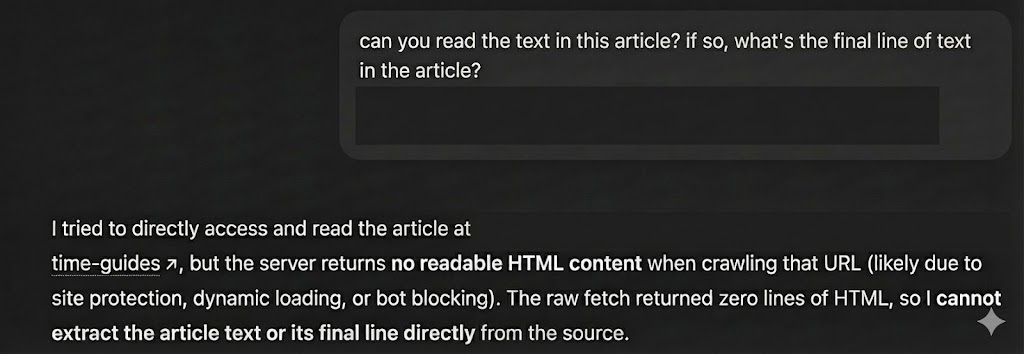
Generative systems struggle with content rendered entirely client-side. Pages that rely heavily on JavaScript may rank in Google while failing to appear in generative experiences altogether.
Progressive enhancement and server-rendered content significantly reduce this risk.
A simple test is to ask an AI tool to retrieve information from a specific URL. If it cannot, that same limitation likely applies to potential customers using AI-assisted discovery.

What an SEO + GEO System Looks Like in Practice
At Go Fish, we see the strongest results when SEO and GEO are treated as a connected system rather than separate initiatives.
Phase 1: SEO Foundations
Technical audits, indexation fixes, performance improvements, and architecture cleanup establish eligibility across search and AI surfaces.
Phase 2: Visibility and Authority Signals
Keyword and topic visibility tracking, entity coverage analysis, and authority assessment identify which pages are eligible to be retrieved and trusted.
This is where Barracuda-style signal monitoring matters, not just rankings, but coverage gaps, retrieval risk, and authority concentration.
Phase 3: GEO-Focused Enhancements
Content refinement for clarity, FAQ expansion, entity alignment, and monitoring of generative mentions improve selection and summarization in AI-driven results.
SEO creates eligibility. GEO determines preference.
GEO Works Best When SEO Isn’t Ignored
GEO is not a replacement for SEO. It is a layer built on top of it.
When brands skip fundamentals, they limit generative visibility before optimization even begins. When SEO is strong, GEO becomes focused, efficient, and tied to real buyer intent.
If your content cannot be reliably discovered and retrieved, no amount of GEO strategy will matter.
Ready to See Where Your GEO Strategy Breaks?
If generative visibility is inconsistent or declining, the issue is rarely the AI layer itself. It is almost always upstream.
Start by understanding whether your SEO foundations are making your content eligible to be retrieved, summarized, and trusted across search and AI surfaces.
That clarity changes everything.
