



Why High-Performing Enterprises Align SEO and Paid Media

Published: February 19, 2026
Share on LinkedIn Share on Twitter Share on Facebook Click to print Click to copy url

Many enterprise organizations continue managing SEO and Paid Media through separate strategies, separate teams, and separate success metrics. The outcome is familiar — Paid campaigns defend queries already owned organically while high-intent gaps remain underfunded.
This fragmentation persists despite clear performance evidence: integrated approaches can deliver up to 500 % higher ROI than running ads alone.
This mix of discovery mechanisms means brands must earn visibility on multiple fronts. SEO builds trust and long-term relevance while paid media provides timely defense and reach in auctions. GEO ensures brand signals are machine-readable where generative answers are becoming more prevalent
Enterprise leaders who treat these parts of search as separate levers will struggle to manage blended efficiency or total share.
Why SEO and Paid Media Must Align at Enterprise Scale
Buyer journeys rarely follow a single interaction path. Paid exposure increases brand recall. Brand familiarity improves click-through behavior. Organic visibility reinforces credibility during evaluation.
What appears as a single search interaction is often the result of multiple reinforcing touchpoints.
These interactions generate performance signals that guide both bidding strategies and content priorities. At enterprise scale, outcomes emerge from this feedback loop where SEO and Paid Media compound influence rather than operate independently.
Brand Signals → Paid Amplification → Engagement → Query Behavior → Conversion
The impact of this coordination becomes most visible at scale. In Go Fish Digital’s work with Apt2B, aligning SEO and Paid Search produced measurable gains across both channels. Organic visibility improvements expanded high-intent coverage, while paid campaigns capitalized on emerging demand and competitive gaps. The integrated strategy drove 336% site-wide revenue growth alongside a 589% increase in paid search revenue, reinforcing how channel alignment compounds performance rather than redistributes it.
Performance gains like these are not anomalies. They reflect how coordinated search strategies behave when channel decisions are tied to visibility, intent, and competitive dynamics.
At enterprise scale, this coordination translates into a set of predictable decision patterns.
| Scenario | Organic position/features | Paid action | Rationale | Expected outcome |
| Exact-match brand with sitelinks | Rank 1, rich snippet | Cap bids or pause exact; monitor incrementality | Avoid cannibalization; preserve blended CAC | Stable volume at lower blended cost |
| Branded navigational (login/support) | Rank 1, FAQ/How‑to | Exclude or restrict; prioritize support extensions | Prevent paying for obvious intent | Reduced waste; improved CSAT |
| Competitive non‑brand category | Rank 5+, heavy ads | Increase bids; use RSAs + audience signals | Regain visibility while SEO builds | Higher total SERP share; incremental conversions |
| New product/theme with no SEO | No ranking | Launch paid; collect query/CTA learnings | Inform SEO targets and messaging | Faster SEO ramp; efficient spend |
| Seasonal peak terms | Rank 2–4, mixed features | Temporarily boost bids; align promos | Maximize share during short windows | Revenue lift with controlled CAC |
Where Misalignment Creates Waste
At enterprise scale, inefficiencies rarely originate from poor execution within a single channel.
Waste most often emerges from disconnection between SEO and Paid Media strategies, where overlapping objectives, inconsistent signals, and fragmented decision-making erode performance.
Duplicate Spend
Enterprises often fund Paid Media on queries already owned organically. Defensive bidding has value, but unchecked overlap means paying for demand SEO would capture anyway. Organic listings drive the majority of clicks, making redundant paid coverage a direct driver of higher blended CAC.
Coverage Gaps
Misalignment creates the opposite problem. High-intent queries with weak organic visibility may lack paid support due to fragmented keyword strategies. These gaps reduce SERP share and leave revenue exposed to competitors.
Conflicting Signals
Separate SEO and Paid Media execution frequently produces inconsistent messaging and offers. Variations weaken buyer confidence and conversion probability. In paid auctions, misalignment lowers Quality Scores, increasing CPCs and reducing efficiency.
Inefficient Budget Allocation
Channel-level optimization distorts investment decisions. Paid may scale where organic strength could deliver lower-cost acquisition. Integrated strategies consistently outperform siloed execution by reallocating spend toward incremental demand.
Fragmented Landing Experiences
Misalignment often appears on landing pages. SERP messaging and on-page content diverge, creating friction. Engagement drops. Conversion rates decline. Performance signals weaken across channels.
Benefits of Aligning SEO and Paid Media for Enterprises
Measurement & Attribution
Enterprise leaders face a persistent measurement challenge. Channel-level reporting struggles to distinguish incremental impact from overlap effects, particularly when SEO and Paid Media influence the same queries, the same buyers, and the same conversions.
Last-click attribution amplifies this distortion. By assigning full credit to the final interaction, it obscures the visibility sequence influencing buyer behavior. Organic discovery, paid reinforcement, and assist interactions collapse into a single channel outcome. Cannibalization remains hidden, paid impact appears inflated, and organic influence is undervalued.
Correcting this imbalance requires a layered measurement approach. Different methodologies answer different performance questions, making measurement design a strategic necessity:
| Method | Answers | Timescale | Best for | Watchouts |
| Incrementality tests (geo/holdout) | Cannibalization; true lift of paid on strong organic | Weeks | Brand terms, core categories | Requires clean split; short-term noise |
| MMM (marketing mix modeling) | Channel contribution; diminishing returns | Quarterly/annual | Strategic budget allocation | Granularity limits; data quality heavy |
| MTA (multi-touch attribution) | Path-level assist; audience effects | Ongoing | Tactical optimization | Biased by platform visibility; privacy limits |
| Platform signals (QS, CPC, rank) | Auction health; creative impact | Daily | Bid/creative tuning | Not a measure of incrementality |
Landing Pages & Content
Research consistently shows that relevance between search placement and landing page experience is a primary driver of performance. Message alignment improves conversion rates, landing page quality influences Quality Scores and CPCs, and structured content strengthens both organic visibility and machine interpretation. At enterprise scale, landing pages are not channel assets. They are shared performance infrastructure.
Platforms like Google Ads explicitly include landing page experience as a core component of Quality Score, which influences auction eligibility, cost-per-click, and ad positioning. A strong landing page that matches search intent and provides useful content can improve Quality Score, leading to lower CPCs and a better return on spend.
Intent-Based Templates
Pages should be organized around user intent rather than channel ownership. Buyers do not arrive as “SEO traffic” or “paid traffic.” They arrive with goals, questions, and decision context. Structuring templates around intent clusters reduces friction and improves conversion probability across acquisition sources.
Entity-Rich Structure
Search engines and AI systems rely on entity signals to interpret relevance and authority. Structured data, schema markup, and clearly defined topical relationships improve visibility in rich features and AI-driven results. Studies show that structured content increases eligibility for enhanced SERP features, reinforcing both rankings and engagement outcomes.
Conversion Consistency
Alignment between SERP messaging and landing page experience improves both conversion efficiency and cost performance. When headlines, offers, and proof points reinforce discovery-stage expectations, bounce rates decline and conversions increase. Landing page relevance directly influences Quality Score, and higher scores can reduce CPC by up to 37%.
URL & Page Consolidation
Fragmented page structures dilute authority and create internal competition. Consolidation strengthens topical relevance, improves crawl efficiency, and stabilizes rankings. Enterprises that reduce duplication generate clearer performance signals while improving both organic and paid efficiency.
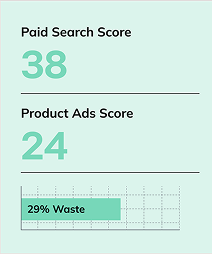
When channels are managed independently, budget inefficiencies often emerge that remain invisible within siloed reporting frameworks. Research estimates that an average of 30% of paid search spend is wasted due to redundancy, misallocation, and targeting inefficiencies — patterns that frequently stem from disconnection between SEO and Paid Media strategies.
Budgeting & Auction
Budget allocation decisions therefore depend on visibility strength rather than channel ownership. Paid Media investment expands, contracts, or stabilizes based on organic presence, SERP layouts, and competitive pressure.
| Visibility Condition | Budgeting Priority | Paid Strategy Response | Efficiency Objective |
| Strong Organic Presence | Protect / Optimize | Bid caps / selective defense | Reduce overlap & CPC inflation |
| Weak Organic Presence | Expand | Aggressive paid coverage | Capture incremental demand |
| Ranking Volatility | Stabilize | Temporary bid support | Control revenue risk |
| SERP Feature Displacement | Defend Visibility | Paid prioritization | Preserve click share |
This model clarifies why SEO and Paid Media investments compound rather than operate independently. Improvements in relevance and experience strengthen auction efficiency, which expands reinvestment capacity while stabilizing blended acquisition costs.
Feedback loops for budgeting should look more like:

Roadmap and Change Management for Enterprise Adoption
Alignment challenges inside enterprise organizations rarely stem from tooling or channel expertise. They more often reflect structural friction, where separate reporting lines, conflicting success metrics, and channel-specific incentives reinforce fragmentation. Transitioning to an integrated search model therefore requires organizational alignment alongside strategic change.
Successful adoption typically follows a phased progression that balances early validation with durable operational adjustments. Wholesale transformation often generates resistance, while structured, incremental alignment creates space for evidence-driven decision-making and sustainable efficiency gains.
Phase 1:
Establish a shared understanding of search performance by identifying overlap, visibility gaps, and measurement distortion across SEO, GEO, and Paid Media.
- Audit query overlap and redundant coverage patterns.
- Identify high-intent gaps across organic and paid visibility.
- Establish unified taxonomies and shared performance language.
- Launch incrementality testing to isolate true lift.
- Define blended KPIs aligned to acquisition efficiency.
Phase 2:
Translate diagnostic insight into coordinated execution by aligning bidding, landing page strategy, and channel decision frameworks.
- Implement bid strategies informed by organic visibility conditions.
- Standardize landing pages around intent-based templates.
- Consolidate SEO, GEO, and Paid Media roadmaps.
- Align messaging, targeting, and query ownership rules.
- Mature governance structures into decision authorities.
Phase 3:
Institutionalize alignment by embedding visibility-weighted budgeting, measurement, and incentives into the operating model.
- Shift budget allocation toward marginal efficiency models.
- Reinforce blended outcomes through incentive structures.
- Prioritize incrementality and contribution metrics.
- Scale experimentation velocity across markets.
- Codify alignment through playbooks and reporting systems.
Key Takeaways
Enterprise growth leaders can no longer treat SEO, GEO, and Paid Media as independent investments. At scale, these channels operate within a unified search ecosystem where visibility, auctions, and conversion dynamics are structurally connected.
Integrated approaches like this do not just sound good in theory. They produce measurable performance outcomes across complex environments. Human Rights Campaign’s integrated optimization strategy generated ROAS increases exceeding 1,000% in Google Search, reinforcing how alignment strengthens efficiency, visibility, and return dynamics even outside traditional retail models.
Operational integration requires shared governance, unified taxonomies, and measurement frameworks capable of isolating incremental impact. Enterprises that implement visibility-weighted bidding models, intent-based landing systems, and blended performance KPIs consistently produce more stable cost structures and clearer investment logic.
Budget efficiency improves when Paid Media investment prioritizes incremental demand gaps while organic strength shapes defensive thresholds and bidding guardrails. Structured, entity-rich landing pages reinforce relevance signals across search engines, AI systems, and paid auctions.
At enterprise scale, integration is not a refinement. It is a requirement.
