


AI in Advertising: How Google AI Search, Paid Media, and ChatGPT Ads Are Reshaping Discovery

Published: March 06, 2026
Share on LinkedIn Share on Twitter Share on Facebook Click to print Click to copy url

Over the past few weeks, three updates have stood out to me.
- Meta embedded AI directly inside Ads Manager.
- Google began testing sponsored listings inside generative AI search results.
- ChatGPT started experimenting with advertising inside conversations.
Individually, these look like product updates. Together, they point to something bigger.
AI in advertising is no longer just about optimizing campaigns faster. It’s becoming the layer that shapes how discovery, recommendation, and visibility work across paid media, search, and conversational platforms.
This isn’t incremental. It’s structural.
What Is AI in Advertising?
AI in advertising refers to the use of machine learning and generative AI systems to automate campaign decisions and influence how brands are surfaced across paid media, search engines, and conversational platforms.
For years, AI meant automated bidding, audience expansion, and dynamic creative testing.
Now it goes further.
- AI interprets intent.
- AI synthesizes answers.
- AI determines which brands get surfaced before a click ever happens.
As Google integrates generative AI directly into search results, sponsored placements are increasingly appearing alongside AI-generated summaries (see Google’s overview of generative AI search.)
Visibility is shifting upstream.
AI in Paid Media Is Moving From Optimization to Orchestration
AI has powered paid media for years. What’s different now is integration depth.
Meta has publicly emphasized its ambition to automate campaign setup and creative generation using AI.
More recently, industry coverage confirms that Meta embedded its Manus AI agent directly into Ads Manager, allowing multistep automation inside the workflow itself .
This changes the marketer’s role.
If the platform increasingly handles micro-optimizations, the competitive advantage moves to:
- Budget architecture
- Cross-channel alignment
- First-party data integration
- Creative modularity
Execution becomes automated. Structure becomes strategic.
Explore how we approach paid media strategy in an AI-driven environment.
Google AI Search Is Blurring SEO and Advertising
Google is testing sponsored listings inside generative AI search results, blending paid placements directly into AI-generated answers .
This is not a minor UI tweak. It changes the relationship between SEO and paid media.
Users no longer experience separate “organic” and “paid” layers. They experience one synthesized answer.
That means optimization now requires:
- Structured product data
- Extractable, machine-readable content
- Schema markup
- Consistent messaging across paid and organic
If your paid ads promise one value proposition and your organic content reinforces another, AI systems detect that inconsistency.
They evaluate signal coherence.
That’s where a structured SEO and content strategy stops being technical hygiene and becomes a competitive advantage.
Conversational Advertising Is Changing Intent Interpretation
OpenAI has confirmed it is exploring advertising models within ChatGPT.
Industry reports show that ChatGPT has begun testing advertising directly inside conversations.
In conversational environments:
- A user asks a question.
- The system generates an answer.
- That answer may include a suggestion.
There is no traditional search results page. No ten blue links. No scroll behavior to measure.
Intent is interpreted before the click.
That reframes AI in advertising.
Instead of optimizing purely for keyword triggers, marketers must consider:
- Question framing
- Context relevance
- Inclusion eligibility
- Trust signals
Conversational advertising shifts the competitive layer earlier in the journey.
AI-Driven Discovery Is Already Converting Differently
One of the most telling data points from recent industry reporting:
Research from early customer data shows that AI-driven search channels now account for roughly 20% of website traffic but generate closer to 40% of inbound leads, suggesting stronger intent among users arriving through conversational discovery, according to reporting from TechCrunch.
That means AI discovery isn’t just experimental. It’s high-intent.
When users interact with AI systems, they are often deeper in the evaluation process. The system synthesizes options and surfaces trusted brands.
If your brand isn’t structured for inclusion in those answers, you may never enter consideration.
How the AI Operating Layer Now Intersects Channels
Instead of thinking about paid media, SEO, and conversational AI as separate channels, it’s more accurate to think of them as feeding into a shared decision layer.
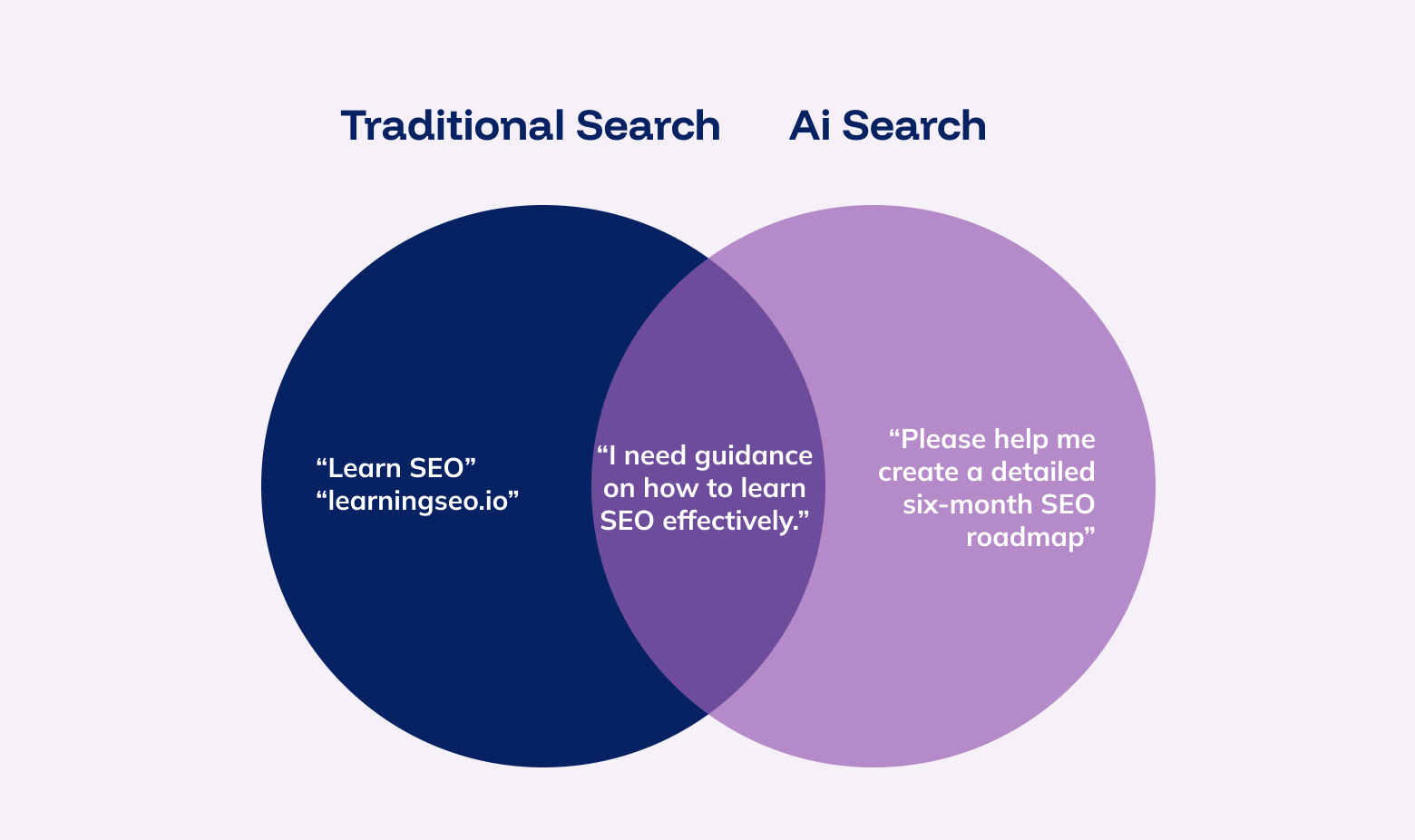
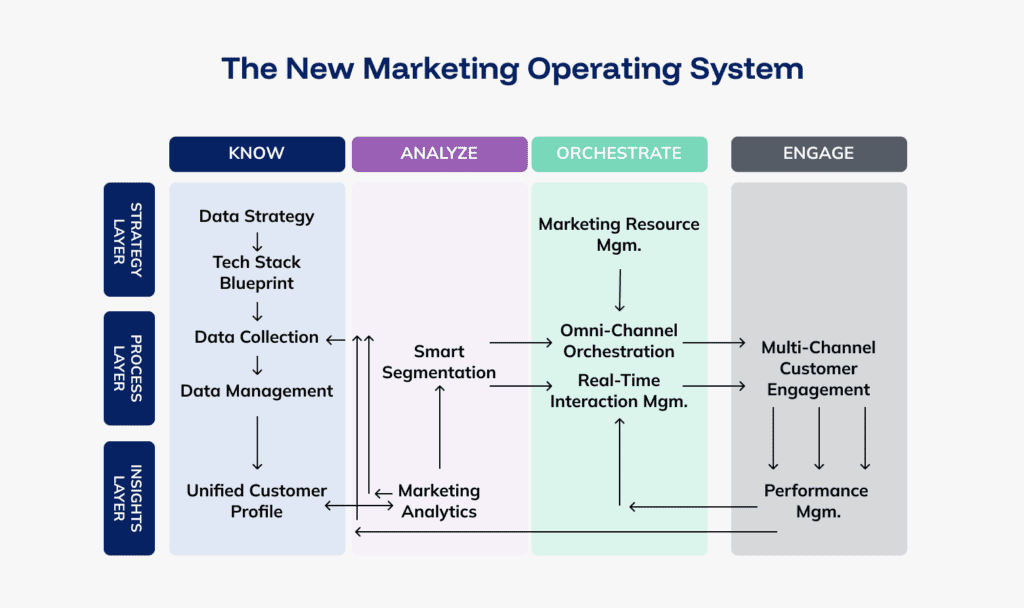
At the center sits what we can think of as the AI operating layer:
- Intent interpretation
- Structured data parsing
- Signal evaluation
- Recommendation logic
Visibility increasingly happens inside that layer before a click occurs.
If your systems are fragmented, AI sees fragmentation.
The Funnel Is Compressing
In AI-mediated environments, discovery and evaluation can collapse into a single interaction.
Users receive synthesized comparisons, tradeoffs, and recommendations inside one response. Traditional models required multiple site visits.
Now: Discovery – Evaluation – Recommendation can happen inside one exchange. That makes pre-click visibility critical.
What This Means for Marketing Teams
These shifts are not channel experiments. They are operating implications.
1. Paid and SEO Silos Break Down
- AI systems evaluate authority, performance signals, and content structure holistically.
- Fragmented teams create fragmented signals.
2. Structure Becomes a Performance Lever
- Clean taxonomy, structured feeds, schema markup, and consistent messaging matter more than content volume.
- AI surfaces what it can confidently interpret.
3. Measurement Must Expand
- Traditional metrics remain important.
- But AI introduces influence before the click.
- Brands should begin evaluating:
- Inclusion inside AI summaries
- Recommendation frequency
- Alignment between paid and organic signals
This is where integrated reporting becomes foundational.
AI in Advertising Is Becoming Infrastructure
It’s tempting to treat Meta’s AI tools, Google’s generative search ads, and ChatGPT advertising experiments as isolated developments.
They’re not.
They’re signals that AI is becoming the connective layer across optimization, discovery, and recommendation.
When that happens, marketing stops being about channel management and starts being about system design.
The brands that win won’t be the ones experimenting with the most tools.
They’ll be the ones building structured, aligned systems that AI platforms can interpret and confidently surface.
That’s the shift.
Want to see where your current setup breaks down under AI? Let’s look at it together.
Frequently Asked Questions About AI in Advertising
What is AI in advertising?
AI in advertising uses machine learning and generative AI to automate campaign decisions and influence how brands appear across paid media, Google AI search, and conversational platforms like ChatGPT.
How is AI changing paid media?
AI is moving beyond automated bidding into deeper workflow integration inside ad platforms, helping analyze performance and potentially execute optimizations automatically.
How does Google AI search impact advertising?
Google AI search blends generative summaries with sponsored placements. Brands must optimize structured data and messaging to be eligible for inclusion inside AI-generated answers.
Are there ads in ChatGPT?
OpenAI has begun testing advertising models within ChatGPT that may include contextually relevant suggestions inside conversations.
How should marketers prepare?
Marketers should integrate paid and SEO strategies, improve structured content clarity, align messaging across channels, and expand measurement beyond click-based metrics.
AI is changing how people discover brands. Is your marketing ready?
If AI search, paid media, and platforms like ChatGPT are starting to influence how customers find you, our team can help you build a strategy that works across all of them. Talk with Go Fish about your AI advertising strategy.
