


3 Trusty Tactics That Still Work for Business Events Social Marketing

Published: June 13, 2025
Share on LinkedIn Share on Twitter Share on Facebook Click to print Click to copy url

If your business events social strategy is built around impressions and follower count, you’re optimizing for the wrong scoreboard.
In today’s B2B marketing ecosystem, social doesn’t win meetings because it “performs.” It wins because it builds trust, the kind that makes a planner click, DM, download, and eventually hit the submit RFP button. The algorithm can change weekly. The trust signals don’t: credible voices, proof over polish, and content that makes the planner’s job easier.
Below are three tactics that still work—refreshed for how planners actually discover, validate, and shortlist destinations now.
Embrace Influencer Campaigns, But Make Them Niche B2B Creator Partnerships
For business events marketing, “influencer” should not mean celebrity. It should mean niche creators with planner credibility: independent meeting planners, event strategists, association leaders, venue scouts, and industry educators with an audience that matches your buyer.
Why this works today:
- Peers and practitioners are viewed as more trustworthy than brands.
LinkedIn continues to reward content that holds attention (watch time/dwell time), which favors expert-led video and story-driven posts over glossy ads. - B2B buying is increasingly hybrid and self-directed; social is part of how planners validate choices before they ever “contact sales.”
What to build with a niche B2B creator (simple formats that work):
- “Planner’s-eye” venue walk-throughs: what matters, what doesn’t, what surprises them
- “One problem, one solution” reels: transportation reality, walkability, seasonal patterns, budget clarity
- Off-site shortlists: best settings by meeting type (association vs. corporate vs. SMERF)
- A mini-series that answers the questions planners are tired of asking destinations
If the creator can’t credibly say, “Here’s how I’d sell this destination to my stakeholders,” they’re not the right partner.
Go with Employee-Generated Content Because It’s a High-Trust Signal
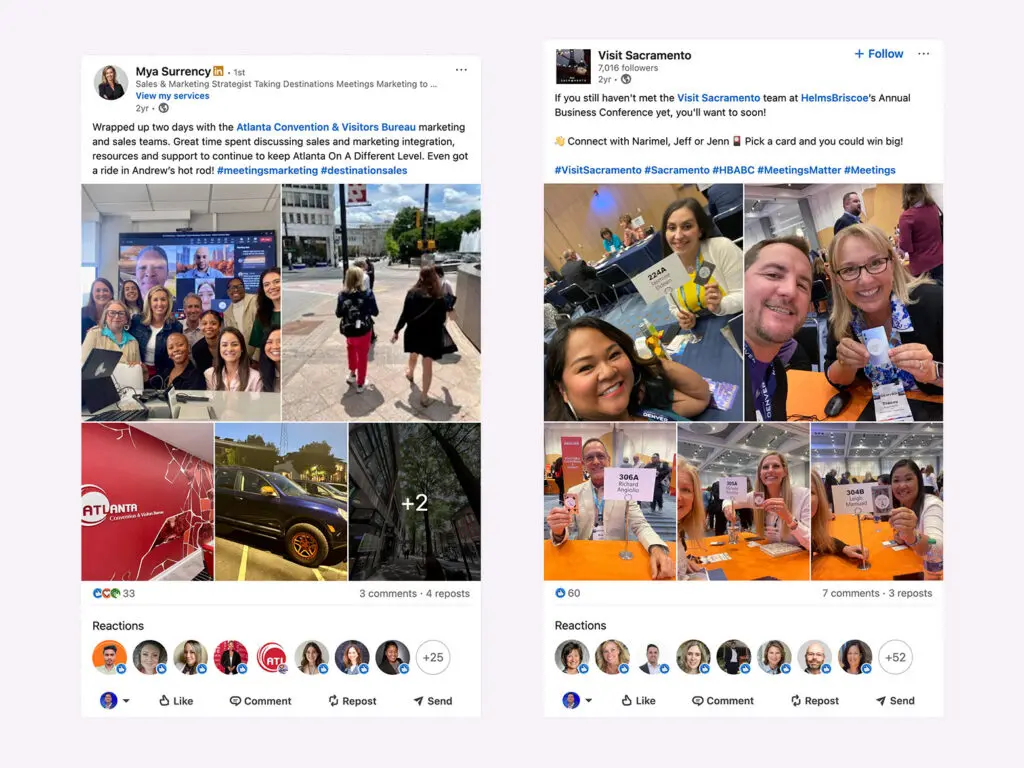
Business events content from real people is often more persuasive than brand-perfect creative. Employee-generated content wins because it communicates:
- You’re active in the industry.
- Your team is accessible.
- You know the planner environment.
- You do real work with real groups.
This is especially effective on LinkedIn, where human-led, expertise-based content is a natural fit.
What to post on social (and what it should do):
- Trade show moments that create planner relevance, not “we were there” filler
- Site visit/FAM content framed as planner utility: “Here are three things to know about X venue”
- Short clips of your sales team answering one planner question
- Event recaps focused on takeaways, not highlight reels
New norm to adopt: Plan EGC like a campaign, not a scramble.
- Give your team 3–5 post prompts per show
- Provide simple brand guardrails (tone, what not to share, image permissions)
- Build a repeatable template: hook → insight → proof → next step
Stop Chasing Vanity Metrics. Measure the Trust and the Business Movement.
Impressions and engagement are not the goal. They’re a means. Today, the better question is: Did social reduce uncertainty and create a sales path?
Here’s a simple outcomes-first measurement model you can run without a complicated dashboard:
Share of voice tracking (Are you showing up where planners pay attention?)
- Your destination’s share of mentions vs. peer destinations in your segment
- Creator/employee content reach compared to brand posts
- Earned reshares by credible industry accounts (the “trust multiplier”)
Site actions (Did social move people into decision behavior?)
- Visits to meetings pages from social by content theme
- Clicks to high-intent pages: venues, hotels, RFP, meet the sales team
- Downloads of planner tools: specs, one-pagers, sample agendas, meeting planner guides
- RFP starts (not just completions)
Lead quality tracking (Did it bring the right planners?)
- Inquiry-to-qualified rate (fit by meeting size, dates, season, room nights)
- Source-assisted influence: when social is part of the path, even if it’s not “last click”
- Time-to-response and time-to-next-step after an inquiry
What changes when you measure this way: Social becomes a demand channel that supports sales—not a content treadmill.
A Content Mix for Social That Drives Business Events Demand
If you’re building a weekly cadence, keep it simple:
- 1–2 posts/week: practical planner utility (answers, checklists, “what to know”)
- 1 post/week: proof (case result, testimonial, venue update, new airlift, win story)
- 2–4 posts/month: human content (sales team POV, BTS, event moments)
- 1 creator campaign/quarter: niche B2B creator content that can be repurposed everywhere
This is how you build compounding trust without burning out your team.
Want Social Marketing That Drives Qualified Meetings Demand?
If you need help building a social strategy for business events that creates trust signals, moves planners to take meaningful action, and improves lead quality, Go Fish Tourism + Business Events can help.