


ai search barracuda GEO tools
3 GEO Tools to Better Understand & Improve AI Search Performance

Published: April 10, 2026
Share on LinkedIn Share on Twitter Share on Facebook Click to print Click to copy url
Teams have more data than ever, but less confidence in what it means or what to do next. GEO tools are meant to solve that, yet most still leave gaps in understanding. Buyer behavior and channel algorithms have shifted rapidly, and traditional insights haven’t kept pace.
You can see these metrics and still not have a clear answer to:
- why certain pages don’t convert (or get recommended).
- why competitors show up where you don’t.
- or what to change next.
Search has gotten harder to understand. AI results, mixed SERPs, and fragmented data make it challenging to tell what’s actually driving visibility.
Barracuda is a GEO tool that eliminates that challenge.
Not by adding more data, but by making it clearer what search engines are evaluating, what to fix on specific pages, and how your brand shows up when people look for you.
There are three modules in particular that teams keep coming back to: Fan Out Queries, Page Optimization, and ORM Configuration.
Fan Out Queries: Understand How Topics Are Actually Evaluated
LLMs and search engines are no longer driven by a single query.
When someone searches for a topic, platforms expand that query into multiple related questions, entities, and subtopics behind the scenes. Most teams never see that expansion, which makes it difficult to understand why some content gets surfaced and other content does not.
Instead of working from a flat keyword list, with Barracuda teams can see how a topic breaks into clusters and supporting ideas.
This includes:
- related questions and subtopics.
- which publishers are being surfaced.
- where coverage gaps exist.

Fan Out Queries is a GEO tool shows us exactly what Google needs to see in order to recommend your brand — and where you’re currently missing coverage.
That leads to:
- stronger topic coverage.
- higher quality lead conversions.
- better alignment with how platforms decide what to surface.
For teams, this is especially useful because it reduces the need for long research cycles. It provides a structured starting point for content, SEO, and even campaign messaging.
Page Optimization: Turn Insights Into Page-Level Wins
It’s easy to see what your pages might be missing. It’s harder to know which changes will actually improve performance.
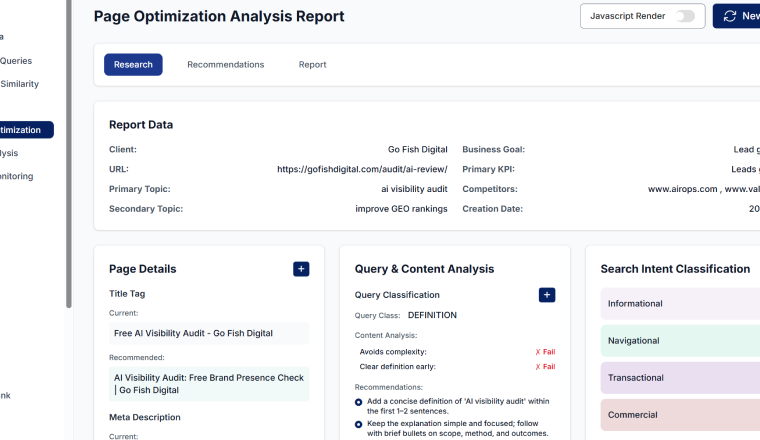
Page Optimization focuses on execution at a detailed level. It shows how a specific page is being evaluated and what to change first; even a single word change can impact performance.
Instead of running a manual audit, teams get a structured set of recommendations based on:
- search intent.
- competitor comparisons.
- content and semantic gaps.
This helps teams move faster and with more confidence.
A typical workflow looks like:
- Identify a priority page tied to a key topic.
- Review what is missing or underdeveloped.
- Prioritize a small set of high-impact updates.
- Implement and measure changes.
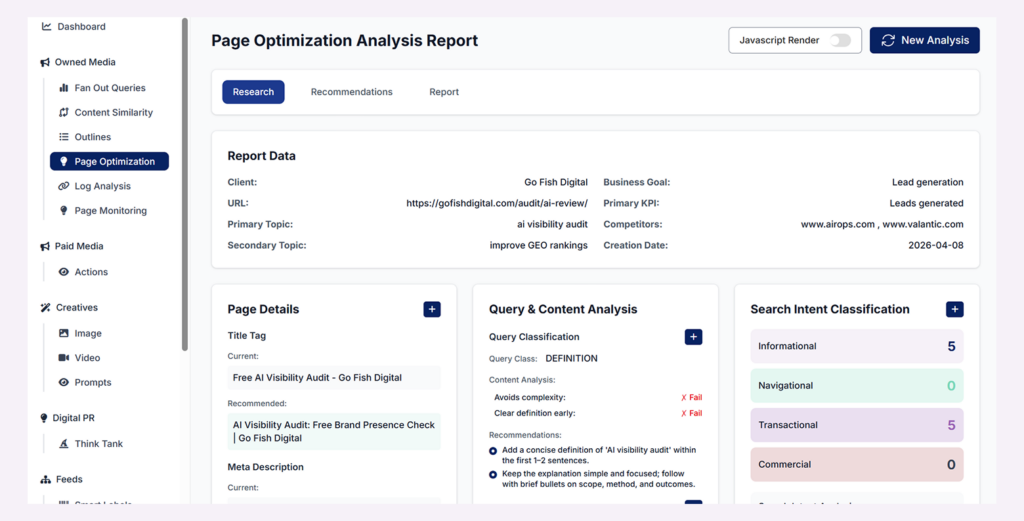
For teams managing large content sets, this becomes a more repeatable way to improve performance without slowing down execution. We’ve seen this play out in practice, like in our work with MoneyGeek, where restructuring 4,000+ pages around clearer topical alignment drove a 75% increase in clicks and over 26.2M impressions.
With less testing and optimization needed from your team, Barracuda is the type of GEO tool that has the potential to save hundreds of hours a year in marketing effort. Instead of trial and error, teams can act on validated recommendations and see impact faster.
ORM Configuration: Understand and Monitor Brand Perception in Search

Search results for your brand are rarely just your own content. They include third-party pages, reviews, and other signals that shape how people perceive you before they ever click to your site.
Online Reputation Management (ORM) Configuration provides a structured way to evaluate how your brand is represented across third-party search results.
Within the ORM Configuration GEO tool, teams can:
- define their domain and what counts as positive.
- set positive and negative terms.
- track specific keywords and locations.
This creates a consistent framework for analyzing how brands appear in search results.
Instead of relying on manual checks, teams can understand:
- which content types dominate branded or category searches.
- how sentiment shifts across queries or markets.
- where perception may be misaligned with brand positioning.
ORM Configuration helps connect search visibility with brand perception, giving teams a clearer view of how they are represented in the market.
How These Modules Work Together
Each module supports a different part of the search workflow, including topic discovery, page-level optimization, and brand visibility analysis, but they are most useful when combined.
- Fan-Out Queries reveals how topics break into related queries and entities so teams can build more complete, competitive content.
- Page Optimization shows what a page is missing based on intent and competitors, guiding higher-impact updates.
- ORM Configuration monitors how your brand appears across discovery, helping you understand and improve brand perception.
Together, these 3 GEO tools create a more complete view of search performance.
Instead of working from isolated metrics or disconnected tools, teams can move from understanding → execution → evaluation faster and with more certainty.
Barracuda connects insight to action and helps teams make decisions with more clarity.
How to Get Started
The best place to start with Barracuda is the problem you’re already trying to solve.
- If strategy feels unclear, start with Fan-Out Queries. It shows how topics actually break down and where you’re missing coverage.
- If key pages aren’t performing, start with Page Optimization. It gives you the fastest path from “something’s off” to “here’s what to change.”
- If leadership is focused on how your brand shows up in search, or results vary by market, start with ORM Configuration. It gives you a clearer view of what people actually see.
These are only three GEO tools, but Barracuda includes dozens of modules across owned media, paid media, feeds, creative, and reputation. All are designed to work together.
Most teams don’t stop at one. They start with a specific need, then expand as they see where the gaps are.
Our Marketing Intelligence Platform connects visibility to action and action to outcomes. We’ve seen when brands like Bandwidth focus on high-intent, non-branded queries, Barracuda can lead to a 1,061% increase in clicks and a 691% increase in impressions YoY.
If you want to evaluate where Barracuda fits into your growth strategy, request a custom demo, and we’ll walk through your current stack, priorities, and highest-impact opportunities. To learn more about Barracuda capabilities, click here.
